First Seen
2023-05-10T21:03:34+00:00
simple-description (llama3.2-vision_11b)
This meme is a humorous take on the classic "I can explain it in 2 minutes, or I can explain it in 1 hour, or I can explain it in 2 hours, or..." joke. In this case, the meme is a humorous commentary on the absurdity of the "I can explain it in 2 minutes..." joke, with a twist that pokes fun at the idea of explaining complex topics in a humorous way. The image shows a character from a popular anime or manga series, with the text "I can explain it in 2 minutes, or I can explain it in 1 hour, or I can explain it in 2 hours, or..." replaced with "I can explain it in 2 minutes, or I can explain it in 1 hour, or I can explain it in 2 hours, or I can explain it in..." with a list of names including "Karl Marx", "Adam Smith", "Peter Kropotkin", and "Ivan" (a reference to the Russian novelist and philosopher who was known for his work on the Russian Revolution).
detailed-analysis (gemma3-27b-vision)
Okay, let's break down this image, applying relevant theoretical frameworks. It's a meme referencing key figures in economic and political thought, so we have a lot to work with.
Visual Description
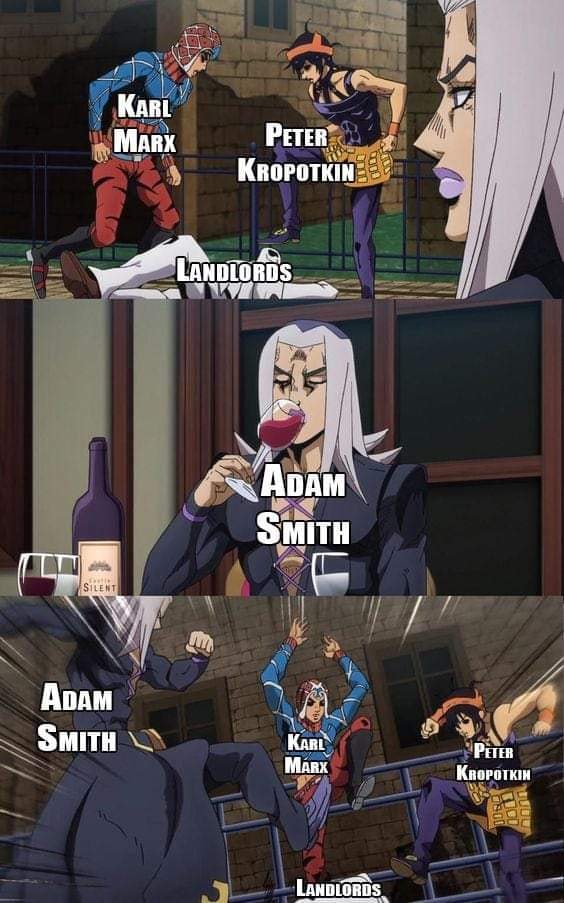
The image is a series of panels based on the style of the manga JoJo's Bizarre Adventure. It’s a meme format based on “unexpected alliances” or power dynamics.
- Panel 1: Features Karl Marx (in red, striking a confident pose) and Peter Kropotkin (a more flamboyant figure, leaning casually). They stand together, apparently opposing a group labeled "Landlords".
- Panel 2: Adam Smith is depicted lounging, enjoying wine, seemingly detached from the conflict.
- Panel 3: The conflict escalates with Karl Marx and Peter Kropotkin confronting the “Landlords” behind a cage/bars, with Adam Smith nonchalantly standing in the background.
The stylistic choices (pose, art style) emphasize drama and power relationships. The text labeling each character is crucial, as it frames the image's meaning.
Marxist Conflict Theory
This image is strongly rooted in Marxist conflict theory.
- Class Struggle: The most obvious theme is class struggle. "Landlords" are directly positioned as the opposing force to Marx and Kropotkin. This highlights the central Marxist idea of inherent conflict between those who own the means of production (landlords, in this case) and those who labor.
- Dialectical Materialism: While not explicitly shown, the image implies a dialectical process. The conflict between these groups is seen as driving historical change. The struggle is represented as an escalation from a stand-off (panel 1) to active confrontation (panel 3).
- Adam Smith’s Role: Adam Smith’s aloofness presents a critique of classical liberalism. He represents the “invisible hand” of the market, passively benefiting from the system even as conflict rages around him. This suggests a Marxist critique that free-market ideologies are ultimately complicit in the perpetuation of inequality.
- Ideology: The meme format itself functions as an ideological statement. It presents a simplified view of complex thinkers, encouraging a particular understanding of their philosophies in relation to modern economic issues.
Critical Theory
This image lends itself well to elements of Critical Theory, particularly the Frankfurt School's focus on power structures and critique of culture.
- Dominant Ideologies: The depiction of landlords as a unified, opposing force (and the general framing of the image) suggests a critique of dominant ideologies that justify property ownership and economic inequality. The meme seeks to deconstruct the “naturalness” of these power dynamics.
- Social Critique: The image offers a blunt social critique of housing and land ownership as sources of exploitation. It doesn’t just analyze these systems; it takes a side.
- Culture Industry: The meme is a product of the culture industry (internet meme culture). It’s a highly accessible, simplified form of political commentary that circulates widely, reflecting and shaping public discourse.
Foucauldian Genealogical Discourse Analysis
While more subtle, a Foucauldian reading can be applied:
- Power/Knowledge: The meme positions certain discourses (Marxist, Anarchist) as tools for understanding and challenging power relationships. By labeling the characters, it assigns them specific intellectual positions and the corresponding “knowledge” they possess.
- Genealogy of Concepts: The image implicitly traces a “genealogy” of concepts like property, class, and exploitation. It doesn't simply accept these concepts as natural; it presents them as historically constructed and inherently linked to power dynamics.
- Disciplinary Power: The “Landlords” representing a form of power that controls and regulates the lives of others through control of housing. The bars of the cage further represent this sort of containment.
Postmodernism
- Pastiche & Intertextuality: The meme utilizes elements of another cultural product (JoJo’s Bizarre Adventure) to communicate a political message. This is a classic postmodern technique of borrowing and remixing existing forms.
- Deconstruction of Grand Narratives: The meme could be seen as deconstructing the “grand narrative” of free-market capitalism by presenting a critical alternative based on Marxist and Anarchist thought. It undermines the idea of a universally beneficial economic system.
- Playfulness and Irony: The meme format itself is inherently playful and ironic. It doesn’t present a serious, academic argument; it delivers a political message through humor and exaggeration.
Queer Feminist Intersectional Analysis (less directly applicable, but possible)
This is the most tenuous application, but consider:
- Interlocking Systems of Oppression: While the meme focuses primarily on class, a queer-feminist reading could expand the analysis to include how class intersects with other forms of oppression (gender, sexuality, race). Landlords might also represent patriarchal and/or racist structures of control.
- Critique of Property Rights: A feminist analysis might question the concept of property rights itself, arguing that it historically served to disenfranchise women and marginalized communities.
- Power Dynamics: Landlord/tenant relationships are deeply entwined with gendered and racialized power dynamics, with women and people of color disproportionately affected by housing insecurity and exploitation.
Important Note: This image is a simplification. Applying complex theoretical frameworks to memes always involves a degree of interpretation. It is a starting point for a more in-depth analysis, but it shouldn’t be taken as a definitive or comprehensive examination of these theories.
Let me know if you'd like me to elaborate on any of these sections or explore a specific aspect of the image further!
simple-description (llama3.2-vision)
This meme is a humorous comparison of historical figures. The image shows a scene from the anime "Jojo's Bizarre Adventure: Golden Wind" where a character named Giorno is about to kill a group of enemies. The text labels each character with a historical figure's name, creating a humorous and unexpected connection between the characters and the historical figures.
tesseract-ocr
ee | ae Riceetr ae, g Ck (4 G | nap? eee CULE | | ih ore | | Bs { | I A = ee eee || a Re | | | i 4 | A Rae . SU Peel 6 oe \ { rae i i if is Roe a TT tee eT, ee ~ Suita AN ant pee! a ee =. Phot) eee | \ — ee a = a ee Bo oo aaa