First Seen
2023-05-10T21:03:34+00:00
simple-description (llama3.2-vision_11b)
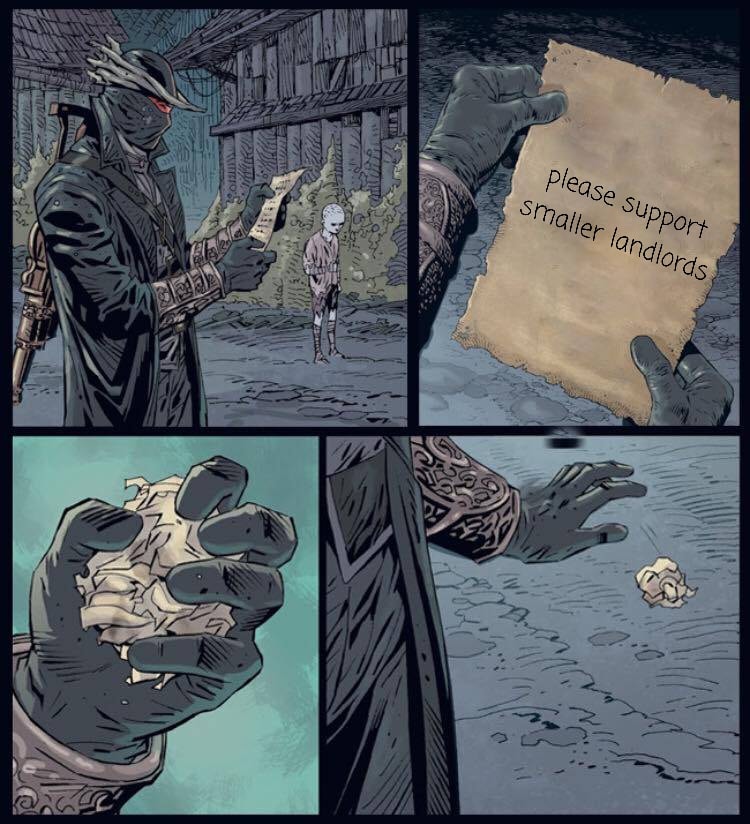
The meme features a character from a fantasy game, "Dark Souls", holding a sign that reads "please support smaller landlords" in a humorous and ironic way, as the character is known for being a ruthless and merciless figure. The image is meant to be humorous and satirical, poking fun at the idea of supporting smaller landlords, which is often associated with being a difficult and demanding experience. The character's brutal and intimidating nature is juxtaposed with the request for support, highlighting the absurdity of the situation.
detailed-analysis (gemma3-27b-vision)
Okay, let's break down this striking comic panel set, considering the requested analytical frameworks. The imagery is highly symbolic and provocative, lending itself well to these critical approaches.
Visual Description
The image is a four-panel sequence presented in a graphic novel/comic style. The art is characterized by stark, dark lines, heavy shadows, and a muted color palette (mostly blues, grays, and blacks). The overall aesthetic leans towards gothic or macabre.
- Panel 1: A looming, monstrous figure with exaggerated features (long limbs, claw-like hands, pointed ears/horns, and a somewhat avian face) stands over a diminutive human figure. The setting appears to be a dilapidated courtyard or alley. The monster is holding what appears to be a scroll or a petition.
- Panel 2: A close-up of the monster's hand displaying the petition. Written on the aged paper are the words "please support smaller landlords."
- Panel 3: A close-up of the monster's hand crushing the petition into a crumpled ball. The texture of the paper and the monstrous hand are emphasized.
- Panel 4: The monster's open hand, releasing fragments of the crushed petition into the air. The context implies a gesture of disdain or rejection.
Marxist Conflict Theory
This image is almost a direct visual metaphor for class struggle.
- The Monster as the Bourgeoisie/Landowning Class: The monstrous figure, large, powerful, and menacing, embodies the capitalist class or, more specifically in this case, the landowning class. The exaggerated features emphasize their alienating power and detachment from the human subject. Their size and position of dominance visually represent the power imbalance inherent in the landlord-tenant relationship.
- The Human Figure as the Proletariat: The diminutive human figure represents the working class or tenants, vulnerable and overshadowed by the power of the landowning class. Their small stature and passive posture highlight their relative powerlessness.
- The Petition as a Plea for Legitimacy/Support: The petition itself is a brilliant stroke of visual irony. Asking for support of 'smaller landlords' is a twisted plea, framing exploitation as a noble cause. It implies that even within the exploitative system, there are layers of power and the need to maintain it.
- The Crushing as Revolutionary Act/Rejection of Exploitation: The crushing of the petition is an act of rejection of the system and potentially a visual metaphor for revolutionary resistance. It denies legitimacy to the "smaller landlords" and their claims for support, revealing the underlying exploitative relationship. It visually suggests a dismantling of the capitalist structure.
Foucauldian Genealogical Discourse Analysis
A Foucauldian analysis focuses on how power operates through discourse and how those discourses create "truths" that seem natural but are historically constructed.
- Discourse of Land Ownership: This image disrupts the seemingly neutral discourse surrounding land ownership. By portraying the request for support of "smaller landlords" as coming from a monstrous figure, the image immediately questions the legitimacy and naturalness of the discourse itself.
- Power/Knowledge: Foucault argues that power and knowledge are inextricably linked. The monster has the power to crush the petition, and in doing so, produces a truth about the relationship between landlords and tenants. The act of crushing is a statement, a declaration of power.
- Genealogy of Landownership: The image suggests a historical lineage of exploitation, hinting at the monstrous origins of land ownership and the accumulation of wealth. The dark aesthetic and monstrous figure imply that this system is rooted in something inherently oppressive and potentially unnatural.
- Discipline and Control: The image can be read as a critique of how the discourse of "responsible landownership" functions as a tool of discipline and control. Even "smaller landlords" participate in a system that maintains power imbalances and exploits tenants.
Postmodernism
The image lends itself to a postmodern reading through its self-reflexivity, irony, and deconstruction of traditional narratives.
- Irony and Parody: The image is intensely ironic. The plea for support of "smaller landlords" from a monstrous figure is a clear parody of power dynamics and the justifications used to maintain them. It deconstructs the narrative that landlords are simply providing a service.
- Deconstruction of the Landlord-Tenant Relationship: The image breaks down the traditional binary of landlord/tenant by visually questioning the legitimacy of the landlord role. It implies that the relationship is inherently exploitative, regardless of the size of the landlord.
- Subjectivity and Perspective: The image challenges the viewer to question their own assumptions about land ownership and social power. It highlights the subjective nature of "truth" and the importance of critically examining dominant narratives.
- Fragmented Reality: The crushed petition and fragments of paper create a visual representation of a fragmented and unstable reality, reflecting the postmodern emphasis on the lack of objective truth.
I've tried to provide a thorough analysis based on your requests. The image is rich with symbolism and opens itself to many different interpretations.
simple-description (llama3.2-vision)
This meme is a humorous take on a scene from the video game Dark Souls, where a character is given a note from a mysterious figure. The note reads, "Please support smaller landlords," which is a tongue-in-cheek commentary on the game's infamous "Pest Control" quest, where players must kill a group of rats to help a local merchant. The meme pokes fun at the absurdity of the situation, making it a ligh-hearted and humorous take on the game's dark and often bleak atmosphere.
tesseract-ocr
WRG ZS =a Sat ee ee ade Ya ae ft S fs ] me ge Acar ope | as ics \ Vy aie gs i Maen UPR or MN ae ord D NOAA ee = = To Ais 3 — >i. SS \A\we2* —_- Cea my DOAN > = ree i Sy ven BE r= Vas on : a ONT ®R. AM Ip 1 SS FB ky —_ Wy | = : VA = Be SS = | 4 Y =. a> — aD) <a Dh