First Seen
2023-05-10T21:03:34+00:00
simple-description (llama3.2-vision_11b)
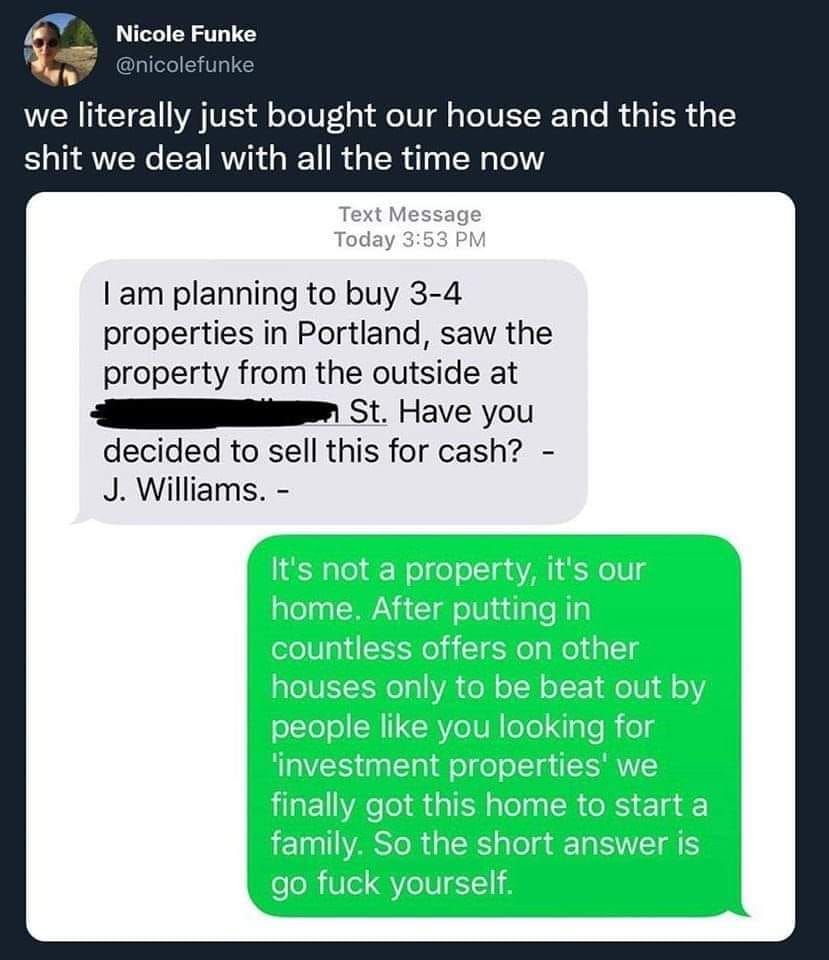
The meme is a screenshot of a text conversation where someone is trying to buy a house, but the seller is being extremely uncooperative and hostile. The buyer is asking for a tour of the house, but the seller is responding with a series of insults and aggressive language. The text reads: "I am planning to buy 3-4 properties in Portland, saw the property from outside, have you decided to sell this for cash?" The seller responds with: "It's not a property, it's our home. After putting in countless offers on other houses, only to be beaten out by people like you looking for investment properties, we finally got this house to start a family. So the short answer is no, we won't be selling."
detailed-analysis (gemma3-27b-vision)
Okay, let's break down this social media post/text exchange using the frameworks you've requested. I'll organize it into sections only when a framework is clearly applicable.
Visual Description
The image is a screenshot of a Twitter post and a text message exchange. The Twitter post shows a user (@nicolefunke) expressing frustration. Below that is a screenshot of a text message from someone named "J. Williams" inquiring about purchasing the tweeter's home for cash. The tweeter replies with a vehement rejection, framing the home not as a "property" but as a home with deeply personal meaning, and expresses frustration with being outbid by investors. The language is direct, emotional, and includes profanity. The screenshot format highlights the immediacy and directness of digital communication.
Marxist Conflict Theory
This exchange is highly relevant to Marxist Conflict Theory.
- Class Struggle: The core of the conflict is a stark demonstration of class struggle. J. Williams, seemingly an investor, represents capital and its pursuit of profit through real estate accumulation. Nicole Funke represents those struggling to access basic needs—in this case, housing—in a capitalist system.
- Commodity Fetishism: J. Williams frames the home as a "property" – a commodity to be bought, sold, and exploited for financial gain. This exemplifies commodity fetishism, where the social relations of production (the labor, resources, and societal factors that create the house) are obscured by its market value.
- Alienation: Nicole Funke’s emotional response ("It's not a property, it's our home") reveals a sense of alienation. She’s alienated from the notion of housing as a basic human right and instead sees it reduced to a speculative asset. The text reveals the sense of loss for something deeply personal being reduced to a financial transaction.
- Exploitation: The investor’s approach, while not explicitly exploitative in this immediate exchange, symbolizes the broader system where investors drive up prices, making homeownership unattainable for many, and profiting from the essential need for shelter.
- Capital Accumulation: The investor is looking to acquire multiple properties which is a clear demonstration of capital accumulation.
Critical Theory
This exchange lends itself well to a Critical Theory analysis, expanding on the Marxist perspective.
- Power Dynamics: The exchange illustrates a power imbalance. J. Williams, as an investor, has economic power, potentially able to offer high prices. Nicole Funke’s emotional response is a form of resistance against this power.
- Social Construction of Reality: The concept of "property" itself is a social construct. Critical Theory would question why we prioritize market value over human needs and the emotional significance of home. Nicole Funke actively deconstructs this idea of “property” by asserting it is “our home.”
- Ideology: The investor's communication represents an ideology that prioritizes capital accumulation and sees housing as a means of investment. The response is a rejection of that ideology and a reclaiming of the idea of “home.”
- Critique of Rationality: The purely rational, economic calculation of investment inherent in J. Williams’ message is contrasted with the emotional and personal connection to the "home" expressed by Nicole Funke. Critical Theory would question the dominance of this narrow form of rationality.
Postmodernism
While not a dominant theme, there's a subtle postmodern element.
- Deconstruction: Nicole Funke's response can be seen as a deconstruction of the term "property." By rejecting the label and asserting "it's our home," she challenges the accepted meaning and redefines it based on personal experience.
- Rejection of Grand Narratives: The response rejects the "grand narrative" of capitalist economic progress.
Queer Feminist Intersectional Analysis
While the exchange doesn’t explicitly focus on gender or sexuality, an intersectional lens can enrich the understanding.
- Access and Exclusion: Housing insecurity disproportionately affects marginalized groups, including women, LGBTQ+ individuals, and people of color. The fact that Nicole Funke and her family were repeatedly outbid by investors suggests they faced systemic barriers to accessing housing, potentially intersecting with other forms of discrimination.
- Home as Safety/Care: For many, “home” is not just a physical space but a space of safety, care, and emotional well-being, particularly important for marginalized communities who may experience higher rates of violence or discrimination outside the home.
- Resistance to Normative Structures: By asserting the personal meaning of “home” against the commodifying logic of the market, Nicole Funke’s response can be seen as a form of resistance to normative structures that prioritize profit over human needs.
Foucauldian Genealogical Discourse Analysis
- Discourse and Power: The exchange demonstrates how language (the framing of the house as “property”) is tied to power. The investor uses the language of the market to exert control, while Nicole Funke resists this power through a counter-discourse that reclaims the meaning of “home.”
- Genealogy of “Property”: A Foucauldian approach would investigate the historical development of the concept of “property” and how it has been constructed through legal, economic, and social forces to maintain power dynamics. How did “property” become separate from “home”?
- Normalization: The investor’s approach represents a normalization of the idea that housing is primarily an investment commodity. Nicole Funke’s response challenges this normalization.
I hope this detailed breakdown, using the frameworks you requested, is helpful! Let me know if you'd like me to explore any of these concepts further.
simple-description (llama3.2-vision)
The meme is a screenshot of a text conversation between two people. The first person is responding to a text from a real estate agent, who is offering to sell them a property for a low price. The agent's text is a joke, asking the buyer if they have any cash to put down, and the buyer's response is sarcastic and humorous, saying that they don't have any money to put down.
tesseract-ocr
es Nicole Funke i Bs @nicolefunke we literally just bought our house and this the shit we deal with all the time now Text Message lam planning to buy 3-4 properties in Portland, saw the property from the outside at Se St. Have you decided to sell this for cash? - J. Williams. -