First Seen
2023-05-10T21:03:34+00:00
simple-description (llama3.2-vision_11b)
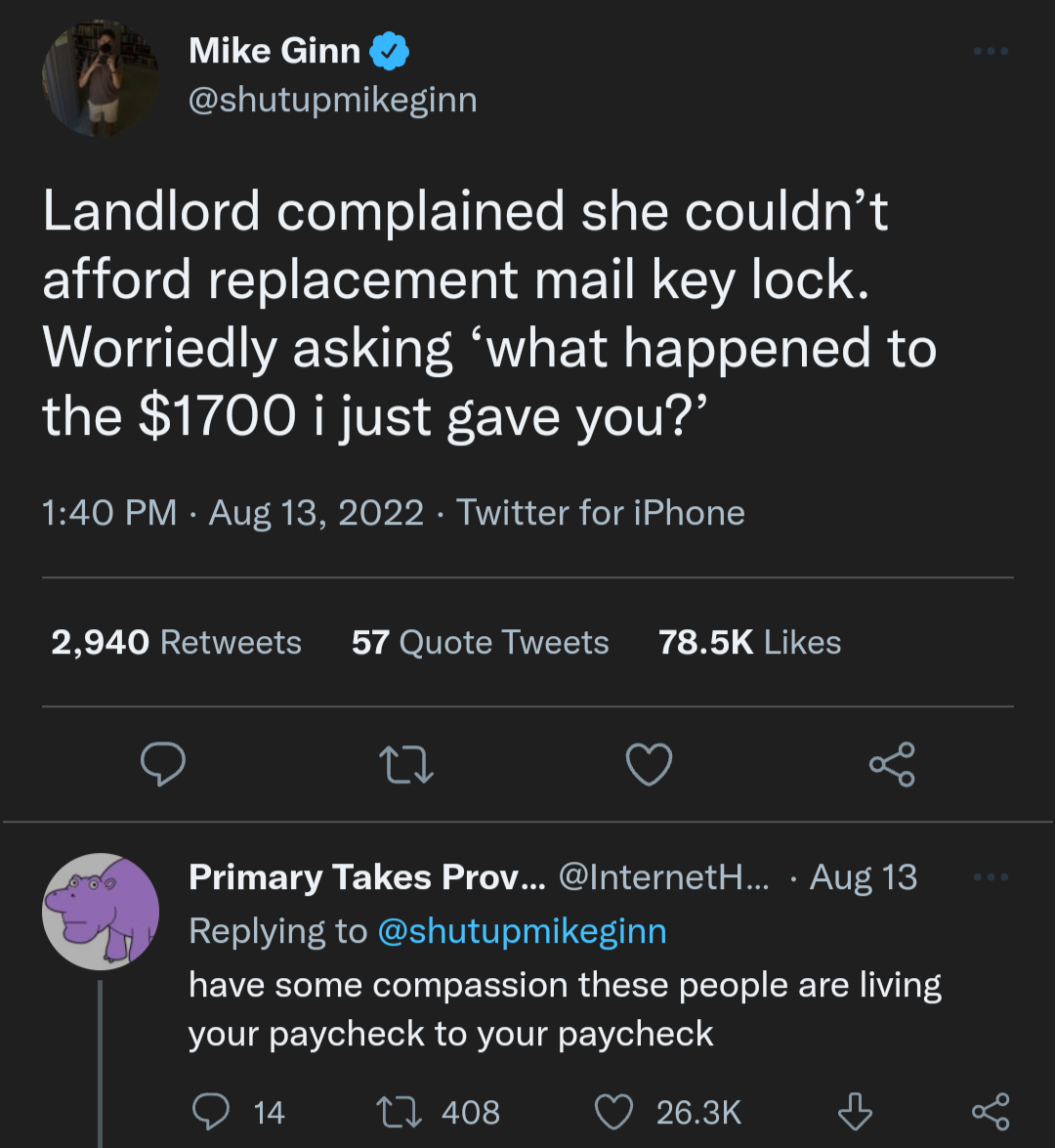
The meme is a humorous exchange between a landlord and a tenant, where the tenant is complaining about the lack of a replacement mail key lock. The landlord responds with a sarcastic and absurd offer to replace the lock with a "$17,000" price tag, implying that the tenant is expecting a free replacement. The meme is a lighthearted way to poke fun at the absurdity of the situation and the expectations of the tenant.
detailed-analysis (gemma3-27b-vision)
Okay, here's an analysis of the provided Twitter exchange, broken down into sections as requested. I'll indicate where a section doesn't apply if a particular theoretical lens isn't meaningfully engaged by the content.
Visual Description
The image is a screenshot of a Twitter post. The first post, from user "@shutupmikeinn" (with a verified blue checkmark), states: "Landlord complained she couldn’t afford replacement mail key lock. Worriedly asking ‘what happened to the $1700 i just gave’?" The post has timestamps, metrics (retweets, quotes, likes), and is marked as coming from an iPhone. Below this is a reply from "@InternetHxh" with the message: "have some compassion these people are living your paycheck to your paycheck." This reply also includes engagement metrics. The overall aesthetic is the typical, dense, fast-moving visual environment of Twitter.
Marxist Conflict Theory
This exchange is strongly situated within a Marxist framework.
- Class Conflict: The core tension is rooted in the inherent conflict between the landlord (representing the ownership class/bourgeoisie) and the tenant (representing the working class/proletariat). The landlord’s concern about the money highlights the economic power dynamic and the exploitative nature of the rental system. The tenant's inability to afford a simple repair despite having provided significant rent (the $1700) illustrates how profits are prioritized over basic needs.
- Exploitation: The $1700 rent represents a surplus value extracted from the tenant’s labor (assuming they work for wages). The fact that this money doesn't cover even a basic repair points to the ways landlords accumulate capital at the expense of tenants' financial stability.
- Alienation: The tenant is alienated from the fruits of their labor. They provide money, but have limited control over where it goes or how it’s used (even to maintain their own housing).
- Reply’s Intervention: The replying user's message ("have some compassion these people are living your paycheck to your paycheck") is a clear expression of solidarity with the tenant and a call to recognize the precarity of working-class life. It emphasizes the shared economic vulnerability, and serves to remind people of the human cost of prioritizing profit.
Critical Theory
The exchange lends itself to a Critical Theory analysis.
- Power Dynamics: The situation exposes the asymmetrical power relationship between landlord and tenant. The landlord has the power to demand rent and potentially evict, while the tenant is dependent on the landlord for housing.
- Ideology: The exchange subtly challenges the ideology of individual responsibility. The landlord’s concern about the missing money, while the tenant is struggling, suggests a focus on financial management rather than recognizing systemic issues of affordable housing and wage stagnation.
- Critique of Rationality: The focus on a seemingly simple transaction (rent payment vs. repair cost) ignores the broader social and economic forces that create this situation. A “rational” economic system, in this context, leads to unnecessary hardship and vulnerability.
- Emancipation: The replying user’s call for compassion could be viewed as a micro-act of emancipation – a challenge to the dehumanizing effects of capitalist relations.
Foucauldian Genealogical Discourse Analysis
While present, this is a less direct fit than Marxism or Critical Theory, but relevant.
- Discipline and Control: The landlord-tenant relationship is a site of subtle discipline and control. The demand for rent, and the threat of eviction, functions as a disciplinary mechanism.
- Power/Knowledge: The landlord wields power through knowledge (knowledge of rental laws, financial procedures, etc.). This knowledge is not neutral; it reinforces the existing power structure.
- Genealogy of Housing: One could trace a genealogy of housing regulations, property ownership, and financial systems to understand how this situation came to be. This would reveal the historical contingencies and power dynamics that shaped the current system.
- Discourse of Responsibility: The landlord’s query about the money can be seen as a discursive act that frames the tenant as solely responsible for their own financial situation, ignoring larger systemic problems.
Postmodernism
The postmodern connection is relatively weak, but present.
- Deconstruction of Grand Narratives: The exchange subtly challenges the "grand narrative" of a fair and rational housing market. The reality, as revealed in the exchange, is one of precarity, inequality, and exploitation.
- Fragmentation of Experience: The exchange captures a fragmented moment of lived experience, highlighting the individual's struggle within a complex system.
- Rejection of Universal Truths: There’s no “universal truth” about housing; it’s contingent on specific social, economic, and political contexts.
Queer Feminist Intersectional Analysis
This is the least directly applicable framework, but intersections could be explored.
- Intersectionality: If we had more information about the tenant (e.g., race, gender, sexual orientation), we could analyze how these intersecting identities might exacerbate their vulnerability. For example, a queer person of color might face additional discrimination in the rental market.
- Precarious Labor: Women and gender-nonconforming individuals are often overrepresented in precarious labor (low-wage, unstable jobs), which makes them more vulnerable to housing insecurity.
- Gendered Power Dynamics: Historically, property ownership has been linked to patriarchal power structures. A female tenant might face different challenges than a male tenant.
- Care Work & Housing: If the tenant is primarily responsible for unpaid care work (e.g., childcare, elder care), this could limit their ability to earn income and afford housing.
Let me know if you'd like me to elaborate on any of these analyses.
simple-description (llama3.2-vision)
This meme is a humorous exchange between a landlord and a tenant. The tenant is asking the landlord to explain the reason for a $1700 charge, and the landlord responds with a non-sequitur about a hypothetical situation where a tenant is asking for an explanation of a $1700 charge.
tesseract-ocr
ACL @ . @shutupmikeginn Landlord complained she couldn’t afford replacement mail key lock. Worriedly asking ‘what happened to the $1700 i just gave you?’ 1:40 PM - Aug 13, 2022 - Twitter for iPhone 2,940 Retweets 57 Quote Tweets 78.5K Likes O i g Cs Primary Takes Prov... @InternetH... - Aug 13 Replying to @shutupmikeginn have some compassion these people are living your paycheck to your paycheck Om 408 © 263K a e