First Seen
2023-05-10T21:03:34+00:00
simple-description (llama3.2-vision_11b)
The meme is a screenshot of a Twitter conversation where a user is responding to a landlord's claim that they own their home. The user is sarcastically pointing out that the landlord's statement is absurd, as they are not the owner of the property, but rather the landlord who is renting out the space. The user is essentially saying that the landlord is not the owner of the home, but rather a renter who is paying to live in the property.
detailed-analysis (gemma3-27b-vision)
Okay, here's a breakdown of the Twitter thread by Faith Naff, analyzed through the lenses you requested. It's a rich little exchange, lending itself to several theoretical explorations.
Visual Description
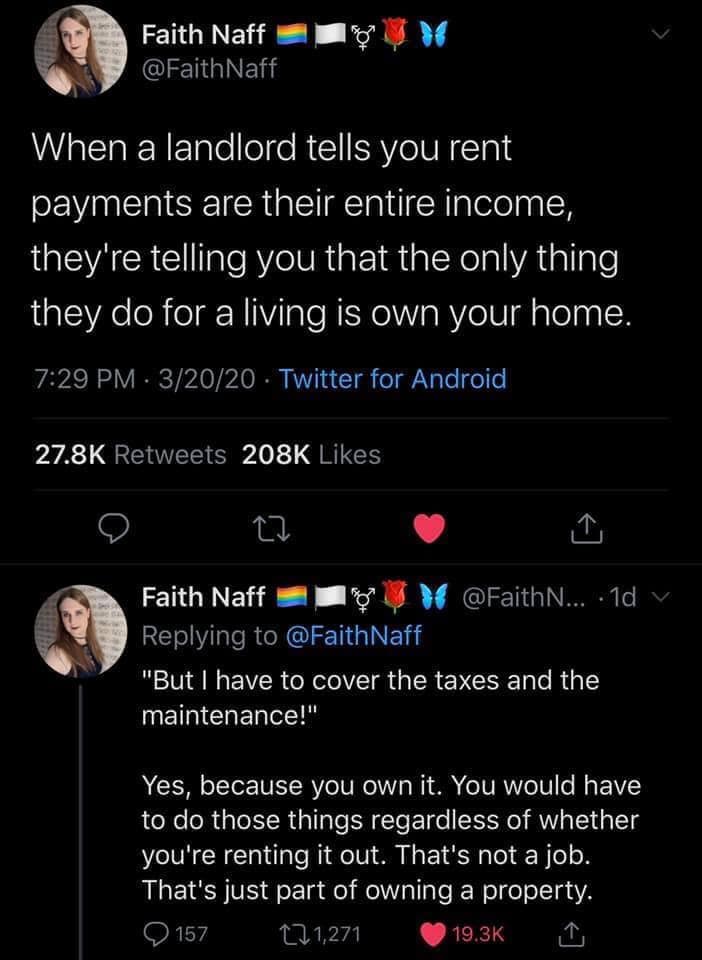
The image consists of two screenshots of Twitter posts from user @FaithNaff. The top post states, “When a landlord tells you rent payments are their entire income, they’re telling you the only thing they do for a living is own your home.” It has time/date stamp and indications of engagement (27.8k retweets, 208k likes). A profile photo of a person with dark hair and glasses is shown next to the handle.
The second post is a reply to the first. It addresses a common landlord justification ("But I have to cover the taxes and maintenance!") with the retort: "Yes, because you own it. You would have to do those things regardless of whether you're renting it out. That's just part of owning a property." This post has a lower engagement number (157 retweets, 19.3k likes).
Marxist Conflict Theory
This thread is strongly rooted in Marxist conflict theory. The core argument exposes the fundamental power imbalance inherent in the landlord-tenant relationship and the exploitative nature of the housing system.
- Class Struggle: The thread highlights the inherent conflict between those who own the means of production (housing, in this case) – the landlord – and those who must labor (by paying rent) to access basic necessities. Rent becomes a form of surplus value extracted from the tenant's labor.
- Exploitation: The core argument is that landlords are presented as doing nothing because they own property, benefitting from the labor of others through rent. It’s a passive accumulation of wealth based on ownership, not productive labor.
- Commodification of Housing: The thread points out the housing isn't seen as a human right but as a commodity to be bought and sold for profit. This commodification creates a situation where basic needs are subject to market forces and exploitation.
- False Consciousness: The reply directly tackles the landlord's justification of taxes and maintenance. This is a classic example of attempting to legitimize exploitation by framing it as unavoidable costs, rather than acknowledging the profit being derived from ownership.
Critical Theory
The thread engages with critical theory by questioning established power structures and societal norms.
- Ideology Critique: The thread deconstructs the ideology that landlords deserve rent simply because they own property. It challenges the notion that ownership is inherently a justification for extracting wealth from others.
- Power Dynamics: It brings into focus the unequal power relationship between landlord and tenant, demonstrating how ownership translates to control and the ability to extract resources.
- The Social Construction of Reality: The thread subtly suggests that the idea of landlords "doing nothing" and therefore deserving rent is a socially constructed narrative that serves to maintain existing power structures.
- Emancipatory Potential: By exposing the exploitative nature of the system, the thread implicitly suggests the need for social change and a more equitable distribution of resources.
Queer Feminist Intersectional Analysis
This lens provides additional nuance. The discussion, while not explicitly about queer or feminist issues, intersects with them through the lens of precarity and systemic inequalities.
- Precarity & Vulnerability: Renters, particularly those from marginalized groups (queer folks, women, people of color, disabled individuals), often face heightened vulnerability and precarity. Housing insecurity can be a tool of oppression, and the lack of secure housing exacerbates existing inequalities.
- Disproportionate Impact: Queer and trans individuals, historically and presently, face discrimination in housing, leading to increased rates of homelessness and housing instability. The exploitative nature of the rental system particularly impacts those who are already vulnerable.
- Intersectionality: The thread can be understood in intersection with other forms of oppression. For example, the combination of being a queer person of color and a renter can create a uniquely precarious situation.
- Challenging Normative Structures: The thread, by questioning the power dynamics of the rental system, implicitly challenges the normative structures that perpetuate inequality and marginalization.
- Body Autonomy and Space: The right to secure and affordable housing is linked to body autonomy and the ability to create safe and affirming living spaces, particularly important for queer and trans individuals.
Foucauldian Genealogical Discourse Analysis
We can trace the discourse around renting through a Foucauldian lens.
- Power/Knowledge: The discourse around renting is shaped by power relations. Landlords, through their ownership, have the power to define the terms of the rental relationship. This power is reinforced by legal frameworks and social norms. The knowledge surrounding renting is often framed in terms of property rights and economic efficiency, which serve to legitimize the landlord’s position.
- Discursive Formation: The idea that landlords are "passive" in owning property is a product of a discursive formation. It's a way of talking about ownership that obscures the active role landlords play in extracting wealth.
- Genealogy: Tracing the historical development of renting reveals how the current system emerged. It's not a natural or inevitable state of affairs, but the result of specific historical and political forces.
- Normalizing Mechanisms: The expectation that tenants must pay rent, regardless of the landlord’s level of activity, is a normalizing mechanism. It reinforces the power imbalance and makes it difficult to challenge the system.
- Resistance: The thread itself can be seen as an act of resistance against the dominant discourse. By challenging the accepted narratives, it opens up space for alternative ways of thinking about housing and ownership.
Postmodernism (Less Direct)
Postmodernism is the least immediately applicable lens here, but we can find some connections.
- Deconstruction of Grand Narratives: The thread implicitly challenges the “grand narrative” of capitalism and property ownership. It deconstructs the idea that ownership is inherently good or just.
- Relativism: There is an implicit rejection of the idea that there is a single “right” way to organize housing. The thread suggests that alternative models of ownership and access are possible.
- Fragmentation of Meaning: The thread highlights the way in which the concept of "work" is often narrowly defined in capitalist society. It challenges the idea that only paid labor is considered valuable.
I hope this detailed analysis is helpful! Let me know if you'd like me to focus on any of these lenses in more detail.
simple-description (llama3.2-vision)
This meme is a humorous commentary on the relationship between landlords and tenants. It presents a conversation between a landlord and a tenant, where the landlord is explaining to the tenant that they have a right to control the property and make decisions about it. The key point of the conversation is that the tenant is not actually the owner of the property, and therefore they have no right to make changes to the property.
tesseract-ocr
r ( TNC a od km A Olean elie When a landlord tells you rent payments are their entire income, they're telling you that the only thing they do for a living is own your home. 7:29 PM - 3/20/20 - Twitter for Android 27.8K Retweets 208K Likes QO Td ~ va Pi Cia komm | Cla lita eee A Replying to @FaithNaff "But | have to cover the taxes and the maintenance!" Yes, because you own it. You would have to do those things regardless of whether you're renting it out. That's not a job. That's just part of owning a property. Ory) 5 a Tes @19.3K FAL