First Seen
2023-05-30T20:08:53+00:00
simple-description (qwen3.5_2b-q8_0)
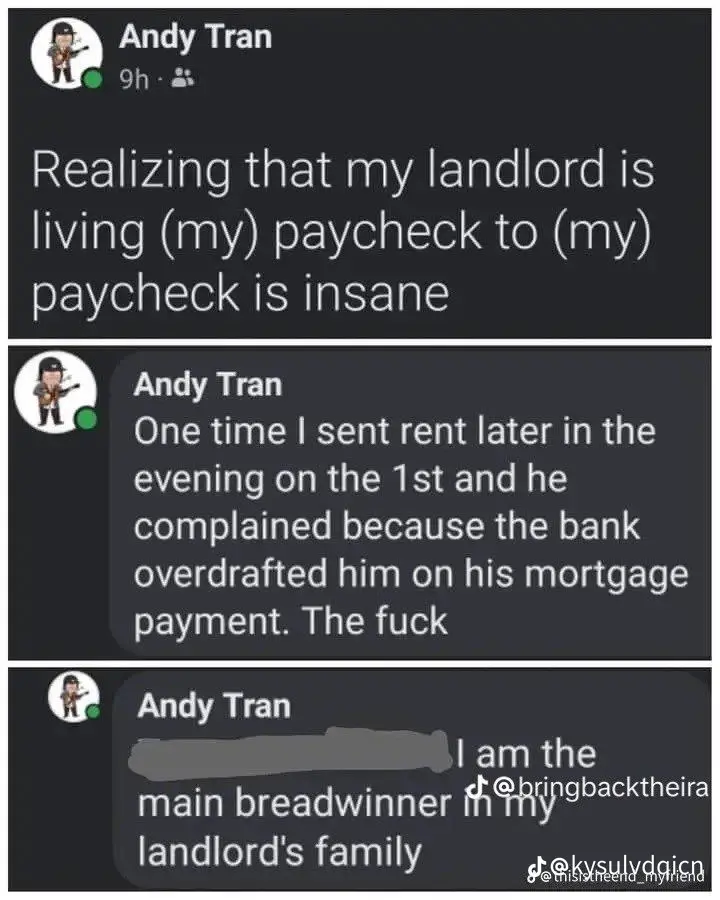
This anti-landlord meme plays a psychological reversal by revealing that the landlord is actually living paycheck to paycheck on the tenant's rent. The landlord mistakenly believes he is the main breadwinner in the family, but the tenant realizes that he is the one earning the money to save the landlord's household from financial ruin.
simple-description (llama3.2-vision_11b)
The meme is a screenshot of a social media post from a user named "Anti-Landlord" who is sharing a personal experience of being frustrated with their landlord. The text reads: "Just got a notice from my landlord that I need to pay 30% of my rent to cover the cost of a new roof... which is literally falling apart...". The meme is likely to resonate with people who have had similar experiences with landlords who prioritize their own interests over the well-being of their tenants.
detailed-analysis (gemma3-27b-vision)
Okay, let's break down this social media post using the frameworks you requested. It's important to note that a short post like this is ripe for interpretation, and multiple frameworks can overlap. I'll prioritize the most relevant connections.
1. Visual Description
The image shows a series of three Twitter/X posts from a user named Andy Tran. Each post is a text-based statement. The background is a standard social media interface. There's a profile picture of Andy Tran with a silhouette. The handle @bringbacktheira is visible at the bottom of the last screenshot. The tone is increasingly exasperated and angry, emphasized by the use of the expletive "the fuck." The posts are presented sequentially as a thread, creating a narrative of escalating realization.
2. Marxist Conflict Theory
This post strongly aligns with Marxist conflict theory. The core of this theory revolves around the inherent class struggle between those who own the means of production (landlords, in this case) and those who must labor to survive (tenants, the poster).
- Exploitation: The poster's statement highlights a power imbalance. The landlord depends on the tenant's wages (the "paycheck") to maintain their own financial stability, specifically their mortgage. This is a clear example of extracting surplus value – the landlord profits from the tenant's labor (earning income) without directly contributing to its creation.
- Alienation: The situation hints at alienation, a key Marxist concept. The tenant's earnings, the fruit of their labor, are immediately redirected to enrich someone else, further distancing them from the true value of their work. They are laboring not to improve their own life, but to keep someone else afloat.
- Class Consciousness: The escalating tone suggests a growing awareness of this power dynamic – a budding "class consciousness". The poster is recognizing the absurdity and inherent injustice of their situation, and expressing frustration at the exploitation.
- Dependency: The core reveal is that the landlord relies on the tenant's income. This flips the traditional power dynamic and illuminates the landlord's dependency on the tenant.
3. Foucauldian Genealogical Discourse Analysis
A Foucauldian approach would analyze how the discourse of landlord-tenant relationships constructs power and knowledge.
- Power Dynamics: The post reveals a subtle but potent shift in the power dynamic. Historically, landlords are presented as being in a position of control, demanding rent from those dependent on their property. The post reveals that this power isn’t as absolute as it appears, and the landlord is actually dependent on the tenant for their own financial stability.
- Discipline and Control: While not explicitly stated, the demand for rent, and the anxiety around timely payments, represent a form of disciplinary power. The landlord establishes a system that dictates how the tenant’s time and resources are managed. The threat of eviction is a clear example of this.
- Genealogy of "Rent": Tracing the historical development of "rent" reveals that this isn't simply a neutral economic exchange. It's a product of specific power relations—ownership of land and the necessity of housing. The post challenges the 'naturalness' of this arrangement by revealing the landlord’s dependency on the tenant’s income.
- Normalization of Exploitation: The post challenges the normalization of this exploitation. The landlord’s frustration at being overdrafted highlights the absurd situation of someone benefitting from the labour of another, and yet still experiencing financial hardship.
4. Postmodernism
Postmodernism, while less central than Marxism, can contribute to understanding this situation.
- Deconstruction of Power: The post can be seen as deconstructing the traditional understanding of landlord-tenant relationships. The expected power dynamic is overturned, revealing a more complex and nuanced reality.
- Rejection of Grand Narratives: The post implicitly challenges the “grand narrative” of capitalism, which promotes the idea of a fair and rational economic system. By revealing the exploitation inherent in the landlord-tenant relationship, it suggests that this system is anything but fair.
- Subjectivity and Experience: The post emphasizes the subjective experience of the tenant, framing the situation as deeply personal and frustrating. This aligns with the postmodern focus on individual perspectives and the rejection of objective truth.
5. Critical Theory
Critical Theory, a broader framework that overlaps with many of the above, can be applied as follows:
- Ideology Critique: The post implicitly critiques the ideology that justifies the landlord-tenant relationship. The expectation that tenants must pay rent, even when it creates hardship for both parties, is seen as a product of a system that prioritizes profit over human well-being.
- Emancipation: The post expresses a desire for a more just and equitable relationship. By revealing the exploitation inherent in the landlord-tenant relationship, it challenges the status quo and calls for a fundamental transformation of the system.
6. Queer Feminist Intersectional Analysis
While not immediately apparent, a Queer Feminist Intersectional analysis could be applied if we knew more about the poster and the landlord. It’s important to note that this requires speculation.
- Power Imbalance: This lens would emphasize the power imbalance inherent in the landlord-tenant relationship, and how this imbalance may be exacerbated by other forms of oppression (e.g., racism, sexism, homophobia).
- Dependency & Vulnerability: It would examine how the tenant’s vulnerability and lack of economic power may be linked to their gender, race, or sexual orientation.
- Intersectionality: If the landlord and tenant had intersecting identities, it would explore how these identities shape their respective experiences of power and oppression.
Let me know if you'd like me to elaborate on any of these points or explore other potential interpretations.
simple-description (llama3.2-vision)
This meme is a humorous commentary on the struggles of being a renter. The text reads: "Realizing that my landlord is living (my) paycheck to (my) paycheck is insane." It pokes fun at the idea that the renter's income is barely enough to cover the rent, implying that the landlord is essentially living off the renter's income.
tesseract-ocr
(A Neate @ 9h- a Realizing that my landlord is living (my) paycheck to (my) paycheck is insane «> Andy Tran mem @)aeMelant-MRSX- 1am cen) a1 ama evening on the 1st and he complained because the bank overdrafted him on his mortgage payment. The fuck if Nie Vara) F-Tuam ual ; mar lUan vcce(e VAT UML Li} ena landlord's family PRN ren