First Seen
2023-05-10T21:03:34+00:00
simple-description (llama3.2-vision_11b)
The meme is a humorous take on the concept of "Stockholm syndrome" (wherein a captive person develops a positive emotional connection to their captor) applied to a situation where someone is a victim of capitalism and develops a positive emotional connection to the capitalist (landlord) who is exploiting them. The image shows a cartoon character with a " Stockholm syndrome" expression, captioned with a quote from a tweet: "I have Stockholm syndrome. I love my landlord. They're so kind. They let me pay rent on time. They even let me use the internet. I wish I could pay them more."
detailed-analysis (gemma3-27b-vision)
Okay, here's an analysis of the image and its implied message, broken down into the requested theoretical frameworks, skipping sections that don’t clearly apply.
Visual Description
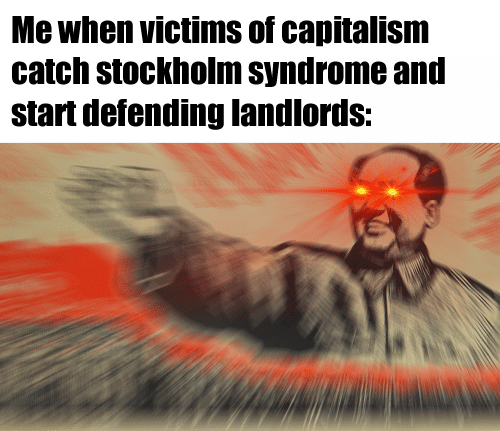
The image is a meme consisting of a sepia-toned portrait of Vladimir Lenin, dramatically altered to appear as if emitting bright red beams of light from his eyes. The image is framed by blurry, radiating red streaks which give the impression of intense, threatening energy. The text overlay reads: "Me when victims of capitalism catch Stockholm syndrome and start defending landlords." The image style evokes a sense of exaggerated, almost parodic, revolutionary fervor. The combination of a historical figure associated with revolutionary action and the exaggerated visual effect creates a darkly humorous, ironic statement.
Marxist Conflict Theory
This meme is deeply rooted in Marxist conflict theory. The core of Marxism is the struggle between classes, and this meme immediately sets up that dynamic. It posits a division between "victims of capitalism" (implicitly the working class, renters) and "landlords" (the capitalist class, owners of the means of production – in this case, housing).
The meme implies that some members of the oppressed class ("victims of capitalism") are exhibiting a false consciousness. False consciousness refers to a state of being unaware of one's true class interests, often due to the dominant ideology perpetuated by the ruling class. In this context, defending landlords—those who exploit the working class through rent and profit—is presented as a bizarre, illogical act rooted in this distorted understanding.
The use of Lenin—a symbol of class struggle and revolutionary action—highlights the frustration of the speaker with this perceived betrayal. The intense visual effect (the "beams" from his eyes) can be read as a metaphorical expression of rage toward those who seemingly align themselves with their oppressors. It's an angry critique of internalized oppression.
Foucauldian Genealogical Discourse Analysis
Applying a Foucauldian lens, we can examine the power dynamics at play in the normalization of landlord-tenant relations. Foucault emphasizes that power isn't simply top-down, but rather dispersed and operates through discourse—the systems of thought, language, and practice that shape our understanding of the world.
The "Stockholm syndrome" metaphor suggests that individuals, through repeated exposure to a power imbalance (e.g., unequal rental agreements, the constant threat of eviction), begin to internalize the perspective of their exploiters. This isn't necessarily about individual pathology, but a result of the power relations themselves. The discourse around rental housing—often framed in terms of contracts, property rights, and individual responsibility—can mask the inherent power imbalances and exploit the working class.
The meme doesn't just express anger; it critiques the discourses that make this phenomenon possible. It implies that the dominant narrative around housing has created a situation where even those harmed by the system can become its defenders. Genealogy would suggest examining how this discourse emerged over time, what historical conditions made it possible, and what power structures it serves.
Critical Theory
This meme also functions as a critique of broader societal structures and ideologies. Critical Theory (influenced by Marxism and the Frankfurt School) analyzes how power operates in culture and everyday life. This meme can be interpreted as a comment on the widespread acceptance of capitalist norms.
The idea that someone exploited by a system would defend that system speaks to a deeper issue of normalization. It suggests that the relentless barrage of capitalist ideology (emphasizing individual responsibility, the sanctity of property rights, and the inevitability of inequality) has effectively obscured the exploitative nature of the system for some. The meme's anger suggests a critique of the cultural forces that perpetuate this situation. It's a call to examine the underlying assumptions that allow inequality to persist.
Sections Omitted & Why:
- Postmodernism: While the image is a meme (a postmodern cultural form) and relies on irony, it doesn’t explicitly engage with core postmodern themes like the deconstruction of grand narratives or the relativity of truth. The meme is more direct in its critique than typically associated with postmodernism.
- Queer Feminist Intersectional Analysis: While one could potentially apply an intersectional lens by considering how gender, race, and other factors intersect with housing insecurity, the meme doesn't explicitly address those dimensions. It focuses primarily on class-based exploitation.
Disclaimer: This analysis is based on interpretation of the image and text. Different individuals may arrive at slightly different conclusions depending on their theoretical background and lived experiences.
simple-description (llama3.2-vision)
The meme is a humorous illustration of a person being hit with a massive, unseen force. The text at the top reads, "Me when victims of capitalism catch Stockholm syndrome and start defending landlords:". The image depicts a person being blasted by an invisible force, with a shocked expression on their face. The meme is likely poking fun at the idea that some people who are victims of exploitation or oppression can become so desperate that they start defending their oppressors, even if it means being a "landlord" (a person who owns or rents out property).
tesseract-ocr
Me when victims of capitalism catch stockholm syndrome and Start defending landlords: wl wa \