First Seen
2023-05-10T21:03:34+00:00
simple-description (llama3.2-vision_11b)
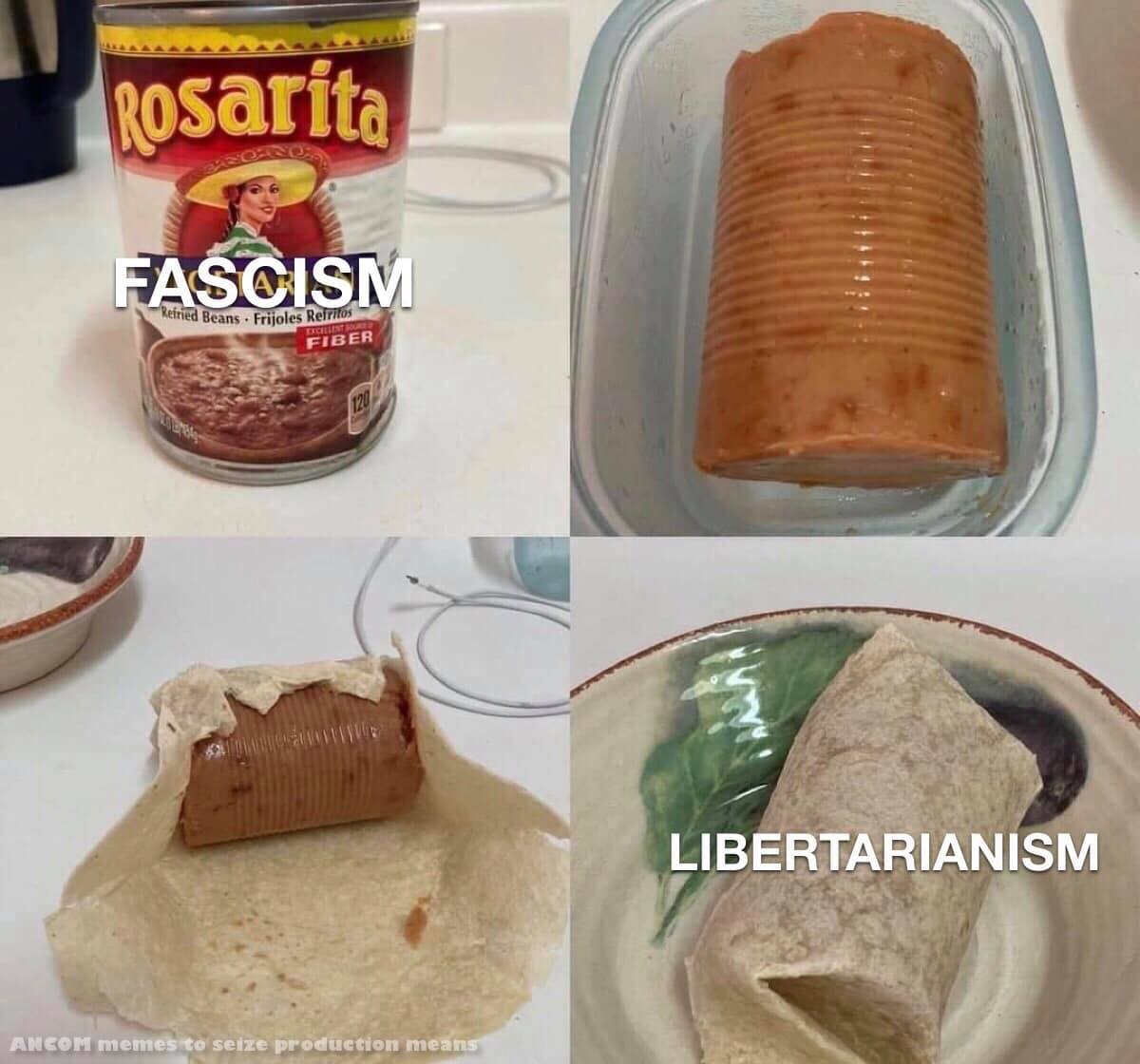
The meme is a humorous commentary on the contrast between the ideologies of Fascism and Libertarianism. It presents a can of refried beans as a symbol of Fascism, while a burrito is used to represent Libertarianism, implying that the latter is more "free" and "unrestricted" in its form.
detailed-analysis (gemma3-27b-vision)
Okay, here's an analysis of the image, broken down into the requested theoretical lenses. It's... a very strange image, so the analyses will be somewhat speculative and lean into the absurdity to find relevant points.
Please note: This image seems to be an intentionally bizarre meme. It's a collage of seemingly unrelated objects and labels. The interpretations here are built on the assumption that the juxtaposition is meaningful, likely as a satirical commentary.
1. Visual Description
The image is a 2x2 grid of photographs.
- Top Left: A can of "Rosarita" Refried Beans is labeled "Fascism".
- Top Right: A rectangular block of pink/red gelatin/Jell-O is inside a clear plastic container.
- Bottom Left: A partially eaten, bright red hot dog appears to be resting on a plate.
- Bottom Right: A clear container with green liquid and an unknown substance submerged within it is labeled "Libertarianism".
The overall aesthetic is amateurish and somewhat unsettling. The lighting is poor, and the composition feels haphazard. There's a hand in the bottom frames indicating direct manipulation.
At the bottom, there is text, “ANCOM memes to seize production means”.
2. Foucauldian Genealogical Discourse Analysis
This image operates powerfully through juxtaposition, creating a discourse around power relations. Foucault would be interested in how these seemingly unrelated objects are made to mean something about political ideologies.
- Discourse and Power/Knowledge: The labeling is the crucial act. The image doesn’t prove a link between refried beans and fascism or Jell-O and libertarianism. It imposes a relationship, making them objects of a new discourse. This act of labeling is an exercise of power – the power to define and categorize.
- Genealogy: The image implies a historical trajectory, even if absurd. It asks us to consider how these seemingly random objects came to represent these ideologies in the mind of the creator. What prior associations, historical events, or cultural meanings inform this connection? (e.g., beans as a "basic" food, Jell-O as representative of American consumerism, hotdogs as American nostalgia).
- Archaeology of Knowledge: The image “digs up” assumed relationships between these seemingly unrelated elements and their corresponding ideologies. The arrangement attempts to unearth a hidden or unconventional logic behind associating certain objects with political beliefs.
3. Critical Theory
The image functions as a critique of ideology itself. Critical Theory, particularly in the Frankfurt School tradition, often focuses on how ideologies become reified—treated as natural or inevitable, rather than constructed.
- Reification & Commodity Fetishism: The image can be read as a parody of how we attach meaning to objects. The beans, Jell-O, hot dog, and green liquid are treated as symbols of complex political ideologies, obscuring the actual material and social conditions that create those ideologies. It's a meta-commentary on symbolic representation.
- Culture Industry: The image could be interpreted as a fragmented piece of "culture industry" output, designed to provoke a reaction, but ultimately lacking in substantial meaning. It’s a pastiche that comments on the superficiality of ideological debate.
- The Absurd and Critique: The sheer absurdity of the image forces us to question the underlying assumptions of the labeling. By making these connections so bizarre, it disrupts the naturalization of ideological categories.
4. Marxist Conflict Theory
While a stretch, one can interpret the image through a Marxist lens focusing on the means of production and social class.
- Means of Production (and Misappropriation): The "ANCOM memes to seize production means" text implies a call to action, echoing a core tenet of Anarcho-Communism. The image itself can be seen as an attempt to "produce" a new ideological discourse, using memes as the means of production.
- Class Struggle (Symbolic): The image could be interpreted as a symbolic depiction of class tensions. The processed, mass-produced food items (beans, Jell-O, hotdog) represent a particular mode of production and consumption, while the "seize production means" text suggests a desire for a different system.
- Ideology as False Consciousness: The labeling of the food items as representing ideologies can be viewed as a form of false consciousness, masking the material conditions that shape these ideologies.
5. Postmodernism
The image is deeply rooted in postmodern principles.
- Deconstruction: The image deconstructs the very notion of coherent ideological representation. It breaks down the expected associations between political ideologies and concrete objects.
- Pastiche & Intertextuality: The image is a pastiche – a collage of disconnected elements that creates a new, fragmented whole. It doesn't offer a coherent narrative but relies on the viewer to make connections (or acknowledge the lack thereof).
- Simulacra & Simulation: The image can be seen as a simulation of ideological debate. The labels are not tied to any real substance but are merely signifiers that refer to other signifiers. It becomes a self-referential system devoid of authentic meaning.
6. Queer Feminist Intersectional Analysis
This lens is the most difficult to apply, but one can speculate on how the image might challenge normative structures.
- Disruption of Order: The chaotic juxtaposition of elements can be seen as a disruption of traditional ordering systems, challenging the rigid categories that often define ideology and identity.
- Rejection of Essentialism: The arbitrary labeling rejects the idea that there is a natural or essential connection between objects and ideologies, mirroring the feminist critique of essentializing gender or sexuality.
- Parody & Subversion: The absurdity of the image can be read as a form of parody, subverting the seriousness and authority of ideological discourse.
Overall:
This image is a bizarre and complex meme. Its meaning is open to interpretation, but it seems to be a satirical commentary on the arbitrary nature of ideological labeling. It’s a meta-commentary on the way we attach meaning to objects and the constructed nature of political belief systems. The fact that it resists easy interpretation is, arguably, its most significant feature.
simple-description (llama3.2-vision)
The meme is a humorous comparison between two political ideologies, Fascism and Libertarianism, using a can of refried beans as a metaphor. The top-left image shows a can of refried beans with the label "Fascism" overlaid on it, while the top-right image shows a can of refried beans that has been opened and is now in a glass dish, labeled "Libertarianism". The bottom-left image shows a tortilla with a small amount of refried beans on it, while the bottom-right image shows a burrito with a large amount of refried beans inside, labeled "Anarchism". The meme suggests that Fascism is restrictive and controlling, while Libertarianism is more open and free. The use of refried beans as a metaphor adds a touch of humor to the comparison.
tesseract-ocr
A | \ } Sarita! — \W iP i = ’ _— \ =a 7 7 sai Ss Ls ( = ee 14 ee i OS J = ay Se ee € | exw Re me = : * ey AWEOM me ‘ethane chal lle + ie a