First Seen
2023-05-10T21:03:34+00:00
simple-description (llama3.2-vision_11b)
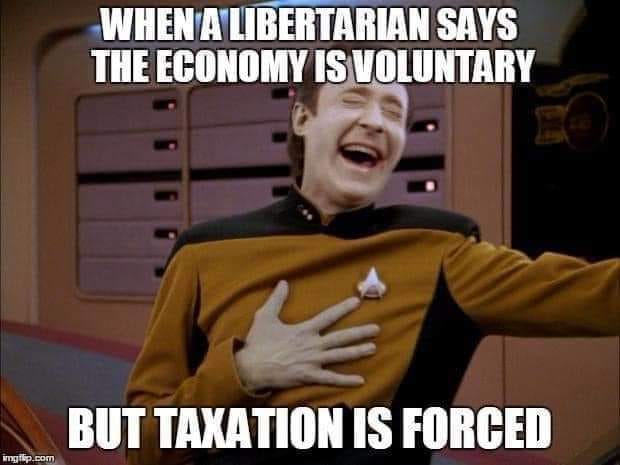
This meme is a humorous commentary on the libertarian ideology, specifically its stance on taxation. The image depicts a character from the Star Trek franchise, Jean-Luc Picard, who is known for his intellectual and philosophical nature. The meme juxtaposes a quote from Picard with a libertarian's hypothetical response to the question of whether the economy is voluntary, implying that the libertarian's answer is "no" and that taxation is a necessary aspect of a functioning society.
detailed-analysis (gemma3-27b-vision)
Okay, let's break down this meme through the lenses of various theoretical frameworks. It's a particularly rich meme for analysis given the inherent contradiction it highlights.
Visual Description
The meme features a still image of Commander Data from Star Trek: The Next Generation in a moment of boisterous, somewhat exaggerated laughter. Data, an android designed to emulate human emotion, is visibly reacting with mirth. He's standing in a corridor of the Enterprise, and the background is a standard Starfleet setting. Text overlays the image: "WHEN A LIBERTARIAN SAYS THE ECONOMY IS VOLUNTARY" is positioned above him, and "BUT TAXATION IS FORCED" is below. The juxtaposition is key - the android's almost mechanical yet very enthusiastic laughter highlights the perceived hypocrisy of a certain libertarian stance. The use of Data is apt; an entity programmed to understand and sometimes mimic human concepts, making it a playful commentary on ideological frameworks.
Foucauldian Genealogical Discourse Analysis
This meme engages with power dynamics and the construction of concepts like "voluntariness" and "force" through discourse. A Foucauldian analysis wouldn’t focus on whether the libertarian claim is true or false, but how the idea of a "voluntary economy" is constructed and maintained.
- Power/Knowledge: The libertarian claim that the economy is voluntary is not a neutral observation, but an exercise of power/knowledge. It's a way of framing economic relations that justifies certain structures and ignores others. It's a way of defining what constitutes “freedom” and “coercion.”
- Genealogy of "Voluntary": The concept of "voluntary" has a history. It has been used in different contexts and tied to different justifications. Tracing the genealogy reveals that what counts as "voluntary" is often shaped by existing power structures. (e.g., the voluntariness of accepting a low wage due to lack of alternatives).
- Discourse and Subjectivity: This meme challenges the discourse surrounding economic freedom by pointing out a contradiction. It implicitly asks: if taxation is clearly coercion, what about the ways in which economic necessity or unequal power relations force people into accepting unfavorable terms? The meme suggests that the libertarian framing of 'voluntary' is a discursive maneuver to normalize certain power imbalances.
- The Paradox: The meme calls attention to the inherent paradox in a system where some forms of compulsion (taxation) are readily acknowledged, while others (the compulsion of needing to work for survival) are often framed as 'free choice'.
Critical Theory
From a Critical Theory perspective (drawing on thinkers like the Frankfurt School), the meme serves as a critique of ideology.
- Ideology as Masking: The libertarian claim that the economy is voluntary functions as an ideology. It masks the underlying structural inequalities and power relations that shape economic outcomes. It presents a distorted picture of reality that benefits those in power.
- Critique of Rationality: Critical Theory questions the notion of pure rationality. The meme suggests that framing the economy as "voluntary" isn’t a logically sound assessment, but a justification for existing systems. It points to a disconnect between the stated ideals of freedom and the realities of economic exploitation.
- False Consciousness: The meme implies that those who believe the economy is entirely voluntary may be operating under a form of "false consciousness"—they haven’t fully grasped the extent to which their choices are constrained by structural forces.
- The Contradiction as Revelation: The juxtaposition of the voluntary economy and forced taxation reveals a contradiction that undermines the ideological claim. This unveiling of contradiction is a key element of critical analysis.
Marxist Conflict Theory
From a Marxist perspective, the meme underscores the inherent contradictions within capitalist ideology.
- Class Struggle: The meme implicitly highlights the class struggle. The “voluntary economy” is often presented as a meritocratic system where individuals succeed based on their own effort. However, the meme suggests that this narrative ignores the exploitative relationships at the heart of capitalism.
- Coercion in Capitalism: Even within a “free market,” workers are coerced into selling their labor power to survive. The meme subtly draws attention to this form of coercion, contrasting it with the more overt coercion of taxation.
- The State and Power: Taxation, as the meme acknowledges, is a form of state power. However, from a Marxist perspective, the state itself is an instrument of class rule, used to maintain the capitalist system.
- Ideology as Justification: The notion of a voluntary economy serves as an ideology that justifies the exploitation inherent in capitalism. It obscures the power dynamics and prevents the development of class consciousness.
Postmodernism
A postmodern reading would focus on the meme's deconstruction of meaning and its playful engagement with language.
- Deconstruction: The meme deconstructs the binary opposition between “voluntary” and “forced.” It demonstrates that these categories are not fixed or absolute, but rather socially constructed and contingent.
- Simulacra and Simulation: The idea of a "voluntary economy" could be seen as a simulacrum—a copy without an original. It’s a representation of freedom that lacks genuine substance, obscuring the underlying realities of power and inequality.
- Playfulness and Irony: The use of the Data image adds a layer of playfulness and irony. It suggests that the libertarian claim is a bit absurd, and that the meme is not necessarily making a serious argument, but rather highlighting a contradiction.
- Relativism of Truth: Postmodernism would resist the idea of a single "truth" about the economy. It would emphasize that different perspectives and interpretations are possible, and that the meme is simply one way of challenging the dominant narrative.
In conclusion, this meme is a surprisingly rich site for theoretical analysis. It touches on themes of power, ideology, inequality, and the construction of meaning, making it a valuable tool for understanding the complexities of social and political discourse.
simple-description (llama3.2-vision)
This meme is a humorous image of a character from the Star Trek: The Next Generation series, Captain Jean-Luc Picard, laughing and holding his heart. The text above the image reads, "When a libertarian says the economy is voluntary, but taxation is forced." The image is meant to be ironic, implying that the idea of a voluntary economy is not actually possible, and that the government will always need to collect taxes to fund its activities.
tesseract-ocr
SE SVS THE ECONOMY IS\WOLUNTARY =e / rn ~~ eC tet