First Seen
2023-05-10T21:03:34+00:00
simple-description (llama3.2-vision_11b)
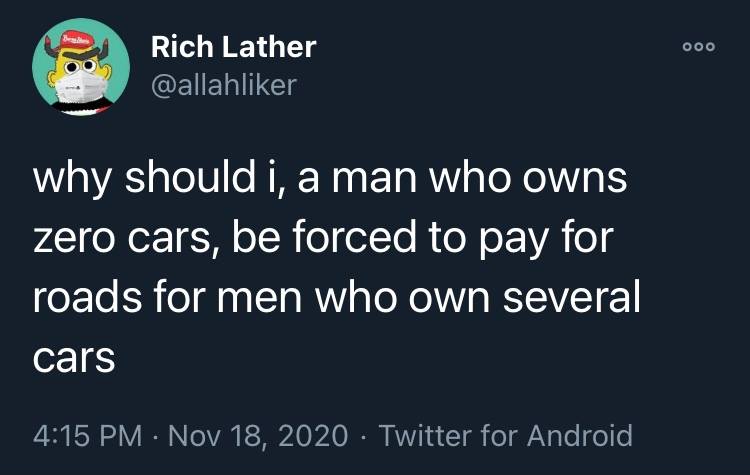
The meme is a humorous commentary on the concept of libertarianism, which emphasizes individual freedom and limited government intervention. The meme suggests that if a man is not willing to pay for roads, he should not expect to use them. The text reads: "why should i, a man who owns no cars, be forced to pay for roads for men who own many cars?" The meme is a satirical take on libertarian ideology, implying that if one doesn't contribute to the system, they shouldn't expect to benefit from it.
detailed-analysis (gemma3-27b-vision)
Okay, here's an analysis of the Twitter post, broken down into sections as requested, applying relevant theoretical frameworks where applicable.
Visual Description
The image is a screenshot of a Twitter post. The profile picture is a cartoonish depiction of a penguin wearing a red hat, with a slightly unsettling, digital-manipulated facial expression. The Twitter handle is "@allahliker". The text of the post is a rhetorical question: "why should i, a man who owns zero cars, be forced to pay for roads for men who own several cars". The post's timestamp is 4:15 PM on November 18, 2020, and it was posted via Twitter for Android. The layout is typical for a Twitter post with the username and handle at the top, followed by the text, and then metadata regarding the time and platform.
Foucauldian Genealogical Discourse Analysis
This post is ripe for analysis through a Foucauldian lens. The question isn’t simply about car ownership and taxes; it's about the discourse of infrastructure funding and the power/knowledge dynamics embedded within it.
- Discourse and Power: The post challenges the dominant discourse of public funding, which usually assumes that road taxes are a necessary social good benefiting everyone. The tweeter disrupts this by framing it as a system benefiting a specific group ("men who own several cars") at the expense of another.
- Genealogy of the Road System: A genealogical approach would look at the historical development of road systems. When were roads primarily designed for cars? Who benefited most from that historical trajectory? How did the prioritization of car infrastructure shape urban planning and social organization? The post implicitly highlights how the historical prioritization of car infrastructure creates an inequitable present.
- Normalizing Discourses: The implicit assumption that everyone should contribute to roads (regardless of personal use) is normalized through continuous repetition and institutionalization. This post challenges that normalization by questioning the underlying logic.
- Discipline & Panopticism: While not immediately apparent, the system of road taxes can be seen as a form of subtle discipline. Through taxation, individuals are regulated and controlled, contributing to a larger system of social order.
Critical Theory
This post embodies several key themes within Critical Theory, particularly related to ideology and the critique of everyday life.
- Ideology Critique: The post implicitly critiques the ideology of car-centric society. It questions the taken-for-granted assumption that supporting car infrastructure is universally beneficial. The questioning exposes the ideology’s role in obscuring inequalities and maintaining existing power structures.
- Rationalization and Instrumental Reason: This can connect to Max Horkheimer & Theodor Adorno's work on the "dialectic of enlightenment". The post questions the "rational" system of road funding, suggesting that this rationale ultimately serves to reinforce societal stratification. The system is presented as efficient but at what cost?
- Domination and Power Relations: The post exposes a power dynamic. Those who benefit most from the road system (those with multiple cars) are arguably those with more socio-economic power. The tax burden is disproportionately placed on those with less.
- Critique of the Public Sphere: The post is made on Twitter, a platform that is often viewed as a space for public discourse. The question itself is a challenge to the prevailing norms within that sphere, attempting to disrupt the consensus and provoke critical reflection.
Marxist Conflict Theory
This post is powerfully resonant with Marxist Conflict Theory.
- Class Struggle: The core of the post revolves around a conflict of interest between different social groups. It posits a struggle between those who use and benefit from publicly funded infrastructure (the car owners), and those who pay for it without receiving equivalent benefit (the non-car owners).
- Means of Production & Infrastructure: Roads can be seen as a form of “social infrastructure” – a collective means of production facilitating the movement of goods and people, and therefore, capital. The post suggests an unequal distribution of access to and benefit from this infrastructure.
- Exploitation & Surplus Value: Though not explicitly stated, the argument can be framed as an example of exploitation. Those who don’t benefit directly from the infrastructure (the non-car owners) are effectively contributing to the “surplus value” enjoyed by those who do.
- False Consciousness: The normalization of road taxes can be seen as a form of “false consciousness,” where individuals unknowingly contribute to a system that works against their interests.
Postmodernism
The post demonstrates several elements of postmodern thought.
- Deconstruction of Grand Narratives: The post challenges the “grand narrative” of universal public benefit. It doesn't accept the assumed justification for road funding, but instead questions the underlying premises and power dynamics.
- Relativism and Subjectivity: The post implicitly suggests that there is no objective justification for the current funding system. The "rightness" of the system is contingent on one's position and perspective (i.e., car owner vs. non-car owner).
- Simulation & Hyperreality: In a hyperreal world, the infrastructure itself becomes divorced from any "real" need. Roads aren't necessarily built to serve everyone; they're built to serve a specific ideology and economic system, creating a "simulation" of public benefit.
- Fragmentation & Plurality: The post, presented on a fragmented social media platform (Twitter), reflects the broader postmodern condition of fragmented experiences and competing narratives.
Queer Feminist Intersectional Analysis
While not immediately obvious, this post can be analyzed through an intersectional lens.
- Interlocking Systems of Oppression: The post brings together class and access to mobility. It highlights how gender, race, and other identities can intersect with class to determine access to transportation and the burden of infrastructure costs. For example, women, people of color, and low-income individuals are more likely to rely on public transportation or be excluded from car ownership.
- Mobility Justice: This post speaks to the emerging field of "mobility justice," which argues that transportation systems are deeply intertwined with social justice issues. The current system may disadvantage marginalized communities by prioritizing car-centric infrastructure and neglecting alternative modes of transportation.
- Challenging Masculinity: The post is framed in terms of “men” owning cars. This subtly critiques the association of car ownership with masculinity and privilege.
- Disrupting Normative Infrastructure: Car-centric infrastructure is often designed around assumed norms of travel and access, excluding those with different needs or lifestyles. By questioning the system, the post challenges these normative assumptions.
Disclaimer: The level of analysis applied to the post is subjective and dependent on the lens through which it's viewed. The above interpretations are based on commonly understood definitions of these theoretical frameworks.
simple-description (llama3.2-vision)
This meme is a humorous take on the idea that a man who owns no cars is being forced to pay for roads that are used by men who own multiple cars. The text reads: "why should i, a man who owns zero cars, be forced to pay for roads for men who own several cars." The meme is likely intended to be humorous and ironic, poking fun at the idea that someone who doesn't own a car is being forced to pay for roads that are used by others who do own multiple cars.
tesseract-ocr
top W erlang crt @allahliker why should i, a man who owns zero cars, be forced to pay for roads for men who own several cars 4:15 PM - Nov 18, 2020 - Twitter for Android