First Seen
2023-05-10T21:03:34+00:00
simple-description (llama3.2-vision_11b)
The meme is a humorous critique of the concept of "Libertarianism" from an anti-Libertarian perspective. It depicts a dog and a cat in medieval-like attire, with the dog holding a shovel and the cat holding a sword. The text reads: "Libertarianism is just feudalism in a different language."
detailed-analysis (gemma3-27b-vision)
Okay, let's break down this image through several theoretical lenses.
Visual Description
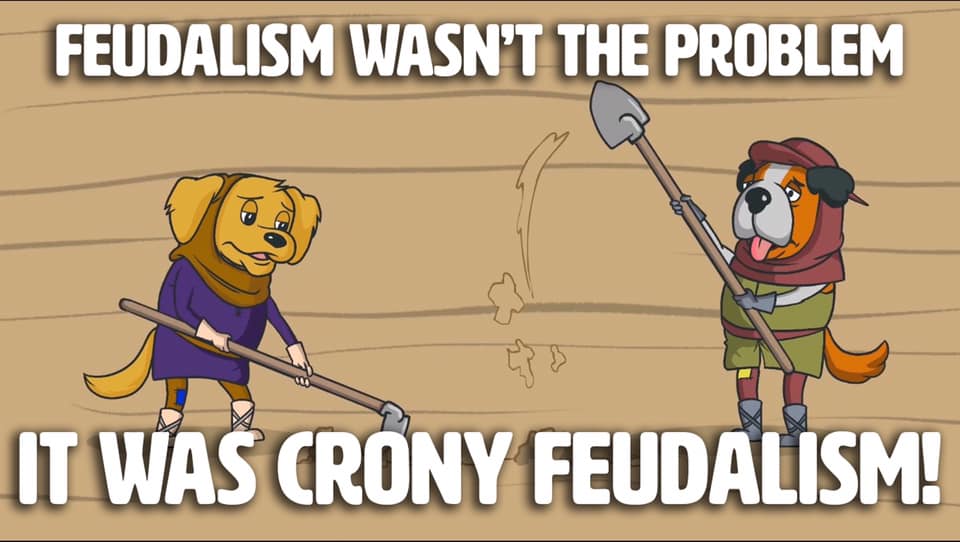
The image is a cartoon illustration against a plain, light-brown background. It depicts two anthropomorphic dogs, seemingly Golden Retrievers, engaged in an activity that evokes feudal labor.
- Left Dog: This dog wears what appears to be a purple robe and is using a hoe to work the land. It has a somewhat distressed or downcast expression. The attire and the tool suggest a serf or peasant.
- Right Dog: This dog is dressed as a hunter or guard, wearing a red hooded coat and green accents. It wields a long pole with a sort of flag or symbol on top, suggesting an authority figure or a land owner. This dog appears more jovial.
- Text: The image features text in bold capital letters: "FEUDALISM WASN'T THE PROBLEM / IT WAS CRONY FEUDALISM!" – which is the main message conveyed by the artwork.
- Dynamic: Dirt or clumps are being ejected from the area being hoed by the first dog, emphasizing the labor being performed.
Marxist Conflict Theory
This image lends itself well to a Marxist analysis. It visually represents the core dynamic of feudal society: class struggle.
- Bourgeoisie/Proletariat: The dogs represent distinct classes. The dog with the hoe is the proletariat (working class), actively producing wealth, while the other dog, dressed as a hunter/authority, represents the bourgeoisie (ruling class) who benefit from that labor without directly engaging in it.
- Means of Production: The land being hoed is the means of production – the resource that generates wealth. Ownership of this land is clearly unequal.
- Exploitation: The image implicitly depicts exploitation. The working dog is performing the physical labor, while the other dog benefits from the results, establishing a clear power imbalance.
- "Crony Feudalism": The text highlights a specific type of conflict. It doesn’t necessarily indict the system of feudalism itself, but a corrupted version of it. This implies that fairness or meritocracy was absent, and power was concentrated in the hands of those with connections ("cronies").
Foucauldian Genealogical Discourse Analysis
While the image is simple, Foucault’s concepts of power/knowledge could be applied.
- Discourse of Feudalism: The image participates in a discourse about feudalism. The text doesn't accept feudalism as inherently problematic. Instead, it challenges a specific understanding of feudalism, suggesting that the issue wasn’t the structure itself, but rather a distorted form of it.
- Power/Knowledge: Feudalism functioned through a system of power and knowledge. The authority dog wields power through its attire and possession of the flag-topped pole. Knowledge of the social hierarchy, roles, and rules legitimized this power.
- Genealogy: A genealogical analysis might look at how the idea of "feudalism" was constructed – how it was defined, what values were attached to it, and how it has been used to justify certain social arrangements. The image is suggesting a re-examination of how we understand the historical context. It’s a historical challenge.
Critical Theory
The image can be viewed through a Critical Theory lens focusing on social structures and power dynamics.
- Social Critique: The image is, at its core, a social critique. It’s not simply describing feudalism; it’s offering an interpretation that challenges a common understanding.
- Ideology: The text "Crony Feudalism" suggests that the problems weren’t inherent to the system itself, but to how it was practiced. This implies an ideological distortion—that the true principles of feudalism were subverted by corruption and favoritism.
- Emancipation: Implicitly, the image may suggest a desire for a different, more just social order. It calls for a re-examination of the past and an awareness of how power can be abused, pointing towards the possibility of achieving a more equitable future.
Postmodernism
A Postmodern reading might focus on the image’s questioning of grand narratives.
- Deconstruction: The statement "Crony Feudalism" is a deconstructive move. It takes a seemingly monolithic concept ("Feudalism") and breaks it down into a more nuanced understanding, highlighting the corruption within the system.
- Relativism: The image implies that there is no single "true" understanding of history. The text emphasizes a specific interpretation – that "Crony Feudalism" is the real problem – which suggests that other interpretations are possible.
- Meta-Narrative: The image challenges the simple narrative that "feudalism is bad." It suggests that the problem is not the system itself, but the way it was implemented.
Queer Feminist Intersectional Analysis
While the image doesn’t explicitly depict gender or sexuality, the principles of queer feminist intersectional analysis could still be applied.
- Power Dynamics: The dogs represent positions of power and subservience. Within that dynamic, it’s possible to imagine how gender, sexuality, race, or other social categories might further complicate those power relations.
- Oppression & Marginalization: While we don't see it in the image, a queer feminist lens would ask how the system disproportionately affects marginalized groups. For example, who was benefiting from the "cronyism?" What marginalized groups were further exploited or excluded?
- Challenging Norms: The image subtly challenges the normative view of feudalism. It doesn’t accept it at face value but calls for a more critical and nuanced understanding. This questioning of established norms is a key principle of queer and feminist thought.
It’s important to note that these analyses aren’t mutually exclusive. Different theoretical frameworks can enrich our understanding of the image and its message.
simple-description (llama3.2-vision)
The meme is a humorous comparison between two historical figures, one being a dog and the other a dog in a medieval-style outfit. The text "Feudalism wasn't a thing" is followed by "It was actually a dog" and then "The problem was... Feudalism!" The meme is poking fun at the idea that a dog was the actual cause of the lack of feudalism, implying that it was a dog's fault that the system of feudalism didn't exist.
tesseract-ocr
—_ al - \e . | aT, “rg TT 1 IVI) PEG hg Sy