First Seen
2023-05-10T21:03:34+00:00
simple-description (llama3.2-vision_11b)
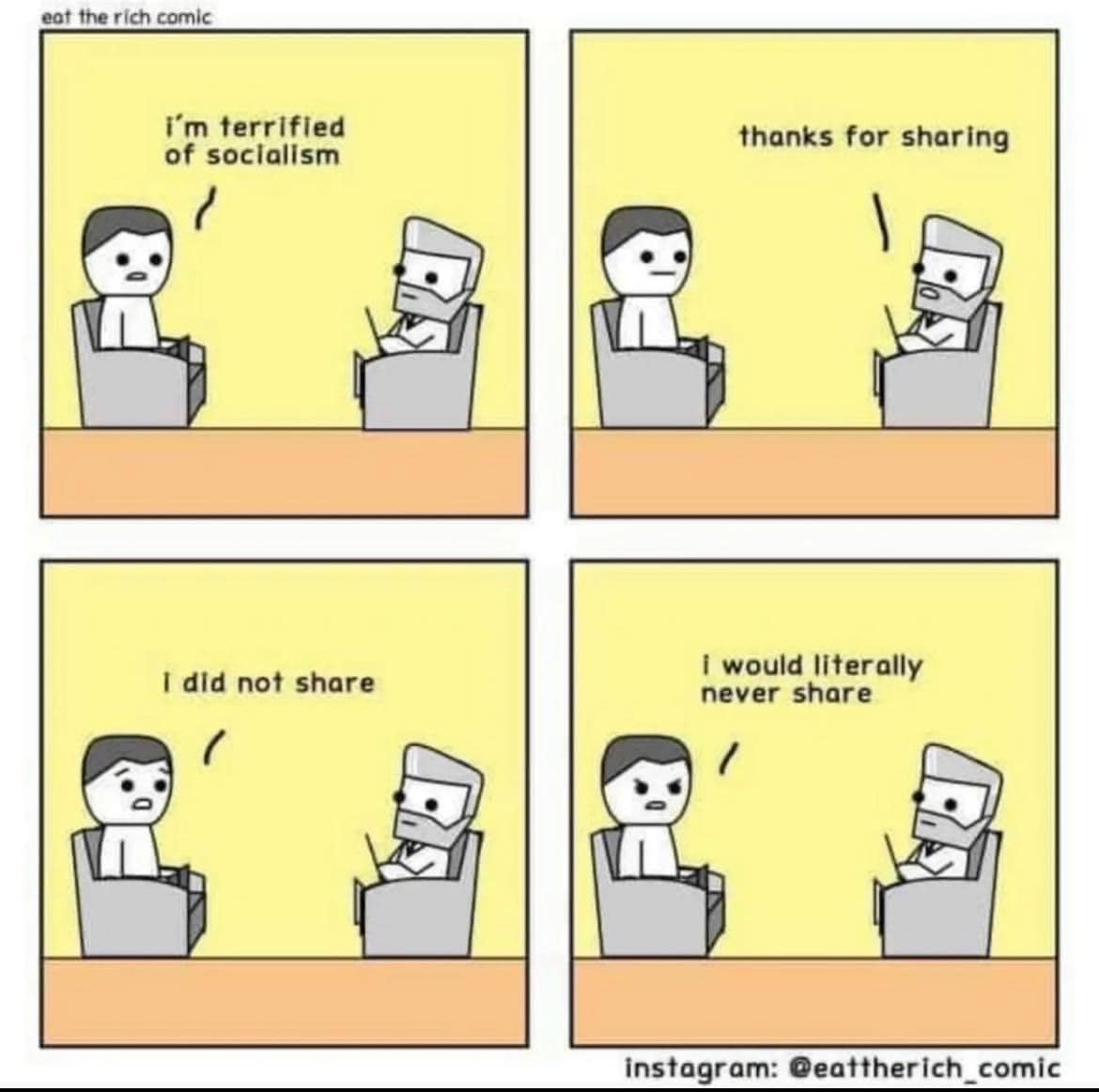
The meme is a cartoon of a person sitting at a table with a robot, with the robot saying "I'm terrified of socialism" and the person responding with a series of increasingly absurd and humorous statements about socialism, culminating in the person saying "I'd rather die than live under socialism". The text is meant to be humorous and satirical, poking fun at the idea of socialism and the fear of it.
detailed-analysis (gemma3-27b-vision)
Okay, let's break down this comic strip with the requested theoretical lenses.
Visual Description
The comic is a four-panel strip in a simplistic, black-and-white style. Each panel depicts two figures sitting at desks facing each other. The figure on the left is drawn with a neutral, somewhat distressed expression throughout, while the figure on the right is depicted as a stern, imposing figure wearing a pilot's hat and goggles. The background is a solid yellow. The panels are arranged in a grid. Each panel contains dialogue bubbles attributing spoken lines to each figure.
- Panel 1: The figure on the left says, “I’m terrified of socialism.”
- Panel 2: The figure on the right says, "Thanks for sharing."
- Panel 3: The figure on the left says, "I did not share."
- Panel 4: The figure on the right says, "I would literally never share."
The humor derives from the disconnect between the left figure's initial anxiety about socialism and the right figure's increasingly aggressive and dismissive responses, along with the implication that the act of expressing fear of socialism is itself a form of sharing that the stern figure is mocking.
Foucauldian Genealogical Discourse Analysis
This comic can be viewed through a Foucauldian lens as highlighting the production of truth regarding socialism and fear.
- Discourse: The comic demonstrates a discourse around socialism where expressing a fear of it is considered a sharing of information (a "share" in internet slang). The stern figure in the pilot's hat (representing perhaps authority or an ideological "gatekeeper") is regulating the discourse.
- Power/Knowledge: The pilot figure exerts power through their responses. They don’t engage with the substance of the fear but instead focus on the act of sharing, turning the original statement into something to be controlled and dismissed. This illustrates Foucault’s idea that power isn't just repressive, but productive—it creates the very categories and definitions of what is acceptable and unacceptable discourse.
- Genealogy: The joke relies on the recent rise of internet "sharing" culture and how it's become a dominant metaphor for spreading information, including political opinions. The comic traces the evolution of this "sharing" concept into a tool for controlling and dismissing dissent. The pilot figure weaponizes this culture.
- Regulation: The pilot’s increasing insistence that sharing never happened indicates a desire to control the narrative and erase any expression of fear of socialism.
Critical Theory
The comic resonates with key tenets of Critical Theory, particularly those related to ideology and communication.
- Ideology Critique: The stern figure embodies a specific ideological position (potentially anti-socialist, or more broadly, a refusal to acknowledge valid anxieties about systemic change). They are not addressing the content of the fear but enforcing an ideological demand for silence or adherence to a particular narrative.
- Mass Communication/Culture Industry: The comic mocks the way anxieties and fears become commodified and circulated in a digital culture dominated by the concept of “sharing.” The pilot figure represents a controlling force within this culture, dictating what can be shared and how.
- Domination & Resistance: The initial expression of fear could be seen as a form of tentative resistance, or at least a voicing of concern. However, the pilot figure quickly shuts down this resistance through dismissive language.
- Reason/Irrationality: The pilot’s insistence that the other person did not share could be seen as a rejection of a valid emotional response (fear) in favor of a purely rational or ideological stance.
Marxist Conflict Theory
From a Marxist perspective, the comic can be understood in terms of class relations and ideological control.
- Power Dynamics: The pilot figure can be interpreted as representing the ruling class or a dominant ideological force. They are enforcing a specific viewpoint and suppressing dissenting voices.
- False Consciousness: The initial fear of socialism might stem from a lack of understanding of class dynamics and systemic inequality, potentially a result of ideological manipulation.
- Ideological Hegemony: The pilot figure is trying to establish and maintain ideological hegemony—the dominance of a particular set of ideas and beliefs—by suppressing alternative viewpoints. They don’t debate the content; they deny the act of expression itself.
- Conflict & Control: The comic illustrates a power struggle in which the dominant group (represented by the pilot) attempts to control the narrative and maintain its position of power.
Postmodernism
The comic exhibits postmodern characteristics through its play with language, irony, and the blurring of reality and simulation.
- Hyperreality & Simulation: The emphasis on "sharing" is a reference to digital culture and the ways in which information is constantly circulated and often divorced from its original context. The pilot figure is operating within this hyperreal realm, where the act of sharing is more important than the content being shared.
- Deconstruction of Meaning: The comic deconstructs the meaning of "sharing" by turning it into a tool for control and dismissal. It challenges the notion that sharing is always a positive or liberating act.
- Irony & Parody: The comic uses irony to critique the performative nature of political discourse and the ways in which anxieties are often amplified and manipulated online.
- Fragmented Narrative: The comic's short, fragmented panels create a sense of disorientation and instability, reflecting the fragmented nature of postmodern experience.
Queer Feminist Intersectional Analysis
This lens is the least directly applicable, but still offers some insights:
- Silencing & Control: The pilot figure’s aggressive dismissal of the expressed fear can be viewed as a form of silencing, reminiscent of how marginalized groups are often silenced and denied the ability to express their anxieties and concerns. This tactic is often used to maintain power structures.
- Power Imbalances: The dynamic between the two figures highlights a power imbalance that could be seen as analogous to other forms of oppression, such as those based on gender, sexuality, race, or class.
- Performativity: The act of "sharing" (or denying sharing) can be seen through a queer lens as a performance of identity and ideology. The pilot figure is performing a rigid ideological stance, while the other figure is attempting to express vulnerability (which is then shut down).
- Intersectionality: While not explicit, the silencing dynamic could be compounded for individuals who hold multiple marginalized identities, as their voices are often further suppressed and overlooked.
I hope this detailed breakdown is helpful! Let me know if you'd like me to elaborate on any of these analyses or explore different theoretical frameworks.
simple-description (llama3.2-vision)
The meme is a comic strip featuring two people sitting at a table with a third person, who is a robot. The robot is saying "I'm terrified of socialism" and the other person responds with "I did not share" and the robot then says "I would literally never share".
tesseract-ocr
rin dere thanks for sharing ( \ a Sle ‘Ss ry . <A it by : AS] | did not share inerchine’ ( / & pe | | C9 =)