First Seen
2023-05-10T21:03:34+00:00
simple-description (llama3.2-vision_11b)
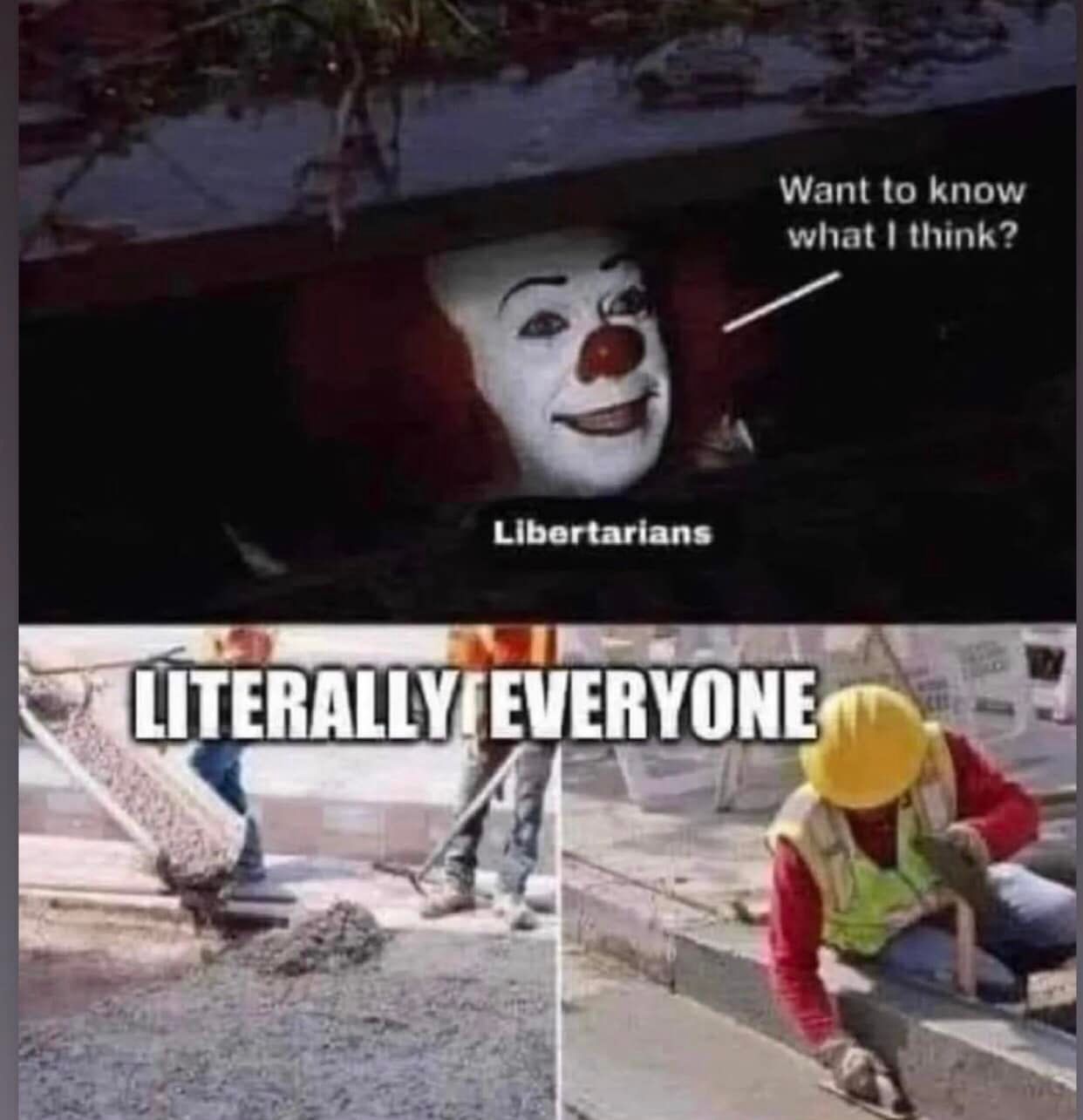
This meme is from the perspective of Anti-Libertarian, a category that rejects the idea of individual freedom and autonomy. The meme depicts a person who is unaware of their surroundings, with a caption that reads "I want to know what I think" and is followed by the phrase "I am a libertarian". The image is meant to be humorous and ironic, as it pokes fun at the idea of libertarians who are unaware of their own thoughts and actions.
detailed-analysis (gemma3-27b-vision)
Okay, let's break down this meme through several theoretical lenses. It's a potent image, and multiple frameworks apply.
Visual Description
The meme utilizes a two-panel "drakeposting" format.
- Top Panel: A stark, high-contrast image of a clown, dressed in traditional circus attire. The clown stares intensely, and the text “Want to know what I think?” is superimposed above its head. The label “Libertarians” is placed below the clown. The background is a black, slightly blurred woodland.
- Bottom Panel: A photograph of multiple construction workers working on a sidewalk. They are engaged in the physical labor of pouring and smoothing concrete. The text “LITERALLY EVERYONE” is overlaid in large, white capital letters, appearing like a banner across the image.
The contrast between the two panels is striking, positioning the clown as a separate entity from the labor being done. The style is raw and intentionally uses bold text for impact.
Foucauldian Genealogical Discourse Analysis
This meme offers an interesting point for a Foucauldian analysis. The meme reveals a discourse concerning labor and power.
- Power/Knowledge: The clown (labeled Libertarians) posits itself as a “thinker” – someone who creates knowledge. This position asserts a power dynamic, suggesting a separation from the doing and from those who produce concrete results. The "literal everyone" panel represents the enacted power, the physical manifestation of work. Knowledge, in this framework, isn’t just abstract thought, but embodied practice.
- Genealogy of ‘Thinking’ vs. ‘Doing’: We can trace the historical development of valuing ‘thinking’ over ‘doing’ back to philosophical traditions that prioritize reason and intellect. Libertarian thought often champions individualism and the ‘free market’ as expressions of intellect. This meme implicitly critiques the separation between those who theorize about society and those who build it—literally.
- Disciplinary Power: The meme can be read as a critique of the ways in which certain ideologies (like those often associated with libertarianism) can be detatched from the messy, physical realities of labor. The meme suggests that the "thinkers" do not understand, or choose not to engage with, the work that sustains everything.
Critical Theory
Drawing on the Frankfurt School’s emphasis on the culture industry and the manipulation of ideology, we can interpret the meme as a critique of how abstract theories become detached from material reality.
- Alienation: The meme points to the alienation between intellectual labor (represented by the clown) and manual labor (the construction workers). The clown represents a position of detached observation, perhaps even a theoretical justification of an economic system that exploits labor.
- Ideology Critique: The meme challenges the implicit ideology behind certain strains of libertarian thought—the idea that ‘freedom’ is achieved through minimal government intervention, potentially at the expense of collective welfare or worker protections. It implies this “freedom” exists for only a small segment of society, disconnected from the needs of those who provide essential services.
- The "One-Dimensional Man": The contrast between the clown and the workers can be understood as a representation of Herbert Marcuse’s concept of the “one-dimensional man”— individuals who have been molded by dominant ideology and have lost the ability to critically question the status quo. The workers represent a tangible, material reality, while the clown represents an abstract, potentially distorted view of it.
Marxist Conflict Theory
This meme lends itself strongly to a Marxist reading.
- Class Struggle: The meme directly illustrates the inherent conflict between the bourgeoisie (those who own the means of production and theorize about society) and the proletariat (the working class who perform the labor). The clown is positioned as belonging to the former, while the construction workers represent the latter.
- Base and Superstructure: The workers' labor creates the material “base” of society (roads, buildings, infrastructure). The clown represents the “superstructure” – the ideology, ideas, and beliefs that are built upon this material base. The meme suggests that the superstructure (libertarian thought) can become detached from, and even exploit, the base.
- False Consciousness: The meme implies that libertarian ideology may foster a ‘false consciousness’ among those who benefit from the exploitation of labor, allowing them to ignore the realities of the working class.
Postmodernism
A postmodern interpretation would focus on the breakdown of grand narratives and the questioning of truth claims.
- Deconstruction of Authority: The meme deconstructs the authority of intellectual thought (represented by the clown). It challenges the assumption that abstract ideas are inherently superior to physical labor.
- Simulacra and Simulation: The clown can be seen as a “simulacrum” – a copy without an original. Its pronouncements are divorced from the realities of the world, representing a hyperreality where image and representation have replaced substance.
- Rejection of Metanarratives: The meme implicitly rejects the metanarrative of "free-market" individualism. It suggests that the ideology fails to account for the material conditions of those who build and maintain the social order.
Queer Feminist Intersectional Analysis
While the meme doesn't directly address gender or sexuality, an intersectional lens can still provide valuable insights.
- Labor and Gendered/Racialized Division: It's worth noting that construction work, like many manual labor jobs, has historically been dominated by white men. An intersectional analysis would highlight how certain groups are systematically excluded from economic and political power.
- Devaluation of Care Work: While construction work is visible, much essential labor (often performed by women and people of color) – like caregiving, cleaning, and domestic work – remains invisible and undervalued. The meme highlights the devaluation of all forms of work that aren't intellectual or “high status.”
- Challenging Hierarchies of Value: This meme, by juxtaposing the clown with the construction workers, challenges the hierarchies of value that prioritize intellect over manual labor, and potentially reinforce existing social inequalities.
I hope this thorough breakdown is helpful! Let me know if you'd like me to explore any of these lenses in more detail.
simple-description (llama3.2-vision)
The meme is a humorous comparison between two images. The top image shows a clown from the movie "It" with a caption "Want to know what I think?" and the text "Libertarians" below it. The bottom image shows a worker in a hard hat and vest, with the caption "Literally everyone" above it. The meme implies that the idea of a clown asking what he thinks is similar to the idea of a worker in a hard hat and vest asking what he thinks, both being absurd and unlikely.
tesseract-ocr
. Want to know = what | think? a s aT Tee ter a ee eT ST x 4 ap . "y - 2 es” . z se = f << os | ar er Sh | ~ ge; - = | Phy <2 ™