First Seen
2023-05-10T21:03:34+00:00
simple-description (llama3.2-vision_11b)
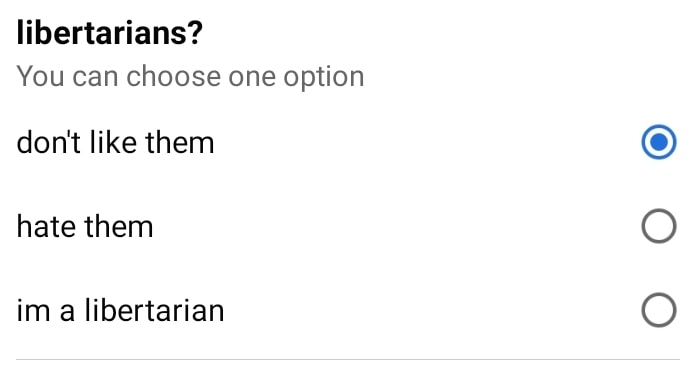
The meme is a screenshot of a hypothetical poll asking "Libertarians?" with options "You can choose one", "Don't like them", "Hate them", and "I'm one". The user has selected the "I'm one" option, implying a tongue-in-cheek response to the poll.
detailed-analysis (gemma3-27b-vision)
Okay, here's an analysis of the provided image, broken down into the requested theoretical frameworks, with sections only included when relevant.
Visual Description
The image displays a simple user interface element – a poll or survey question asking, "Libertarians?". Three response options are presented: "don't like them", "hate them", and "im a libertarian". Each option is accompanied by a radio button. The "don't like them" option is pre-selected, indicated by the filled blue radio button. The background is a light, neutral grey. The layout is clean and minimal, typical of a digital survey or polling mechanism.
Foucauldian Genealogical Discourse Analysis
This simple poll functions as a site for the production of truth about libertarianism, and importantly, a narrowing of its possible meanings. Foucault's genealogical method encourages us to investigate the history of power/knowledge embedded within this framing.
- Discourse and Power: The question itself, phrased as a prompt to select negative sentiment ("don't like," "hate") alongside mere identification, isn't neutral. It actively constructs libertarianism as something potentially undesirable, or at least needing justification. The lack of a neutral or positive option other than identification suggests a pre-existing assumption of opposition.
- Normalization and Exclusion: By limiting the responses to feelings of negativity or identification, the poll normalizes dislike/hatred as the expected responses and subtly excludes other nuanced positions (e.g., "I'm undecided," "I don't know much about them," "I have mixed feelings"). It produces a discourse where libertarianism is inherently debatable/unlikeable.
- The Power of Categorization: The very act of offering pre-defined choices categories and shapes the responses. It disciplines the potential respondent, forcing them to fit their opinion into pre-established boxes.
Critical Theory
From a Critical Theory perspective, this poll represents the continuation of ideological control and the manipulation of public opinion.
- Ideology & False Consciousness: The limited response options work to reinforce potentially dominant ideologies that may be critical of libertarianism. The poll presents a constrained choice, implicitly asking for affirmation of a negative perspective. This can contribute to a "false consciousness" where individuals are led to believe their negative feelings towards libertarianism are simply rational.
- Domination and Control: The poll doesn’t seek understanding; it seeks affirmation of existing beliefs. This is a form of subtle social control – subtly reinforcing pre-existing biases against libertarianism by framing it within a negative context. The pre-selected "don't like them" option further reinforces the idea that this is the 'default' position.
- Reproduction of Power Relations: The poll doesn’t challenge existing power structures; it reproduces them by subtly directing participants toward a pre-determined perspective. It reinforces a possible existing power dynamic between those who dislike/hate libertarianism and those who identify with it.
Marxist Conflict Theory
While not overtly central, a Marxist lens can analyze this poll in terms of class struggle and ideology.
- Ideological Struggle: The poll can be seen as a small manifestation of a broader ideological struggle within society. Libertarianism, with its emphasis on minimal government intervention and free markets, often clashes with ideologies advocating for social welfare programs and collective action. The poll’s framing presents libertarianism as something potentially to be disliked or hated, reinforcing a specific ideological position.
- Hegemony & Counter-Hegemony: The poll, if widely distributed, might contribute to the hegemonic dominance of a particular anti-libertarian ideology. The pre-selection of 'don't like them' subtly positions that as the dominant opinion. Alternatively, the inclusion of the "im a libertarian" option allows for a small space for counter-hegemonic expression.
I hope this detailed analysis, broken down through multiple theoretical lenses, is helpful! Let me know if you’d like me to elaborate on any of these points.
simple-description (llama3.2-vision)
The meme is a humorous response to a survey question about what it means to be a libertarian. The image shows a multiple-choice question with three options: "You can choose one option", "Don't like them", "Hate them", and "I'm a libertarian". The user has selected the "I'm a libertarian" option, which is represented by a blue circle.
tesseract-ocr
libertarians? You can choose one option don't like them © hate them O im a libertarian O