First Seen
2023-06-15T00:17:34+00:00
simple-description (qwen3.5_2b-q8_0)
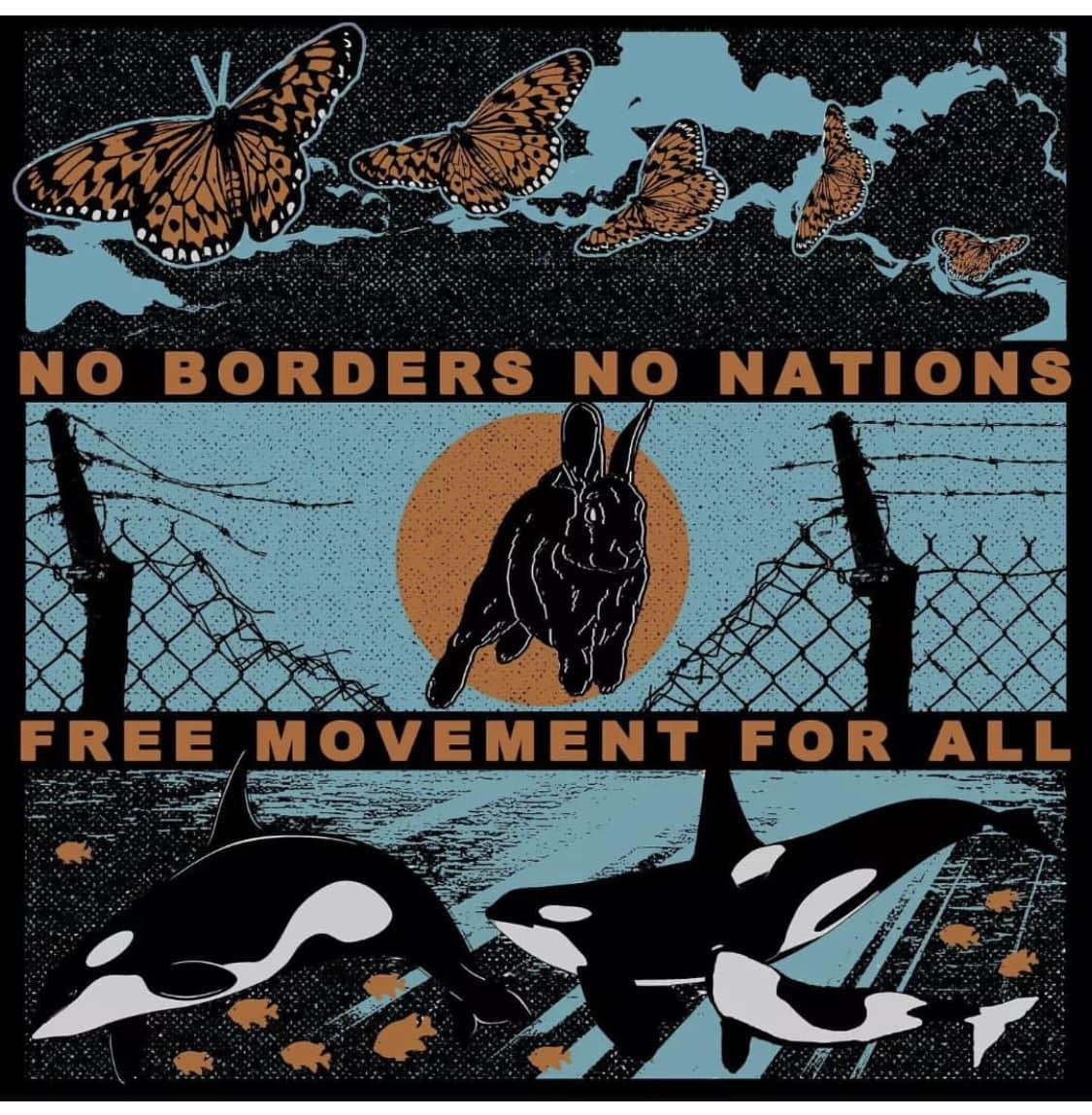
This meme presents an anti-nationalist perspective by suggesting that political borders are artificial barriers rather than natural divisions. It uses imagery of nature and movement—like butterflies, a rabbit jumping through fences, and whales swimming freely—to argue against the concept of restricting travel based on territory. The text "No Borders, No Nations" and "Free Movement For All" reinforces the message that people and animals should be free to move without political boundaries.
simple-description (llama3.2-vision_11b)
The meme is a satirical image that juxtaposes a picture of a border wall with a protest sign that reads "No Borders, No Nations, No Borders, No Nations" in a playful, ironic tone. The image is likely meant to poke fun at the idea of nationalism and the concept of borders, suggesting that the notion of a wall is absurd and that a more inclusive, border-less society is a more desirable one.
detailed-analysis (gemma3-27b-vision)
Okay, here's an analysis of the image, broken down into the requested theoretical sections where applicable. Given the imagery and text, several of these lenses are quite relevant.
Visual Description
The image is a graphic poster with a retro/vintage aesthetic, reminiscent of 1960s/70s political art. It's predominantly colored in shades of teal, orange/rust, and black, with a textured, slightly grainy appearance.
- Central Image: A silhouetted hare is leaping over a barbed wire fence, set against a circular, muted orange/rust background suggesting a sun or a portal. The hare is in mid-leap, giving a sense of dynamic movement and urgency.
- Symbolic Elements: Butterflies (or moths) are scattered throughout the composition, appearing above and below the fence. These creatures contrast with the harshness of the wire.
- Text: Bold, sans-serif text appears in black above and below the central image. It reads "NO BORDERS NO NATIONS" and "FREE MOVEMENT FOR ALL," clearly conveying a political message.
- Overall Composition: The composition is symmetrical, with the fence forming a strong horizontal line. The animals are used to emphasize the concept of freedom of movement. The style is bold and impactful, suggesting it's intended for poster/flyer distribution.
Foucauldian Genealogical Discourse Analysis
This image is profoundly relevant when viewed through a Foucauldian lens. The barbed wire fence acts as a physical manifestation of power. It’s not just a barrier, but a device of control – a technology of power.
- Discourse of Border Control: The image challenges the dominant discourse surrounding borders, which positions them as necessary for security, national identity, and preservation of resources. By depicting an animal overcoming the barrier, it disrupts this accepted truth.
- Genealogy of the Border: We can trace the history (genealogy) of the border as a concept. It's not natural or inherent, but a historically constructed concept created through power relations, often tied to colonialism, state-building, and control of labor and resources. The image implicitly calls for a dismantling of these historical structures.
- Biopower: The desire to control movement relates to biopower - the way modern states seek to manage and regulate life, including the life of those who cross borders. The hare’s escape represents a challenge to this control – a rejection of being defined and regulated by the state.
- Surveillance and Discipline: The fence, and the idea of borders generally, implies surveillance and the discipline required to maintain order. The hare, through its freedom, resists this panoptic control.
Critical Theory
This image aligns with several principles of Critical Theory, particularly those focused on challenging existing power structures.
- Ideology Critique: The image acts as an ideology critique of nationalism and state sovereignty. It suggests that the concepts of borders and nations are not natural or inevitable, but constructed ideologies that serve the interests of those in power.
- Emancipation: The core message of “free movement for all” is explicitly emancipatory. It challenges the limitations placed on individuals and animals by restrictive borders and calls for a more just and equitable world.
- Deconstruction: The image subtly deconstructs the concept of the “nation.” By focusing on animals crossing borders, it suggests that borders are arbitrary and that natural boundaries do not align with national divisions.
- Critique of Reason: Critical Theory often questions the idea of “rational” systems of control. The image suggests that the attempt to impose order on movement is irrational and harmful.
Marxist Conflict Theory
From a Marxist perspective, the image highlights the conflict inherent in the control of movement and resources.
- Class Struggle: Borders are often used to regulate labor and control access to resources. The image implicitly speaks to the exploitation of marginalized groups who are denied freedom of movement while the privileged can travel freely. The hare's leap can be seen as symbolic of the marginalized seeking to overcome systemic barriers.
- Capitalism and Migration: The image indirectly critiques the capitalist system, which relies on the free flow of capital but often restricts the movement of people. Borders are used to control the labor supply and maintain economic inequality.
- Alienation: The barriers created by borders contribute to alienation and the separation of individuals from their communities and resources.
- Revolutionary Potential: The image’s message – “free movement for all” – can be seen as a call for revolutionary change, challenging the existing power structures that maintain borders and inequality.
Postmodernism
While not the most dominant reading, Postmodern elements are present.
- Rejection of Grand Narratives: The image challenges the “grand narrative” of the nation-state, suggesting that borders and national identities are constructed and fluid, not fixed or essential.
- Deconstruction of Meaning: The use of animals as symbols can be seen as a deconstruction of traditional political imagery. By focusing on non-human creatures, it challenges the anthropocentric nature of political discourse.
- Blurring of Boundaries: The image, especially with the animals, intentionally blurs the boundaries between “us” and “them,” between “nature” and “culture,” and between “human” and “animal.”
- Simulacra and Simulation: Borders themselves can be viewed as a kind of simulation of security – a manufactured barrier that creates the illusion of protection.
Queer Feminist Intersectional Analysis
This image has a significant resonance within Queer Feminist Intersectional frameworks.
- Border as a Site of Violence: Borders are often sites of violence and discrimination, particularly for marginalized groups such as migrants, refugees, LGBTQ+ individuals, and people of color. The image implicitly recognizes this violence and advocates for a more inclusive and equitable world.
- Mobility Justice: The call for "free movement for all" speaks to the concept of mobility justice - the idea that everyone has the right to move freely and safely, regardless of their immigration status, gender identity, sexual orientation, or other characteristics.
- Challenging the Nation-State: The nation-state is often deeply rooted in patriarchal and heteronormative ideologies. By rejecting national borders, the image implicitly challenges these ideologies and advocates for a more inclusive and fluid social order.
- Intersectionality: The image implicitly acknowledges the interconnectedness of various forms of oppression. The struggle for free movement is linked to broader struggles for social justice, including the fight against racism, sexism, homophobia, and economic inequality. The hare as a marginalized creature speaks to multiple oppressions.
I hope this detailed analysis is helpful! Let me know if you'd like me to elaborate on any of these points.
simple-description (llama3.2-vision)
This meme is an image of a border fence with a group of migrants (including a rabbit) trying to cross into the United States. The text "No borders, no nations, free movement for all" is written across the top of the image, while "No borders, no nations" is written across the bottom. The image is meant to be humorous and ironic, as it is often used to express a desire for open borders and to criticize the idea of nation-states.
tesseract-ocr
a es FINN MA IR YE Sc eee 3 Se : a a7 = Ee ee lL OS SO, A A S oP it - y 3 if [ AKL Y SIS FO LOTS EO © OW EOE Fee ~~ fe f= Fe a ey