First Seen
2023-06-20T22:12:49+00:00
simple-description (qwen3.5_2b-q8_0)
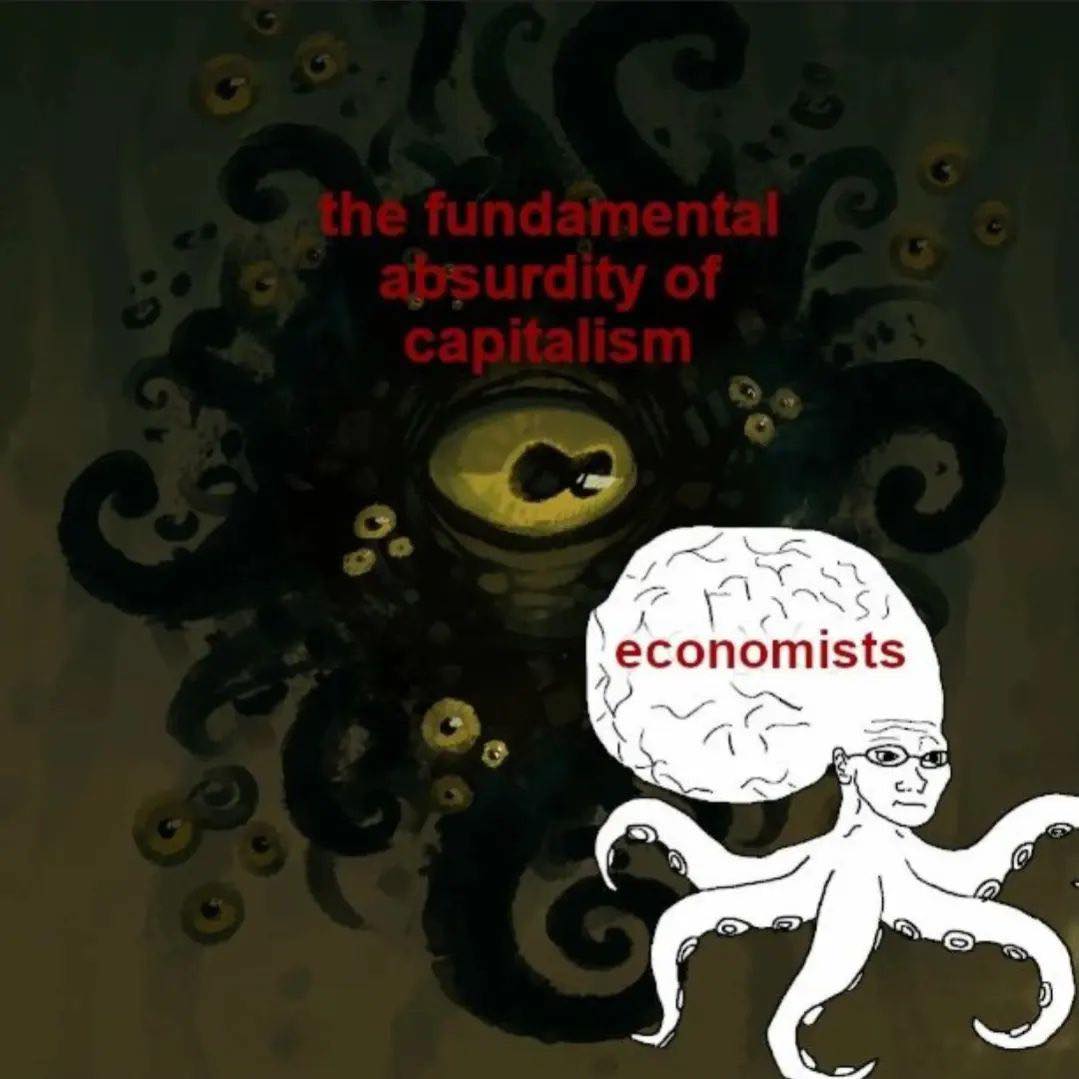
This image depicts a grotesque, multi-eyed monster surrounded by tentacles, with the text "the fundamental absurdity of capitalism" written in red. In the foreground, a human figure with a brain for a head and an octopus tentacle has the word "economists" written near it. This style aligns with Anti-Neoclassicalism, which rejects the clear, orderly logic and rationality of the movement in favor of complex, chaotic, and often nonsensical imagery that mirrors the confusion and irrationality found in society.
simple-description (llama3.2-vision_11b)
This meme is from the category of Anti-Neoclassicalism, which is a critical perspective on economics that challenges the dominant neoclassical school of thought. The meme features a cartoon of a philosopher with a large brain, surrounded by a halo of thought bubbles, and the text "economists are the philosophers of our time" is written above it. The image is a commentary on the idea that economists are not just experts in economics, but also have a deep understanding of the philosophical underpinnings of the field, and are often seen as the "philosophers of our time" in the same way that ancient Greeks were philosophers.
detailed-analysis (gemma3-27b-vision)
Okay, let's break down this image with the requested analytical lenses.
Visual Description
The image presents a stark, unsettling aesthetic. A pale, cartoonish figure resembling an octopus-headed humanoid stands against a swirling, dark background filled with multiple eyes. The figure is labeled "economists," with the text overlaid onto its head. The background is a dark, muddy green, and the swirling shapes give a sense of unease and entrapment. A crimson banner across the top proclaims "the fundamental absurdity of capitalism." The overall tone is surreal, slightly menacing, and clearly critical. The use of eyes in the background suggests surveillance, a lack of privacy, and an all-seeing, potentially predatory gaze.
Critical Theory
The image explicitly invokes Critical Theory by framing capitalism as "absurd." This aligns with a key tenet of the Frankfurt School, who critiqued the logic of instrumental reason and the ways in which it became intertwined with systems of power and domination. The image suggests that economics, as practiced by "economists," is not a neutral or objective science, but is deeply implicated in the perpetuation of this absurdity. The octopus-headed figure, with its multiple "eyes," represents the pervasive reach of economic logic and surveillance, suggesting that economic systems observe and control nearly every aspect of life. The unsettling aesthetic reinforces the idea that capitalism is not a rational or benevolent system, but a source of alienation and distortion.
Marxist Conflict Theory
From a Marxist perspective, the image reinforces the idea of class struggle and the inherent contradictions within capitalism. The “economists” figure can be seen as representing the intellectual apparatus that legitimizes and reinforces the capitalist system. The many eyes in the background symbolize the surveillance and control exerted by the ruling class over the proletariat. The octopus-like form could be interpreted as representing the exploitative nature of capitalism, with its tentacles reaching into all aspects of society and extracting surplus value. The “absurdity” of the banner points to the illogical and exploitative nature of the system, which generates vast wealth for a few while leaving many in poverty and precarity.
Foucauldian Genealogical Discourse Analysis
A Foucauldian reading centers on how the image demonstrates the workings of power/knowledge. The label "economists" isn't simply a descriptive label but rather a designation within a discourse – a system of thought, language, and practice that shapes how we understand the world. This image suggests that the discourse of economics creates a particular reality—one defined by absurdity—and presents it as natural or inevitable. The octopus-headed figure represents how this discourse has become monstrous and all-encompassing. The eyes in the background can be seen as representing the "panoptic gaze" that monitors and controls individuals through the dissemination of economic logic. A genealogical approach would trace the historical development of economic thought and the ways in which it has become intertwined with power structures.
Postmodernism
The image embodies certain postmodern sensibilities. The surreal and unsettling aesthetic rejects traditional representations of reality. The octopus-headed figure is a rejection of humanistic ideals and suggests the fragmentation and de-centering of the subject. The explicit labeling of the figure as “economists” can be seen as a gesture toward the deconstruction of meaning and the questioning of objective truth. The claim of the "absurdity of capitalism" aligns with postmodern critiques of grand narratives and universalizing claims. It implies that capitalism is not a coherent or rational system, but a chaotic and contradictory one.
In summary: The image functions as a visual statement of critique, utilizing both striking imagery and direct textual commentary to convey a critical message about the inherent absurdities of capitalism and the role of economics in perpetuating it. It draws upon a range of critical theories to articulate a complex and challenging vision.
simple-description (llama3.2-vision)
This meme is a play on the idea that economists are often seen as being detached from reality, and that their theories are often based on assumptions that don't reflect the real world. The image shows a cartoon of a person with a brain made of money, with a giant octopus-like creature with a single eye in the background, labeled "the fundamental absurdity of capitalism". The text "economists" is written above the brain, implying that even the most intelligent and educated people (economists) are still susceptible to the absurdity of capitalism.
tesseract-ocr
\ \ rc’ * ) economists V . — Ps re \ 4 af zs 3 » = = Bb gy = i f (S) oy 4 ( p) ZL (/ Y ca