First Seen
2024-01-28T00:38:21.464926+00:00
simple-description (qwen3.5_2b-q8_0)
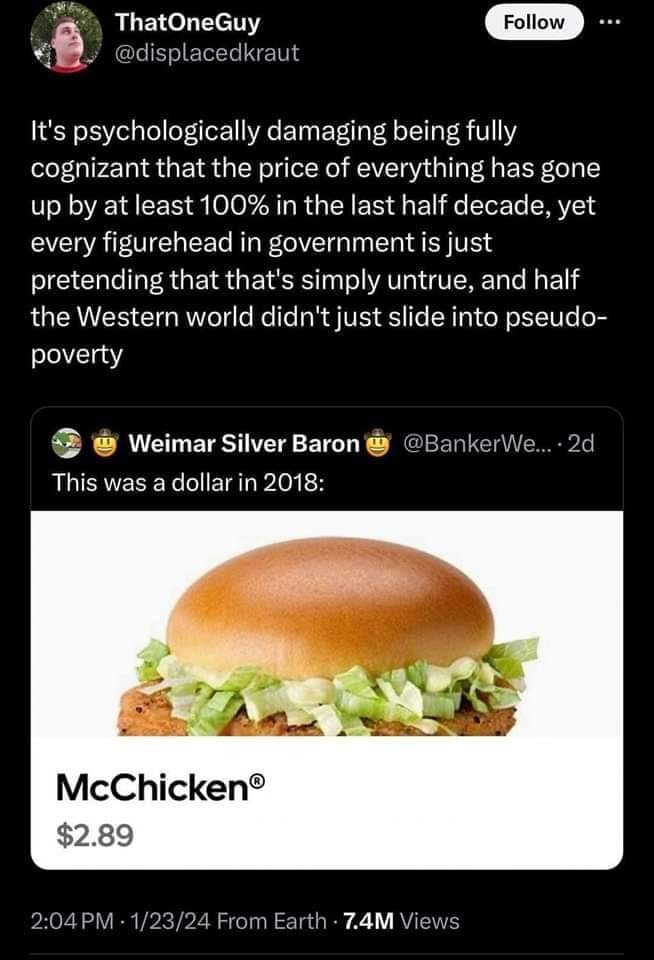
This image features a clean, white-background photograph of an McChicken burger, mimicking 19th-century photography and advertising styles. The caption includes a bold statement about inflation, noting that a dollar once bought a McChicken for just $2.89, which is now significantly cheaper than the price of food in 2018. The accompanying text by @displacedkraut argues that despite prices rising over the past 50 years, the government continues to claim stability.
simple-description (llama3.2-vision_11b)
This meme is a satirical commentary on the economic policies of the 2020s, specifically the inflation of 2022-2023, from the perspective of Anti-Neoclassicalism. The image shows a McDonald's McChicken sandwich priced at $1.00, with a caption referencing the 2023 inflation crisis, implying that even the most basic food items are now unaffordable.
detailed-analysis (gemma3-27b-vision)
Okay, let's break down this Twitter post through the requested theoretical lenses. It’s quite a dense little package of cultural commentary!
1. Visual Description
The image shows a McDonald's McCchicken sandwich, photographed in a bright, fast-food style presentation. It’s a close-up focusing on the sandwich with lettuce visible. Underneath is the price: $2.89, and a notation of "2018." The sandwich appears intended to be the focal point, contrasting with the text and the argument about the cost of living. It has a slightly nostalgic, "remember when..." feel, subtly suggesting a loss.
2. Marxist Conflict Theory
This post is deeply rooted in Marxist conflict theory. At its core, it illustrates the fundamental Marxist argument about exploitation and the alienation of labor under capitalism. Here's how it applies:
- Class Struggle: The post implicitly frames a conflict between the working class/consumers and the ruling class/governmental figures. The argument is that those in power are either deliberately ignoring or actively concealing the economic hardship faced by the majority.
- Value Extraction: The McCchicken as an object represents a commodity, a product of labor. The rising price, contrasted with the historical price ($1 in 2018), highlights the increasing cost of basic necessities. The profit made from this commodity isn't being redistributed fairly, but instead is being accumulated by those already wealthy.
- False Consciousness: The complaint that "every figurehead in government is just pretending that's simply untrue" suggests that these figures are deliberately creating a false narrative to maintain the status quo. This narrative obscures the reality of economic inequality and prevents the working class from recognizing their exploitation.
- Alienation: The McCchicken itself, as a mass-produced commodity, also exemplifies Marx’s concept of alienation. The consumer has no connection to the labor that created the sandwich. The focus is solely on the product's price, a symbolic indicator of the system’s disconnect from human need.
3. Critical Theory
The post resonates with many aspects of Critical Theory, which builds upon Marxism but expands its scope.
- Ideology Critique: The statement about government figures "pretending" points to an ideological manipulation. Critical Theorists like Adorno and Horkheimer argued that dominant ideologies mask power structures and serve to legitimize inequality. The post is accusing the ruling class of perpetuating a deceptive narrative.
- Reason as Domination: Horkheimer and Adorno would also connect this to the critique of instrumental reason. The relentless pursuit of economic growth and profit, at the expense of human wellbeing, is a form of domination. The rising price of a simple item like a McCchicken is a symptom of this distorted rationality.
- Culture Industry: The McCchicken itself can be seen as part of the "culture industry" (Adorno & Horkheimer). Mass-produced, standardized goods contribute to the homogenization of culture and the suppression of critical thought. It reinforces consumerism.
- Loss of Authenticity: The emphasis on a past price ("2018") suggests a longing for a time when basic needs were more affordable and life felt more authentic.
4. Postmodernism
While not a primary focus, elements of postmodern thought are present:
- Metanarratives: The post implicitly challenges the "metanarrative" of economic progress. The idea that capitalism inevitably leads to prosperity is being questioned, as the evidence suggests a different reality – rising prices and increasing poverty.
- Simulation/Hyperreality: (Baudrillard) The nostalgic focus on the past price could be interpreted as a form of hyperreality. The idealized past price becomes a simulation, a representation of a lost authenticity, that obscures the complex economic factors at play.
- Rejection of Grand Theories: Postmodern thought, in general, rejects "grand theories" like Marxism. However, the post uses Marxist concepts, suggesting a blend of perspectives.
5. Foucauldian Genealogical Discourse Analysis
Foucault's genealogy explores how power operates through discourse and knowledge.
- Power/Knowledge: The post implies that "knowledge" about inflation and cost of living is being constructed and manipulated by those in power. They are producing a discourse that obscures the truth.
- Discursive Practices: The act of sharing this image and text is a discursive practice – an attempt to challenge the dominant narrative and construct an alternative understanding of economic reality. It’s an assertion of a counter-discourse.
- Genealogical Investigation: A Foucauldian genealogical analysis would investigate the history of the McCchicken and the changing economic conditions that have led to its price increase. It would explore the specific power relations embedded in the production and consumption of this seemingly simple commodity.
- Normalization of Precarity: The fact that rising prices are becoming "normalized" (accepted as the new reality) is a key Foucauldian point. Power operates by shaping our perceptions and making certain conditions seem inevitable.
6. Queer Feminist Intersectional Analysis
This lens is the least directly applicable, but it can still offer insights.
- Disproportionate Impacts: Rising prices disproportionately affect marginalized groups—people of color, women, LGBTQ+ individuals—who are already facing systemic economic disadvantages. This intersectional analysis highlights the layered nature of oppression.
- Care Work & Basic Needs: Affordable access to basic necessities like food (even fast food) is crucial for care work (which is often unpaid and done by women). Rising prices exacerbate the burden on caregivers.
- Challenging Neoliberal Logic: The post implicitly challenges the neoliberal emphasis on individual responsibility and market forces. A queer feminist perspective would argue that systemic inequalities are the root cause of economic hardship, not individual failings.
In conclusion, this seemingly simple Twitter post is a rich example of cultural commentary that can be analyzed through multiple theoretical lenses. It’s a powerful statement about the economic realities facing many people, and it challenges the dominant narratives that obscure these realities.
simple-description (llama3.2-vision)
This meme is a screenshot of a tweet from 2024 that references a 2018 tweet. The original tweet from 2018 says "This was a dollar in 2018: $2.89" and shows an image of a McChicken sandwich from McDonald's. The 2024 tweet is a response to the original, saying "It's psychologically damaging being fully aware of how much prices have increased since 2018. It's psychologically damaging being fully aware of how much prices have increased since 2018: It's a McChicken for $2.89."
tesseract-ocr
“2 ThatOneGuy t Follow J oo 8. @displacedkraut It's psychologically damaging being fully cognizant that the price of everything has gone up by at least 100% in the last half decade, yet every figurehead in government is just pretending that that's simply untrue, and half the Western world didn't just slide into pseudo- poverty S @ Weimar Silver Baron@ @BankerWe...- 2d This was a dollar in 2018: 2: : ; et » age | XS ae ‘ ~ McChicken® $2.89 2:04PM - 1/23/24 From Earth - 74M Views