First Seen
2023-05-10T21:03:34+00:00
simple-description (llama3.2-vision_11b)
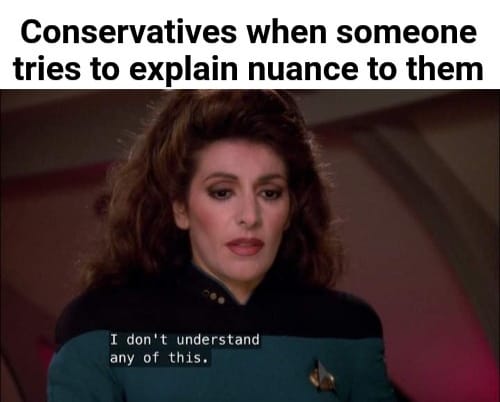
The meme is a screenshot from the TV show Star Trek: The Next Generation, featuring the character Deanna Troi (played by actress Marina Sirtis). The image shows Deanna's face with a concerned expression, and the text overlay reads: "I don't understand the nuances of this conversation." The meme is being used to poke fun at the stereotype that conservatives and libertarians are often unable to understand or explain complex ideas or nuances, and that they often rely on simplistic or "nuance-free" explanations.
detailed-analysis (gemma3-27b-vision)
Okay, let's break down this meme through the lenses you've provided. Keep in mind that applying these frameworks to a meme is often about interpreting the underlying assumptions and power dynamics the meme suggests, rather than analyzing the meme itself as a deeply complex text.
Visual Description
The image depicts Nana Visitor as Kira Nerys from Star Trek: Deep Space Nine. She is shown in close-up, wearing her Starfleet uniform, looking slightly perplexed or confused. A caption beneath her reads, "I don't understand any of this." Above the image is the text "Conservatives when someone tries to explain nuance to them." The lighting is dramatic, casting shadows and emphasizing her expression.
Critical Theory
The meme leverages a common trope within Critical Theory: the claim of "not understanding" as a tactic to dismiss complex ideas, particularly those challenging existing power structures. The text frames conservatives as resisting intellectual engagement with concepts that require acknowledging multiple perspectives or challenging established norms. This resonates with the Critical Theory idea of 'false consciousness' - the idea that dominant ideologies can blind individuals to their true interests and the realities of power imbalances.
The meme implicitly suggests conservatives may be positioned as those invested in maintaining the status quo, and thus unwilling to accept arguments that require critical self-reflection or a shift in perspective. The use of a character from a progressive science fiction series (Star Trek) adds a layer of irony, implying that even within a context typically open to complex ideas, there’s a resistance to nuance from this particular ideological group.
Marxist Conflict Theory
From a Marxist perspective, the meme can be seen as highlighting a conflict between different modes of thinking and their relation to class interests. The "nuance" being explained may involve arguments about social justice, economic inequality, or systemic oppression.
Conservatives, often associated with defending traditional hierarchies and maintaining existing power structures, are presented as being unwilling to engage with arguments that challenge those structures. The inability or refusal to understand nuance is therefore not merely an intellectual failing, but a deliberate tactic used to preserve class privilege and control.
Postmodernism
Postmodern thought often questions universal truths and emphasizes the subjective nature of meaning. The meme subtly touches on this through the framing of "nuance." The meme implies that conservatives prefer simple, binary explanations of the world, rejecting the complexities and ambiguities that characterize postmodern perspectives.
The suggestion that conservatives are incapable of understanding nuance suggests they hold onto 'metanarratives' - overarching stories or ideologies that provide a sense of order and meaning, and which resist alternative perspectives. It proposes a rejection of the Postmodern idea that all knowledge is situated and constructed.
Queer Feminist Intersectional Analysis
While not the most direct application, an intersectional reading can highlight who gets to define what constitutes "understanding." The meme implicitly sets up a norm of "understanding" that is potentially based on dominant (e.g., white, cisgender, heterosexual) perspectives.
The meme suggests that conservatives may be unwilling to grapple with experiences and viewpoints that challenge those norms, or with the complex intersection of identities and power dynamics that create systems of oppression. It can be interpreted as a claim that those in power often dismiss nuanced perspectives from marginalized groups as "difficult" or "ununderstandable," rather than acknowledging the systemic barriers that shape those experiences.
Foucauldian Genealogical Discourse Analysis
The meme’s claim about the inability to grasp nuance points to the ways power operates through discourse. Michel Foucault would be interested in how the claim of “not understanding” is used as a power tactic. This isn’t just about someone lacking knowledge, but about using the language of incomprehension to silence or invalidate certain ways of thinking.
The meme implicitly suggests conservatives are constructing a discourse of “common sense” or “practicality” that implicitly dismisses anything deemed “too complicated” or “theoretical.” The ability to claim “not understanding” becomes a way to legitimize existing power structures by framing alternative perspectives as unrealistic or impractical. Through a genealogical lens, one might trace the historical development of this "inability to understand" as a strategy used to maintain dominance.
Disclaimer: These are interpretations. Applying these theoretical frameworks to a meme is inherently subjective and requires a degree of extrapolation. The meme itself is relatively simple, and these analyses add layers of complexity to its potential meaning.
simple-description (llama3.2-vision)
The meme is a screenshot from the TV show Star Trek: The Next Generation, featuring a character (Deanna Troi) with a serious expression. Above the image is the text "Conservatives when someone tries to explain nuance to them" and below the image is the text "I don't understand anything you're saying. Please, for the love of God, speak slower and use smaller words." However, the actual text in the image is "I don't understand anything you're saying. Please, for the love of God, speak slower and use smaller words." is not present, instead the text "I don't understand anything you're saying. Please, for the love of God, speak slower and use smaller words." is replaced with "I don't understand any of this."
tesseract-ocr
Conservatives when someone tries to explain nuance to them © oa CM tee) Caan Ce