First Seen
2023-05-10T21:03:34+00:00
simple-description (llama3.2-vision_11b)
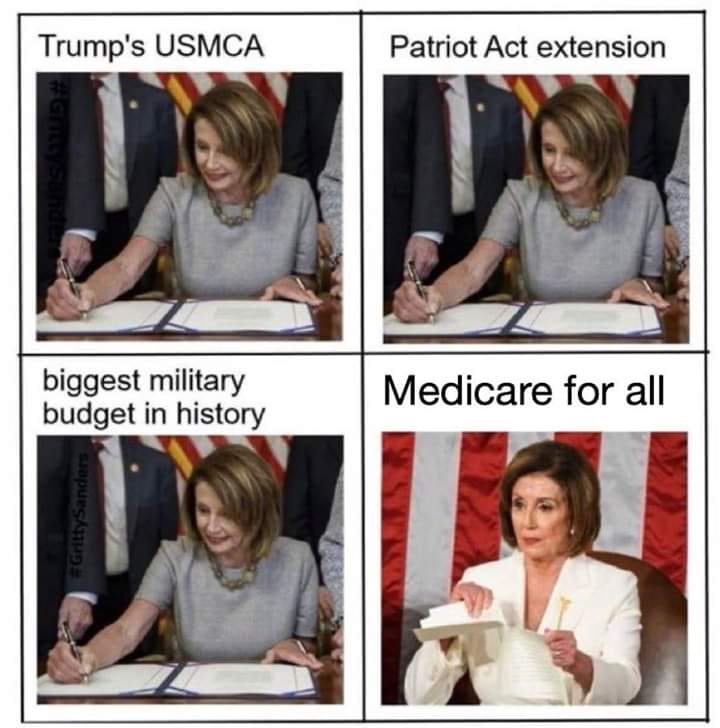
The meme is a humorous commentary on the politics of the US government, specifically the contrast between the Biden administration's proposed budget and the previous administration's policies. The meme juxtaposes a photo of Biden signing the budget with a photo of Nancy Pelosi signing the 2019 budget, with the text "Biden's budget is a disaster" and "Pelosi's budget is a disaster". The meme is meant to be ironic, highlighting the hypocrisy of the Biden administration's policies being similar to those of the previous administration.
detailed-analysis (gemma3-27b-vision)
Okay, let's break down this image, a four-panel meme featuring Nancy Pelosi signing legislation, using the requested theoretical frameworks. I will include sections only where the frameworks apply in a meaningful way.
Visual Description
The image is a four-panel grid meme. In each panel, we see Nancy Pelosi seated at a desk, signing a document. She’s wearing a different-colored suit in each frame: red, black, red, and white. The background in the upper two panels is a subdued office setting; the lower two panels show what appears to be the American flag draped vertically behind her. Each panel is labeled with a different policy or legislative item: "Trump’s USMCA," "Patriot Act extension," "biggest military budget in history," and "Medicare for all.” The visual style is straightforward: a series of similar actions (signing) juxtaposed with different outcomes. It appears to be designed as a political commentary, highlighting perceived hypocrisy or contradiction.
Foucauldian Genealogical Discourse Analysis
This meme offers rich ground for Foucauldian analysis. The repeated act of signing is a performance of power. Signing is not merely a mechanical act; it enacts law, creates reality. The discourse surrounding each piece of legislation is crucial. The meme doesn't argue about the content of those policies; it juxtaposes them.
- Power/Knowledge: The meme implicitly challenges the idea of neutral, objective legislation. Each signature is a manifestation of power through discourse. The "knowledge" about these policies (e.g., USMCA’s effects on labor, the Patriot Act’s impact on civil liberties, the cost of the military budget, and the benefits/drawbacks of universal healthcare) is not presented; rather, the meme suggests that the act of signing itself is what matters.
- Genealogy: This meme could be read as tracing the genealogy of political authority. Pelosi, as a figure of power, repeatedly performs the act of signing, seemingly regardless of the policy's actual content. This suggests that the form of legislation (the signature) may be more significant than the content. The meme implies a historical trajectory of power being exercised through these repetitive actions.
- Discipline & Control: The Patriot Act extension and the substantial military budget can be understood within a Foucauldian framework as instruments of discipline and control. The signature legitimizes these tools, reinforcing state power.
Critical Theory
This meme lends itself readily to a Critical Theory analysis, specifically focusing on ideology and domination.
- Ideology: The meme points to what Critical Theorists like Adorno and Horkheimer might call the “culture industry” – the way political narratives are constructed and presented to maintain the status quo. By presenting these policies side-by-side, the meme suggests a unifying thread – a consistent exercise of power that masks underlying contradictions.
- Domination & Oppression: The inclusion of the large military budget, the Patriot Act extension, and the pairing with "Medicare for all" directly engages with issues of power, dominance, and the distribution of resources. The meme seems to suggest that the government prioritizes militarism and surveillance over the welfare of its citizens.
- Critique of Instrumental Reason: The meme implicitly critiques the “instrumental reason” central to the Frankfurt School’s thought. The focus is not on the reasoning behind each policy, but the mechanics of power—the signing of the document—as an end in itself.
- Commodity Fetishism: Pelosi’s actions can be considered analogous to the ‘commodity fetishism’ in Marxist thought. Pelosi is a representative and the policies are presented as if they are neutral, but they have a history and are intertwined with power dynamics.
Marxist Conflict Theory
The meme very clearly reflects themes central to Marxist conflict theory.
- Class Struggle: While not explicitly about economic classes, the meme highlights a struggle over resources and priorities. The juxtaposition of the military budget with Medicare for All suggests a misallocation of resources, favoring the interests of the military-industrial complex over the needs of the working class.
- The State as an Instrument of Class Rule: The image portrays Pelosi, as a representative of the state, consistently enacting policies that benefit certain interests (e.g., corporations, the military) at the expense of others. This aligns with the Marxist view of the state as an instrument of class rule.
- False Consciousness: The meme might be seen as a critique of "false consciousness." By presenting these policies in a stark juxtaposition, it suggests that the public is being misled about the true priorities of the government.
- Capitalism & Imperialism: The military budget and trade deals (USMCA) can be seen as manifestations of capitalist imperialism, driven by the pursuit of profit and global domination.
Postmodernism
The meme engages with Postmodern themes, though perhaps less overtly than the previous frameworks.
- Deconstruction: The meme “deconstructs” the notion of coherent political action. By pairing seemingly contradictory policies, it undermines the idea that there is a consistent, rational basis for government decision-making.
- Simulacra & Simulation: The image can be seen as a “simulacrum” – a copy without an original. The act of signing itself becomes detached from the actual content of the policies, creating a self-referential system of power. The act becomes more important than the outcome.
- Relativism: By presenting these policies without commentary, the meme implies a degree of relativism. It suggests that there is no objective standard for evaluating these policies; it’s all a matter of perspective.
Queer Feminist Intersectional Analysis
This framework applies to a lesser extent but is still present.
- Intersectionality: The framing of the budget and policies highlights how different power dynamics intersect. The military budget doesn’t just affect the economy, it impacts communities of color, LGBTQ+ individuals, and women differently. The lack of universal healthcare disproportionately affects marginalized groups.
- Challenging Authority: The meme can be viewed as a subversion of traditional power structures, challenging the authority of Pelosi and the government. By exposing perceived contradictions, the meme empowers viewers to question the status quo.
- Care & Compassion: The inclusion of "Medicare for All" positions care and compassion as a political issue, countering the emphasis on militarism and surveillance. It challenges the patriarchal and capitalist values that prioritize profit and control over human needs.
I hope this detailed analysis, employing the requested theoretical frameworks, is helpful! Let me know if you'd like me to elaborate on any specific aspect or explore a different angle.
simple-description (llama3.2-vision)
This meme is a visual representation of Nancy Pelosi tearing up a copy of the US Military's budget (known as the "National Defense Budget" or "NDB") after signing it into law. The text "In God We Trust" is written on the document.
tesseract-ocr
Trump's USMCA Patriot Act extension a ee De PN ik: PS ke FA 4 (F448 PN i. PY Aa we biggest military Medicare for all budget in history vs ad i : = » = ae ae x gy pe ATT >.