First Seen
2023-05-10T21:03:34+00:00
simple-description (llama3.2-vision_11b)
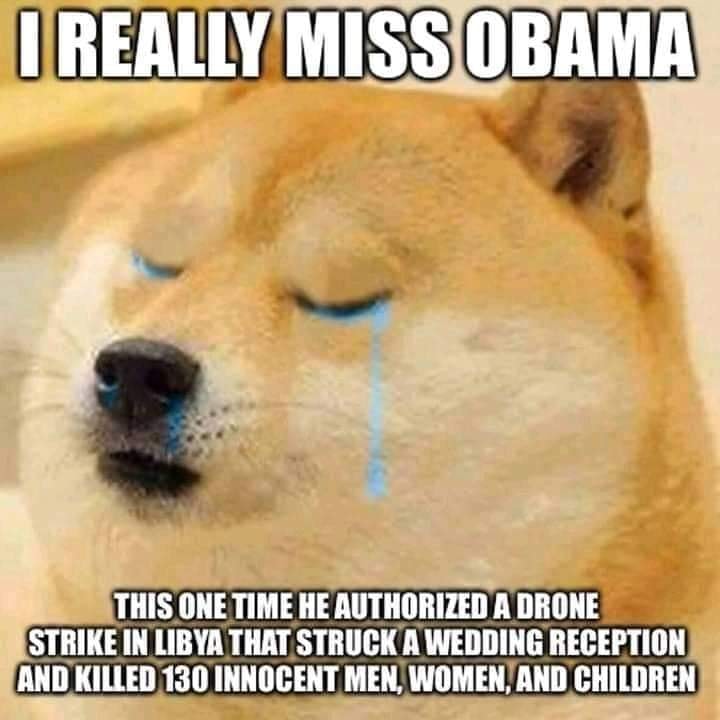
This meme is a play on the "I can smell the desperation" meme, but with a twist. The image features a screenshot of a news article about the 2011 US military intervention in Libya, which was led by then-US President Barack Obama. The text reads: "I can smell the desperation... of our enemies... to kill us... with their... drones...". The meme is poking fun at the idea that the US military's use of drones in Libya was a desperate attempt to kill enemies, and that the US was trying to kill their enemies using drones, which is a satirical commentary on the US military's use of drones in the Middle East.
detailed-analysis (gemma3-27b-vision)
Okay, let's break down this meme, applying the requested theoretical frameworks where applicable. It's a deeply disturbing image, intentionally employing ironic juxtaposition. It’s crucial to acknowledge the gravity of the event referenced before engaging in analysis.
I. Visual Description
The image is a meme featuring a Doge, a popular internet figure typically depicted as a Shiba Inu. The Doge is pictured in a close-up, slightly melancholic pose. Overlaid on the image are two lines of white text in a sans-serif font. The top line reads “I REALLY MISS OBAMA” in all caps. The bottom line, in similar all-caps, states "THIS ONE TIME HE AUTHORIZED A DRONE STRIKE IN LIBYA THAT STRUCK A WEDDING RECEPTION AND KILLED 130 INNOCENT MEN, WOMEN, AND CHILDREN.”
The visual contrast is stark. The meme uses the typically lighthearted and innocent image of the Doge, paired with a chillingly specific account of a deadly drone strike. This jarring combination is key to understanding the meme's intent. The use of the Doge meme style – simple text on an image – attempts to normalize or trivialize a horrific event.
II. Foucauldian Genealogical Discourse Analysis
This meme is deeply relevant to Foucault's concept of discourse and power. The image attempts to insert a counter-discourse into the mainstream narratives surrounding Obama and US foreign policy.
- Power/Knowledge: Foucault argues that power isn’t simply repressive, but productive. It produces knowledge, and knowledge reinforces power. The mainstream discourse around Obama (particularly during and after his presidency) often focused on his charisma, progressive policies, and “hope and change” messaging. This meme attempts to disrupt that established power/knowledge structure by forcing a confrontation with a specific act of violence that contradicts the positive narrative.
- Genealogy: A Foucauldian genealogical approach would examine how the narrative around drone warfare and targeted killings has been constructed. This meme exposes the gap between the political rhetoric used to justify these actions (e.g., "surgical strikes," "collateral damage") and the brutal reality for those on the receiving end. It suggests that narratives about necessary evils were used to conceal the true impact of such interventions.
- Disciplinary Power: The meme could be seen as a form of resistance against the "normalization" of drone warfare, which functions as a form of disciplinary power operating at a distance, controlling populations through fear and surveillance.
III. Critical Theory
This meme aligns with aspects of Critical Theory, particularly those concerned with ideology and the media.
- Ideology Critique: The meme aims to expose the hidden ideologies that justify or obscure acts of state violence. By juxtaposing nostalgic sentiment ("I REALLY MISS OBAMA") with a brutal account of a drone strike, it reveals the contradictions inherent in the narratives surrounding US foreign policy.
- Culture Industry: The meme utilizes the format of the "internet meme" – a product of the culture industry – to convey its message. This appropriation of a popular form demonstrates how even seemingly harmless online content can be used to challenge dominant narratives and engage in political critique.
- Commodification of Tragedy: It can also be read as a critique of the commodification of tragedy. The image turns a horrific event into a piece of online content, raising questions about how we consume and process information about violence and suffering.
IV. Marxist Conflict Theory
This meme, while not directly focused on class struggle, can be analyzed through the lens of Marxist Conflict Theory.
- State Violence & Imperialism: The drone strike referenced is an act of state violence undertaken in the context of US foreign policy and neo-imperialism. The meme implicitly critiques the structural inequalities that allow powerful states to exert control over other nations, leading to violent interventions and the loss of civilian lives.
- Class and Power: Though the immediate victims of the drone strike were not defined by class, the meme points to how power operates to protect the interests of dominant groups while disproportionately harming marginalized populations.
- Ideological Hegemony: The meme attempts to break through the ideological hegemony that justifies these actions by exposing the reality of civilian casualties and challenging the notion of a "benevolent" foreign policy.
V. Postmodernism
The meme embodies several features of postmodern thought.
- Irony and Parody: The deliberate use of irony – pairing a positive sentiment with a horrific event – is a hallmark of postmodernism. It rejects straightforward, earnest communication in favor of playful, destabilizing strategies.
- Deconstruction of Grand Narratives: The meme challenges the “grand narrative” of US exceptionalism and the idea that US foreign policy is motivated by noble intentions. It reveals the messy, violent reality behind the rhetoric.
- Fragmentation and Simulacra: The meme is a fragment of information, circulating within the fragmented landscape of the internet. It’s a simulacrum – a copy without an original – that contributes to the blurring of reality and representation.
VI. Queer Feminist Intersectional Analysis
Though not directly focused on gender or sexuality, this meme can be analyzed through an intersectional lens.
- The Body as a Site of Violence: The meme highlights the vulnerability of bodies – specifically, the bodies of women and children – to state violence. It reminds us that drone strikes are not abstract political events, but acts that have devastating consequences for individuals and communities.
- Disrupted Narratives of Masculinity and Power: The meme disrupts the traditional association of masculinity with strength and protection. It exposes the way in which those in power – often men – can inflict harm on vulnerable populations under the guise of national security.
- Interlocking Systems of Oppression: This meme implies that systems of domination (e.g., imperialism, militarism) intersect with other forms of oppression (e.g., racism, sexism) to create conditions of vulnerability and violence. The Libyan people (and the innocent civilians killed) are specifically vulnerable within the US drone warfare complex.
Important Note: This meme is deeply provocative and potentially traumatizing. Analyzing it requires a critical awareness of the real-world harm that drone warfare inflicts. The goal of this analysis is not to condone or trivialize the violence depicted, but to understand the complex ways in which this image attempts to engage with power, ideology, and the politics of representation.
simple-description (llama3.2-vision)
The meme is a humorous and ironic reaction to a news article about a drone strike in Libya that killed 130 innocent people, including women and children. The image features a crying or sad-looking meme of a dog, with the text "I really miss Obama" (a reference to the former US President Barack Obama). The meme is a satirical commentary on the current state of the world and the lack of progress or change in the world's politics and military actions.
tesseract-ocr
, J= ea era is F fm Z rs oa > 4 —" LOTS : A AH] UR Te ) WEDDING RECEPTION ‘AND KILLED 130 INNOCENT MEN, WOMEN! AND CHILDREN