First Seen
2023-05-10T21:03:34+00:00
simple-description (llama3.2-vision_11b)
The meme is a humorous take on the stereotype that leftists are often seen as being overly critical of neoliberal policies. The image shows a character from the Star Trek: The Next Generation series, Captain Jean-Luc Picard, looking at a group of people with a disapproving expression. The text overlay reads: "I find your lack of neoliberalism disturbing". This is a play on the famous line from the Star Wars franchise, "I find your lack of faith disturbing", which is often used to express disapproval or criticism. In this context, the meme is poking fun at the idea that leftists are often seen as being overly critical of neoliberal policies, and the use of the Star Trek reference is a clever way to add a touch of humor to the meme.
detailed-analysis (gemma3-27b-vision)
Okay, let's break down this meme through several theoretical lenses. It's important to note that applying these frameworks can be interpretive, and there's often overlap.
Visual Description
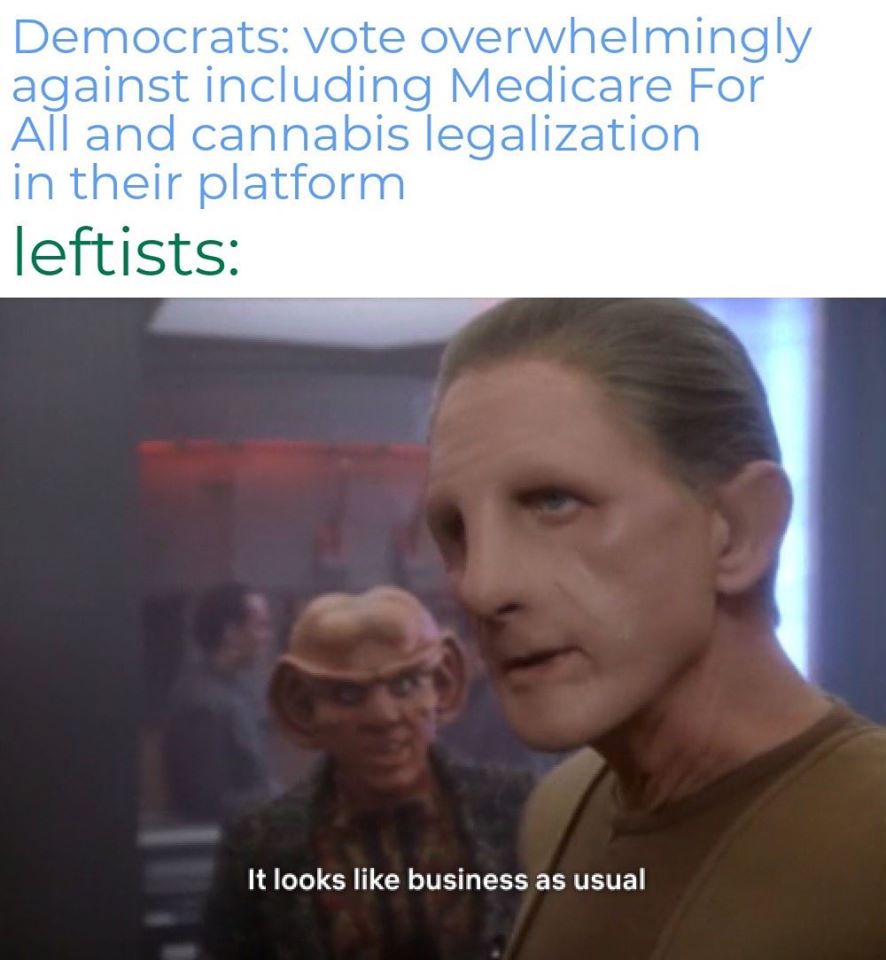
The meme features a still from a Star Trek: The Next Generation episode. Specifically, it depicts Captain Jean-Luc Picard, looking with a somewhat pained and resigned expression at a Ferengi character, Rom, who is in the background. The caption above reads "Democrats: vote overwhelmingly against including Medicare For All and cannabis legalization in their platform". Below the image, the text "It looks like business as usual" is presented as dialogue coming from Picard.
The visual emphasizes a sense of disillusionment. Picard, a symbol of principled leadership, appears to be accepting a disappointing outcome with a stoic weariness. The contrast with the Ferengi, a species driven by profit and opportunism, suggests a perceived parallel between the actions of the Democratic party and an unprincipled pursuit of self-interest. The dark, claustrophobic environment of the starship corridor adds to the feeling of constraint and inevitability.
Foucauldian Genealogical Discourse Analysis
This meme is a commentary on the discourse surrounding political action within the Democratic party. A Foucauldian analysis would focus on how the rejection of Medicare For All and cannabis legalization is not simply a pragmatic decision but is constructed through power relations.
- Power/Knowledge: The "business as usual" caption suggests a historically ingrained power dynamic where the party prioritizes maintaining a certain status quo (appealing to moderate voters, campaign contributions from insurance/pharmaceutical companies) over potentially progressive policies. Knowledge (understanding the political landscape) is deployed to justify these decisions, framed as “realistic” or “strategic.”
- Genealogy: A genealogical tracing would reveal how this emphasis on moderation and pragmatism developed over time. It might show how certain political figures or ideologies shaped the party’s approach, how compromises were made that cemented this pattern, and how it became "naturalized" as the way things are done.
- Disciplinary Power: The rejection of progressive policies can be seen as a form of disciplinary power where the party regulates its own membership and the discourse around acceptable policy positions. Those advocating for more radical changes are marginalized or silenced.
- Discourse as Constitutive: The meme argues that the Democratic party's actions construct a reality of limited possibilities. By repeatedly rejecting these policies, they create the perception that they are not viable, effectively shaping the boundaries of acceptable political debate.
Critical Theory
This meme uses irony and visual critique to dismantle the assumed progressive stance of the Democratic party.
- Ideology Critique: The meme functions as a form of ideology critique. It suggests that the Democrats present themselves as progressive but operate within a system that is fundamentally resistant to meaningful change. The "business as usual" comment implies that the party's rhetoric is a façade masking a commitment to the status quo.
- False Consciousness: The meme can be interpreted as a comment on the false consciousness of voters who consistently support the Democratic party despite its failures to address systemic issues. It suggests that voters are being misled or are unable to see the party's true agenda.
- Reification: The meme points to the reification of the political process—that is, the treatment of political systems and actions as though they were natural and inevitable, rather than constructed and subject to change.
Marxist Conflict Theory
From a Marxist perspective, the meme highlights the inherent contradictions within the Democratic party as a representative of the capitalist class.
- Class Struggle: The rejection of Medicare For All can be seen as a manifestation of class struggle. The insurance and pharmaceutical industries, which benefit from the current system, exert significant influence over the Democratic party. The party's actions, therefore, serve to protect the interests of the capitalist class at the expense of the working class.
- Ideological Hegemony: The Democratic party's ability to maintain support despite its conservative tendencies can be explained by its success in establishing ideological hegemony. It has managed to convince a significant portion of the population that its policies are in their best interests, even when they are not.
- The State as a Tool: The meme implies that the Democratic party—as a political force that operates within the state—functions as a tool for maintaining the existing capitalist order, even when it purports to advocate for progressive change.
- Exploitation: The current healthcare system, which the meme criticizes, is a key component of capitalist exploitation. By protecting the profits of healthcare companies, the party perpetuates a system where access to healthcare is determined by ability to pay.
Important Note: These are interpretations based on applying complex theoretical frameworks to a relatively simple meme. The strength of these readings will depend on individual perspectives and the specific context in which the meme is being used. Also, keep in mind that theoretical lenses are tools for analysis, not definitive answers.
simple-description (llama3.2-vision)
The meme is a humorous comparison between two groups of people, Democrats and leftists, who both support progressive policies. The image is a still from a Star Trek: The Next Generation episode, with the character Data saying "It looks like business as usual" - implying that even in a futuristic, high-tech society, the same old, same old, is still happening.
tesseract-ocr
Democrats: vote overwhelmingly against including Medicare For All and cannabis legalization in their platform leftists: It looks like business as usual