First Seen
2023-05-10T21:03:34+00:00
simple-description (llama3.2-vision_11b)
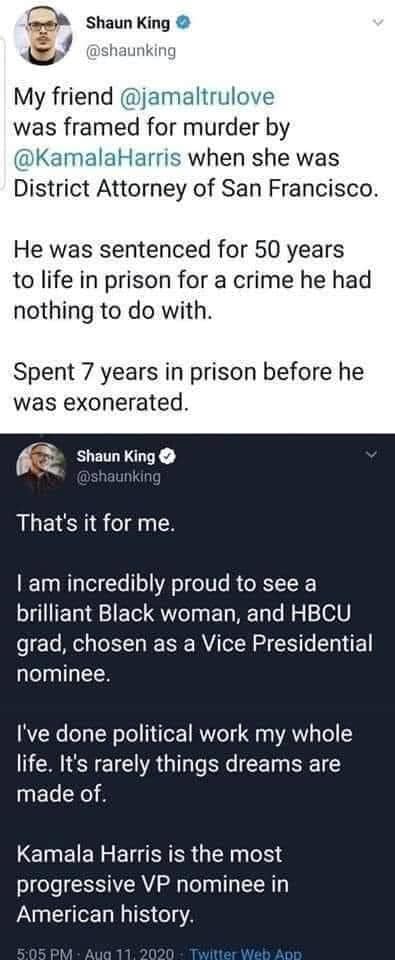
This meme is a commentary on the hypocrisy of some individuals who claim to be anti-neoliberal, yet still support or have supported neoliberal policies and politicians. The meme highlights the double standard of some people who claim to be anti-neoliberal, yet still support or have supported neoliberal policies and politicians. The text in the image reads: "I am incredibly proud to see a Black woman, and HBCU grad, chosen as a VP nominee. I've done political work my whole life. It's rarely things dreams are made of. Kamala Harris is the most progressive VP nominee in American history."
detailed-analysis (gemma3-27b-vision)
Okay, let's break down this Twitter post by Shaun King, applying the requested theoretical lenses. It's a complex post that lends itself to multiple readings.
1. Visual Description
The image is a screenshot of two Twitter posts from @ShaunKing. The first post details a claim that a friend, @jamaltrule, was wrongly convicted of murder while Kamala Harris was District Attorney in San Francisco. It states he was sentenced to 50 years, served 7 years, and then exonerated.
The second post praises Kamala Harris as a progressive Vice Presidential nominee, specifically highlighting her as a Black woman and HBCU graduate, and expresses a personal sense of fulfillment. The visual presentation is standard for Twitter, a simple text-based post. The prominence given to both the personal anecdote and the political endorsement is notable. The contrast between the two posts is key – injustice juxtaposed with celebration.
2. Foucauldian Genealogical Discourse Analysis
This post offers fertile ground for Foucauldian analysis.
- Power/Knowledge: The post implicates the power of the District Attorney’s office (and by extension, the criminal justice system) in the production of truth. The initial “conviction” was a truth produced by the system, a truth that imprisoned Jamal Trulove. The later “exoneration” is another production of truth, equally reliant on the power of the legal system. The post suggests a challenge to the idea of a neutral, objective justice system.
- Discourse & Subjectivation: The discourse surrounding criminal justice, racial bias, and the role of DAs shapes how individuals (like Jamal Trulove) are subjectivated – defined and categorized by the system. The initial conviction placed Trulove in the category of “criminal,” stripping him of agency. The exoneration is a repositioning within the discourse, but doesn't erase the initial classification.
- Genealogy of Punishment: A genealogical inquiry could trace the history of the criminal justice system, its shifts in ideology and practice, and how these changes shaped the experience of individuals like Jamal Trulove. How did the logic of "tough on crime" contribute to the possibility of wrongful conviction? The post hints at a systemic issue, not simply an individual error.
3. Critical Theory
From a Critical Theory perspective, this post highlights the ways in which societal structures perpetuate injustice and maintain power imbalances.
- Ideology: The celebratory language surrounding Kamala Harris’s nomination serves to reinforce the ideology of meritocracy and progress. It suggests that simply having a Black woman in a high-level political position resolves systemic issues. The post's implicit argument is that the celebration is premature, or at least needs to be tempered by a recognition of ongoing injustice.
- Domination and Resistance: The wrongful conviction of Jamal Trulove represents a form of systemic domination. His exoneration can be seen as a form of resistance, but it's a limited one. The post implicitly critiques the idea that representation alone constitutes liberation.
- Hegemony: The post questions the hegemonic narrative of progress in American politics. It suggests that while the country celebrates a milestone, it must also confront the dark realities of its justice system.
4. Marxist Conflict Theory
While not immediately obvious, a Marxist reading can identify class dynamics and the role of the state in maintaining them.
- State Apparatus & Repression: The District Attorney’s office (and the broader criminal justice system) functions as a state apparatus used to maintain social order and suppress dissent. The wrongful conviction of Jamal Trulove, especially if linked to racial bias, can be seen as a form of class-based repression.
- Exploitation & Control: The prison system itself is a site of exploitation, extracting labor and depriving individuals of freedom. The post hints at the disproportionate impact of this system on marginalized communities.
- Class Consciousness & Resistance: Jamal Trulove’s story, when brought to light, can contribute to raising class consciousness and challenging the legitimacy of the system.
5. Postmodernism
A postmodern reading focuses on the instability of truth, the constructed nature of reality, and the fragmentation of meaning.
- Deconstruction of Truth Claims: The post challenges the idea of objective truth in the legal system. The fact that Jamal Trulove was both “guilty” (according to the initial conviction) and “innocent” (according to the exoneration) highlights the contingency of truth claims.
- Narrative & Representation: The post is itself a narrative, a construction of meaning. It invites us to question the dominant narratives surrounding criminal justice and political representation.
- Subjectivity & Identity: The post emphasizes the role of identity (race, gender) in shaping experiences of justice and political opportunity. It suggests that these identities are not fixed, but fluid and constructed.
6. Queer Feminist Intersectional Analysis
This is a complex lens to apply directly, as the post doesn't explicitly address queer or feminist issues. However, we can consider intersectionality:
- Intersection of Oppressions: The post implicates the intersection of racial and class oppression in Jamal Trulove’s wrongful conviction. The criminal justice system often disproportionately impacts Black communities, and this can be compounded by socioeconomic factors.
- Power Dynamics & Marginalization: The post challenges the power dynamics within the legal system and highlights the ways in which marginalized individuals are vulnerable to injustice.
- Challenging Narratives of Progress: The post resists the idea that simply having a Black woman in a high-level political position automatically resolves systemic issues of inequality. It insists on a more nuanced understanding of power and oppression.
In conclusion: This single Twitter post, despite its brevity, is rich with meaning and can be analyzed from multiple theoretical perspectives. It highlights the complexities of justice, representation, and power in the United States, and invites us to critically examine the narratives we tell about progress and equality.
simple-description (llama3.2-vision)
The meme is a tweet from comedian and actor, Shaun King, reacting to a news article about a former San Francisco district attorney who was sentenced to 50 years to life in prison for a crime he had nothing to do with, and was later exonerated after 7 years in prison. The tweet reads: "He was sentenced for 50 years to life in prison for a crime he had nothing to do with. Spent 7 years in prison before he was exonerated. That's it for me."
tesseract-ocr
{ Shaun King ¢ ‘ j @shaunking My friend @jamaltrulove was framed for murder by @KamalaHarris when she was District Attorney of San Francisco. He was sentenced for 50 years to life in prison for a crime he had nothing to do with. Spent 7 years in prison before he was exonerated. r 3 ry Kira @ That's it for me. lam incredibly proud to see a brilliant Black woman, and HBCU. grad, chosen as a Vice Presidential ela I've done political work my whole Th bem allale omer Tue] made of. Kamala Harris is the most progressive VP nominee in American history. Se A ee ERE ge rma VOR aU