First Seen
2023-05-10T21:03:34+00:00
simple-description (llama3.2-vision_11b)
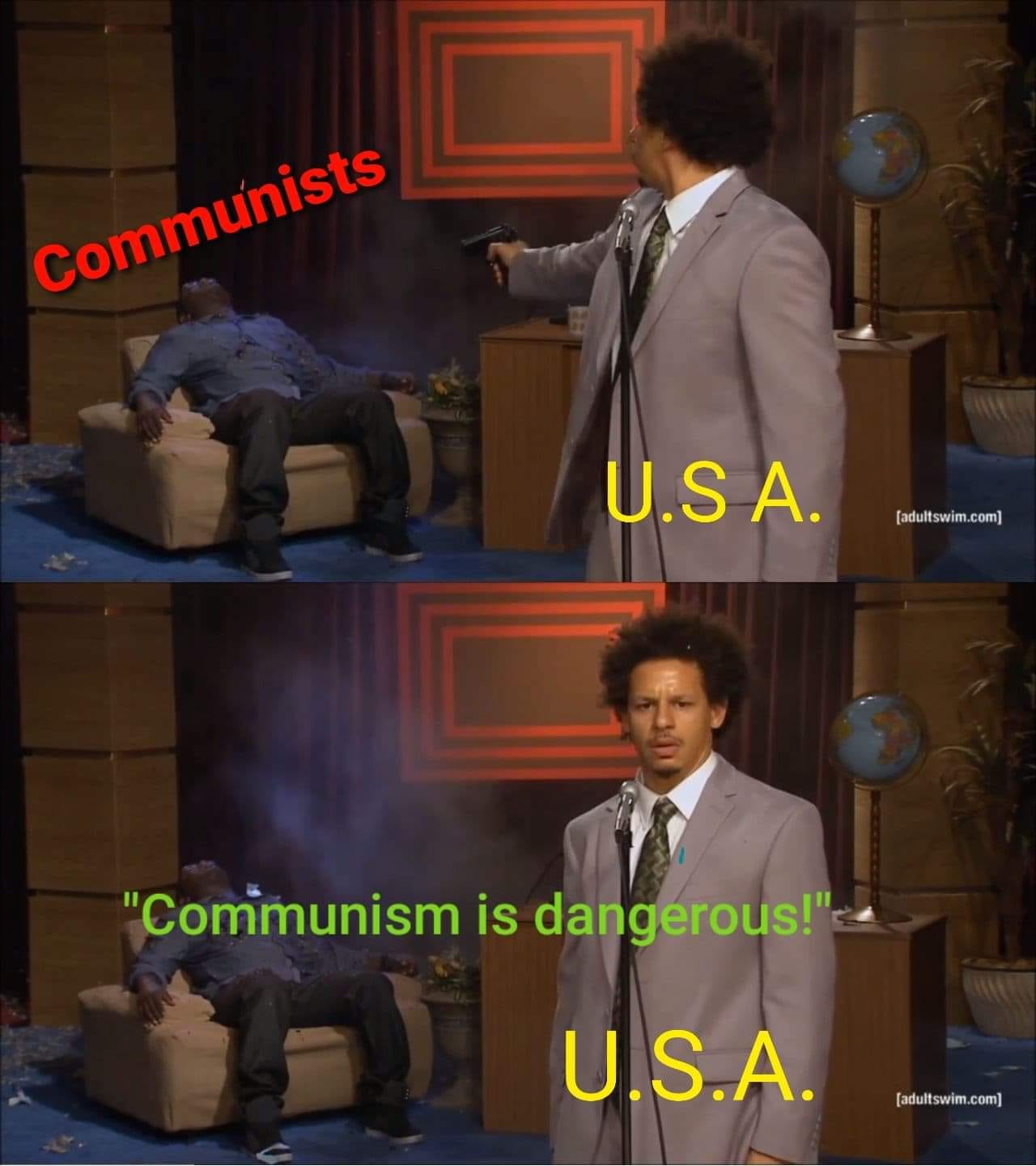
This meme is a commentary on the perceived hypocrisy of the United States' stance on communism, using a humorous and satirical tone. The image features a person who is shot by a gun, with the caption "Communism is dangerous!" being replaced with "Capitalism is great!" and then replaced again with "Communism is dangerous!". This is meant to poke fun at the US's history of criticizing communism while being a capitalist nation itself.
detailed-analysis (gemma3-27b-vision)
Okay, let's break down this meme through the lenses of various theoretical frameworks. It's a complex image, and the following analysis will be lengthy to address the requested frameworks.
Please note: Meme analysis is inherently interpretative. These frameworks offer tools for unpacking meaning, but multiple readings are possible.
1. Visual Description
The image is a digitally manipulated, dual-panel meme. It features Dave Chappelle standing at a podium in what appears to be a stage or performance space with red lighting.
- Panel 1 (Top): Chappelle stands at the podium. In the background, partially obscured, is a chaotic scene depicting what appears to be rubble, a collapsed building, and people in distress, possibly representing the aftermath of a disaster or war. Text overlaid on this panel reads "Communists" and "U.S.A.".
- Panel 2 (Bottom): A close-up of Chappelle at the podium, this time, text is overlaid that says "Communism is dangerous!" and “U.S.A.”
- Visual Cues: The dramatic red lighting, the chaotic background, and Chappelle's earnest (though potentially ironic) expression all contribute to the meme's intended message. The juxtaposition of a public figure (Chappelle) with the visual chaos and a clear political statement sets up a specific, often satirical, argument. The “adultswim.com” watermark suggests an origin within the subversive and often ironic online culture of that network.
2. Foucauldian Genealogical Discourse Analysis
This meme can be read as a demonstration of how "truth" regarding Communism is constructed through discourse.
- Power/Knowledge: Foucault argues that power and knowledge are inextricably linked. This meme attempts to associate Communism (as a concept) with chaos and danger (knowledge), thereby reinforcing the power of the "U.S.A." (representing a specific political ideology/state) to define what is considered "dangerous."
- Genealogy: A genealogical analysis would trace the historical conditions that allowed this association to emerge. The meme plays on the decades-long Cold War rhetoric associating Communism with totalitarianism, destruction, and a threat to American values. This is not necessarily an objective truth, but a historical construction of meaning.
- Discourse & Subjectification: The meme doesn't argue logically; it evokes feelings through visual association. It seeks to subject the viewer into accepting the premise that Communism equals danger. This shapes the understanding of the viewer, encouraging a specific interpretation. The positioning of “U.S.A.” emphasizes the idea that the U.S.A. is the “safe” option and an alternative to what the image portrays as the dangerous, chaotic, and threatening ideology of Communism.
- Normalization: The meme functions through repetition and association, thereby normalizing the idea that Communism is dangerous.
3. Critical Theory (Frankfurt School)
The meme, viewed through the lens of Critical Theory, can be interpreted as a reflection of the "culture industry" and the manipulation of ideological messaging.
- Mass Culture & Ideology: The meme is a product of mass culture (online memes) and functions as a vehicle for ideological messaging. It simplifies a complex historical and political subject (Communism) into a easily digestible, emotionally charged visual statement.
- False Consciousness: The meme can be seen as contributing to “false consciousness,” where people internalize dominant ideologies (in this case, anti-communism) without critically examining them. It doesn’t present nuanced arguments; it relies on emotional appeals and visual shorthand.
- Commodification of Resistance: While appearing to be a form of commentary, the meme itself can be seen as commodified – readily shareable, easily consumed, and ultimately, potentially disarming of genuine critical engagement.
- Instrumental Rationality: The meme utilizes instrumental rationality - presenting a direct, albeit oversimplified, link between an idea (Communism) and a perceived negative outcome (chaos/disaster) to justify a particular viewpoint.
4. Marxist Conflict Theory
From a Marxist perspective, the meme exemplifies the ideological struggle between different classes and systems.
- Class Struggle: The meme can be interpreted as a reflection of the ongoing ideological struggle between capitalist and communist (or socialist) systems. It portrays Communism as a chaotic and destructive force, thereby justifying the existing capitalist order (represented by "U.S.A.").
- Hegemony: The meme contributes to the maintenance of capitalist hegemony—the dominance of capitalist ideology in society—by reinforcing the idea that Communism is inherently dangerous and undesirable.
- False Consciousness (again): From a Marxist angle, the meme serves to create a "false consciousness" among the working class, preventing them from recognizing the potential contradictions and exploitations within capitalism.
- Ideological State Apparatus (Althusser): The meme functions as an “ideological state apparatus,” a structure that propagates and reinforces the dominant ideology without relying on overt force or coercion.
5. Postmodernism
From a postmodern perspective, the meme can be analyzed in terms of its play with signs, its lack of fixed meaning, and its commentary on the spectacle of ideology.
- Simulacra & Simulation: The meme doesn't necessarily represent a real connection between Communism and chaos; it's a simulation of that connection. It creates a hyperreality where the sign (Communism) becomes detached from any underlying reality.
- Deconstruction: The meme can be "deconstructed" to reveal the underlying assumptions and power dynamics that inform its message. What exactly is meant by "Communism" in this context? What is being excluded by this simplistic framing?
- Irony & Parody: The meme often relies on irony and parody. The juxtaposition of Chappelle, a comedian known for challenging conventional wisdom, with a straightforward anti-communist message creates a layer of ambiguity. Is it a sincere statement, or is it a critique of anti-communist rhetoric?
- Fragmentation & Loss of Grand Narratives: The meme reflects the postmodern condition of fragmentation and the loss of grand narratives. It doesn't offer a coherent political philosophy; it's a fragmented, ironic commentary on a complex historical phenomenon.
6. Queer Feminist Intersectional Analysis
This is the hardest application, but possible.
- Exclusionary Ideologies: Historically, anti-communist rhetoric has often been intertwined with patriarchal and heteronormative ideologies. This meme, by reinforcing anti-communist sentiment, could be seen as implicitly reinforcing those exclusionary power structures.
- Intersectionality: This meme erases any consideration of intersectionality – the ways in which different forms of oppression (class, race, gender, sexuality) intersect and shape individual experiences. Communism, while flawed in practice, has at times been associated with movements for social justice and liberation for marginalized groups. This meme ignores that complexity.
- Silencing of Alternative Visions: By demonizing Communism, the meme can be seen as silencing alternative visions of social and economic organization that could potentially challenge patriarchal and capitalist power structures.
- Reinforcing Dominant Narratives: The meme perpetuates a dominant narrative that privileges capitalist values and suppresses alternative perspectives, contributing to the marginalization of queer, feminist, and anti-colonial movements.
In conclusion:
This meme, while seemingly simple, is laden with political, historical, and ideological implications. Different theoretical frameworks offer unique insights into its meaning and function. It's important to remember that meme analysis is inherently subjective, and there is no single "correct" interpretation. The power of the meme lies in its ability to evoke strong emotions, provoke debate, and reflect the complexities of our cultural and political landscape.
simple-description (llama3.2-vision)
This meme is a humorous commentary on the relationship between the United States and communism. It features a character from the TV show "The Office" (played by David K. H. B. , who is a fictional character) being shot by a gun with a sign that reads "Communists" on it. The text that appears in the image reads "Communists: 'Communism is dangerous!'" and is then replaced with "U.S.A.: 'Communists: 'Communism is dangerous!'".
tesseract-ocr
7 | E 7 c ae Lat st f — _: a b . ww : il | [adultswim.com] Ee — » - ‘ F i a | ; " — 5 5 ie . ‘Communism is dag¢ s —% , as if . i / — a ) Pa s oad , y mA So Sea coil — - A =f i; _#