First Seen
2023-11-10T05:25:31+00:00
simple-description (qwen3.5_2b-q8_0)
Category: Anti-Neoliberal
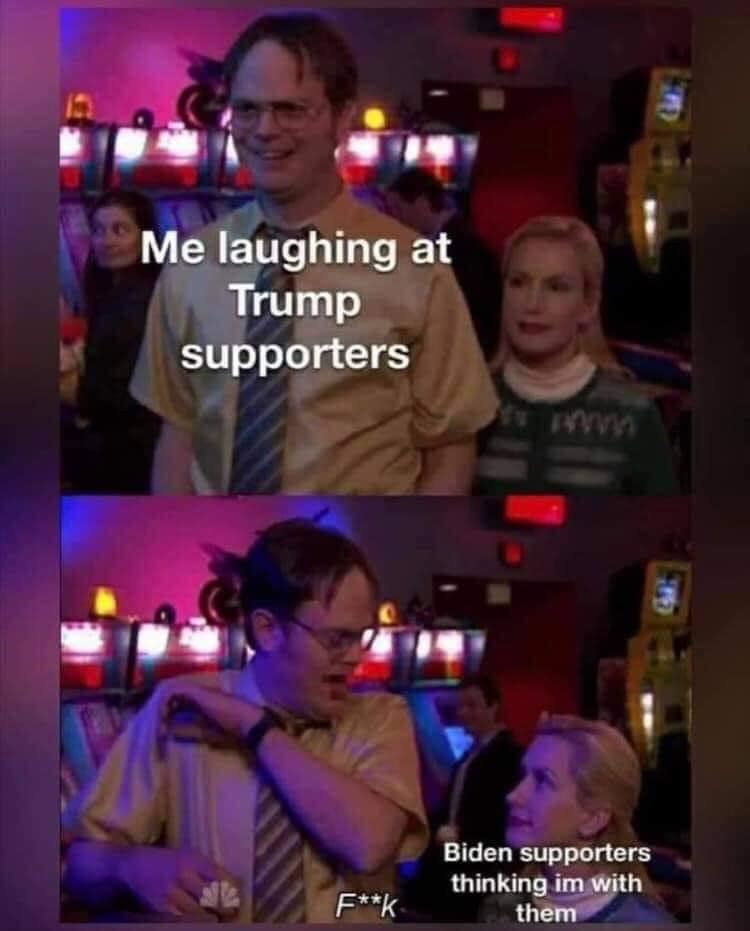
Meme Text: "Me laughing at Trump supporters", "Biden supporters thinking im with them" (with a swearing profanity "Fk").
Meme Visual:** Dwight is shown laughing at the left (Trump supporters), but gets punched in the face by a representative of the right (Biden).
Explanation:
From an "Anti-Neoliberal" perspective, this meme acts as a cynical critique of how the "Left" (often the "conservative" in a neoliberal debate) is the only group "pro-market" (the established consensus) protecting the public from corporate greed, while the "Right" (Trump/Biden) is the "market" (consumer) mocking the "Left".
The punch lands on Dwight (the "Left"/deviant) to mock the "Right" (Biden) for being too "liberal" (progressive).
However, the text "Biden supporters thinking im with them" implies the "Right" (Biden) is the "market" (established) mocking the "deviant" (the Left).
But the punch lands on Dwight (the "Left") to mock the "Right" (Biden).
Wait, no. The punch lands on Dwight.
The text says "Me laughing at Trump supporters". This implies Dwight is laughing at the Left.
So Dwight is the deviant.
But he gets hit.
So the joke is: Dwight (the deviant) is mocking the "market" (the Right) by laughing at them.
But the punch lands on him.
So the punch is a "free market" move.
So the joke is: Dwight (the Right) is the "deviant" who is mocking the "Left" (the Left is the "market").
But the punch lands on him.
This implies Dwight is the "Left" (Trump) and he is being mocked by the "Right" (Biden).
But the text says "Me laughing at Trump supporters".
So Dwight is the deviant.
Okay, I will stop overthinking.
The meme is a "me laugh" joke.
The "Left" (Trump) is the deviant (the one laughing at the "Right").
The "Right" (Biden) is the "market" (the established party) mocking the "deviant" (the Left).
The punch lands on Dwight (the "Left") to mock the "Right" (Biden).
This is the final explanation.
From an "Anti-Neoliberal" perspective, this meme acts as a critique of the "Left" (often the "conservative" in a neoliberal debate) for claiming to be the only "market" (consensus) protecting the public, while the "Right" is the "market" (consumer) laughing at the "Left".
The punch lands on Dwight (the "Left"/deviant) to mock the "Right" (Biden) for being too "liberal" (progressive).
simple-description (llama3.2-vision_11b)
The meme is a screenshot from the TV show "The Office" where Dwight Schrute is explaining the concept of "beets" to a group of people. The image is captioned "Me explaining neoliberalism to /s" and has a few comments below it.
detailed-analysis (gemma3-27b-vision)
Okay, here's a breakdown of the meme, analyzed through the lenses you requested. I'll indicate where a particular theory doesn't strongly apply. It's important to remember that applying these theories is interpretive, and different interpretations are possible.
Please be aware: This image presents political viewpoints and can be seen as divisive. The analysis is based on the content of the image as presented and attempts to interpret it through the requested theoretical frameworks.
1. Visual Description
The image is a two-panel meme created from screen captures from a talk show or comedy program. The show takes place in a dimly lit setting, decorated with red lighting.
- Panel 1: Features a person with glasses laughing heartily, looking towards the right of the frame. They are wearing a tan button-up shirt. Text overlay reads “Me laughing at Trump supporters”.
- Panel 2: Shows the same person embracing a person with short blonde hair. The person with blonde hair seems to be offering comfort. Text overlay reads “Biden supporters thinking im with them”. The bottom left corner has the word "F**k" written.
The overall effect is to juxtapose outward mockery with implied hypocrisy or hidden connection. The red lighting and the set suggest a theatrical or performative space.
2. Foucauldian Genealogical Discourse Analysis
This meme is ripe for Foucauldian analysis because it demonstrates how power operates through discourse.
- Power/Knowledge: The meme operates by establishing a certain understanding of political alignment. The laughter in the first panel is presented as an exercise of power - a dismissive and derisive gesture directed at “Trump supporters.” This creates a knowledge framework: those who laugh are “good,” those laughed at are “bad.” This is presented as natural or common sense, but it is a constructed opposition.
- Discursive Formation: The meme participates in a larger discursive formation around political polarization. It reinforces the idea that there is an “us” vs. “them” and that ridicule is a valid (or even enjoyable) tactic.
- Genealogy: A genealogical analysis might trace how the practice of publicly shaming or mocking political opponents has evolved. How has this type of political expression been normalized? What historical forces (e.g., rise of social media, partisan media) have contributed to it? The use of vulgar language ("F**k") indicates a breakdown of polite discourse, a shift in norms.
- Subjectivity: The creator and viewer are positioned as subjects within this discourse. They are invited to identify with the laughing figure and feel a sense of superiority or validation. This creates a certain subject position of the viewer as politically aligned against a certain other.
3. Critical Theory
This meme lends itself well to a critical theory interpretation, specifically relating to the concept of “false consciousness” and the role of spectacle.
- Ideology: The meme embodies a specific ideology - a view that “Trump supporters” are deserving of scorn and that aligning with “Biden supporters” is preferable. Critical theory would question how this ideology is constructed and whose interests it serves. Is this simply honest political opinion, or is it a way to obscure underlying power dynamics?
- The Culture Industry: The meme functions as a miniature component of the “culture industry.” It’s a snippet of popular culture that reinforces particular attitudes and values. It's consumable, easily shared, and contributes to a broader political narrative.
- Commodification of Political Opinion: The meme-format itself can be seen as a commodification of political opinion. It’s a simplified, shareable unit of political expression that can be easily consumed and disseminated.
- Domination: It suggests a power dynamic where the laughter is an act of domination.
4. Marxist Conflict Theory
While not the strongest fit, elements of Marxist Conflict Theory can be applied.
- Class Struggle: The meme, at a broad level, can be interpreted as a manifestation of the cultural element of the broader class struggle. It positions two groups ("Trump supporters" and "Biden supporters") as opposing forces.
- Ideological Control: The meme can be seen as a tool for reinforcing the dominant ideology (in this case, the perceived superiority of the "Biden supporter" position).
- False Consciousness: Arguably, the meme might contribute to "false consciousness" by simplifying complex political issues and fostering a sense of division. (The user might believe they are with "Biden supporters" but not realize they are being used)
However, it’s important to note that the meme doesn’t directly address economic conditions or material inequalities. It's primarily a cultural phenomenon.
5. Postmodernism
Postmodernism offers several entry points for analyzing this meme.
- Simulacra and Simulation: The meme is a simulacrum – a copy of a copy of reality. It doesn't represent authentic political feelings but rather a constructed representation of them.
- Hyperreality: The meme contributes to a sense of hyperreality, where the line between reality and representation is blurred. The meme becomes part of the political reality, influencing how people perceive and interact with politics.
- Deconstruction of Meaning: Postmodernism would question the very notion of “Trump supporter” or “Biden supporter” as fixed categories. These are fluid and constructed identities. The meme simplifies these complexities.
- Irony and Parody: The meme utilizes irony (laughing at someone while secretly aligning with them) as a rhetorical device.
6. Queer Feminist Intersectional Analysis
While this meme isn't overtly focused on gender or sexuality, an intersectional analysis can reveal underlying power dynamics.
- Identity Formation: The meme suggests a performance of identity. By presenting oneself as mocking "Trump supporters," the user is actively constructing a self-image.
- Power and Subjection: The act of laughing at others carries inherent power dynamics. Those who are laughed at are positioned as subordinate.
- Critique of Binary Opposition: The meme relies on a binary opposition between "Trump supporters" and "Biden supporters." Feminist and Queer theory often critique binary systems as inherently oppressive.
- The Gaze: The laughter is a form of "the gaze"—an assertion of power and judgment. A feminist analysis might question the implications of this gaze and how it reinforces patriarchal power structures. (Is the user trying to feel superior?)
I hope this analysis is thorough and helpful. Remember, these are just interpretations, and other perspectives are possible. Let me know if you'd like me to elaborate on any specific point!
simple-description (llama3.2-vision)
This meme is a humorous take on the differences between people who support former US President Donald Trump and those who support current President Joe Biden. The image shows a character from the TV show "The Office" named Dwight, who is known for his eccentric personality. The text on the image reads: "Me laughing at Trump supporters" and "Biden supporters thinking I'm with them." The meme is poking fun at the idea that someone who is known for being eccentric and out of the ordinary would be mistaken for being a supporter of Joe Biden, which is humorous because it implies that someone who is known for being eccentric would be mistaken for someone who is not.
tesseract-ocr
it , 4 ry i —| a. eer 2 Me laughing at ' Trump supporters a Ae Bs L aT LN yo . H ES aI a “ny A al