First Seen
2023-05-10T21:03:34+00:00
simple-description (llama3.2-vision_11b)
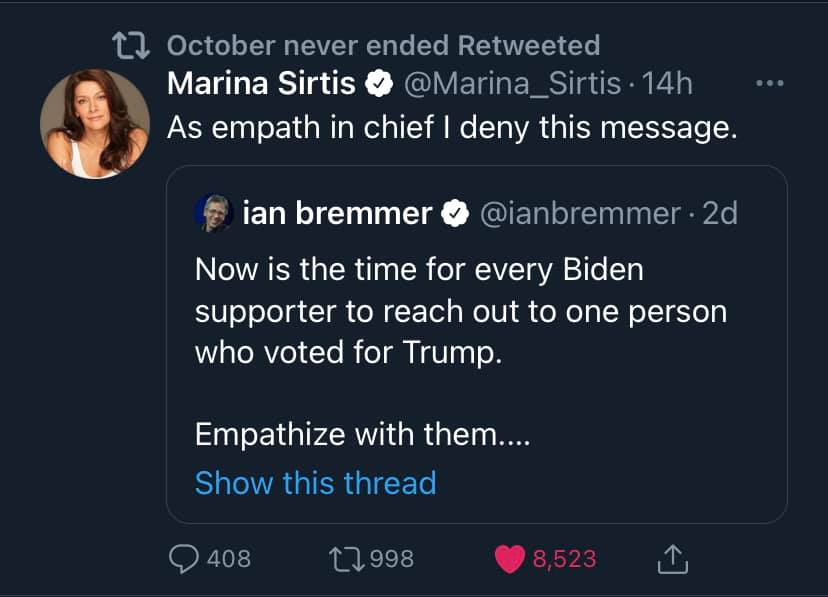
The meme is a screenshot of a Twitter conversation between a user named "Marina Sirtis" (a British actress) and a user named "Ian Bremmer" (a political scientist and journalist). The conversation appears to be a response to a tweet by Ian Bremmer, where he is commenting on the current political situation in the US, specifically the Biden administration. The tweet is a sarcastic comment about the Biden administration's handling of the situation, with Marina Sirtis responding with a sarcastic comment of her own, implying that the administration is not doing anything to address the situation.
detailed-analysis (gemma3-27b-vision)
Here's an analysis of the provided Twitter post, broken down into sections as requested. Please note that some sections will be minimal or absent if the content doesn't strongly lend itself to that particular theoretical framework.
Visual Description
The image is a screenshot of a Twitter post. It shows a retweet by Marina Sirits (@Marina_Sirits). Above the retweet is a circular profile picture of a woman with dark, curly hair, looking forward. Below is the retweeted text from Ian Bremmer (@ianbremmer) which states, "Now is the time for every Biden supporter to reach out to one person who voted for Trump. Empathize with them...". Below this retweeted text are icons for number of views (408), retweets (998), likes (8,523), and replies (Upload icon).
Foucauldian Genealogical Discourse Analysis
This post offers an interesting point for Foucauldian analysis because it reveals how a discourse of unity and empathy is being constructed. The call to "reach out" and "empathize" doesn't appear neutrally; it’s presented as a directive, a call to action. A genealogical approach would ask:
- What historical power structures underpin the expectation to 'empathize'? Historically, demands for empathy can be ways of exerting power—of normalizing certain emotional responses and dismissing others. Specifically, in a politically polarized environment, a call to empathize with those who voted differently can function as a way to subtly define appropriate political behavior – namely, one that prioritizes reconciliation over critique.
- What “truths” are being produced and enforced through this discourse? The post implies a 'truth' that understanding is essential for healing political divides. However, it doesn’t specify how empathy should be practiced, leaving room for potentially manipulative or superficial expressions.
- How does this discourse operate to create subjects? The call to reach out constructs "Biden supporters" as benevolent actors and "Trump voters" as those who need empathy. It places subjects into specific, pre-defined roles within this narrative.
- The relationship to power: It’s noteworthy that the call for empathy comes after an election. The implication is that empathy should be expressed toward those who exercised their political agency in a way the author disagrees with.
Critical Theory
A critical theory lens immediately points to the post as part of a larger system of power dynamics.
- Hegemony: The post participates in a subtle effort to establish hegemony – the dominance of a particular ideology or worldview. The expectation that Biden supporters should reach out to Trump voters, framed as empathetic, subtly reinforces the idea that "understanding" those who hold opposing views is a virtue, potentially obscuring the harmful consequences of those views.
- False Consciousness: One could argue that the demand for empathy risks obscuring the fundamental interests at stake in political polarization. It could function as a form of "false consciousness" - a way of preventing a deeper understanding of the systemic factors that led to the political divide.
- Communication and Manipulation: The post is an instance of communication used to persuade and shape behavior. The appeal to empathy can be viewed as a rhetorical tactic used to encourage specific actions (reaching out, understanding) and potentially defuse conflict in a way that maintains existing power structures.
Marxist Conflict Theory
While this post doesn’t directly address material conditions, a Marxist lens could still be applied by focusing on the underlying class tensions that contribute to political polarization.
- Ideological Struggle: The call for empathy can be viewed as part of an ideological struggle between different groups. By emphasizing the need to “understand” Trump voters, the post attempts to shift the narrative away from the material factors that might have driven their vote (economic hardship, class anxieties, etc.).
- False Unity: The call for reaching out attempts to bridge the gap between opposing groups by appealing to a shared sense of humanity. However, this effort to create unity could be seen as obscuring the fundamental conflict of interests that exist between different classes.
- Class Consciousness: This message implicitly asks those who support policies more beneficial to the working class to extend empathy to those who voted for policies that historically benefit the wealthy.
Postmodernism
A postmodern reading would focus on the instability of meaning and the constructed nature of reality.
- Deconstruction of Empathy: A postmodern approach would question the very concept of empathy. Is empathy a universal, objective feeling, or is it a culturally and historically contingent construct? What power dynamics are at play when someone claims to “empathize” with another?
- Hyperreality and Simulation: The post itself exists within the hyperreal space of social media. It’s a simulation of genuine connection, potentially divorced from real-world interactions.
- The Fragmentation of Meaning: In a postmodern world, there's a breakdown of grand narratives. The call for unity appears as an attempt to impose a sense of coherence on a fragmented reality, but this effort is ultimately unstable and contested.
Queer Feminist Intersectional Analysis
This post is less overtly relevant to a queer feminist analysis, but one could draw connections.
- Emotional Labor: The call for empathy places an emotional burden on Biden supporters, particularly those who may already be marginalized or vulnerable. Asking someone to empathize with those who hold views that may be harmful to their identity or community can be a form of exploitation.
- Privilege and Burden: The post implicitly asks people who hold more progressive and inclusive views to empathize with those who may hold prejudiced or discriminatory beliefs. This places an unfair burden on those who already face systemic discrimination.
- Intersectional Identities: This post is devoid of any consideration of how identities (race, class, gender, sexuality, disability) shape political views and experiences. A queer feminist analysis would call for a deeper understanding of the complex and intersecting factors that contribute to political polarization.
It’s important to remember that these analyses are not mutually exclusive. They can be combined and layered to provide a more nuanced understanding of the text.
simple-description (llama3.2-vision)
This meme is a screenshot of a Twitter conversation between two users. The original user, @marinarosso, tweeted "I'm not going to be able to get a job because I'm a woman" and the response from @marinrosso is "I'm not going to be able to get a job because I'm a woman". The meme is a humorous take on the idea that women are often expected to be able to do everything, from being a good mother to a good employee. The text on the image reads "I'm not going to be able to get a job because I'm a woman" and "I'm not going to be able to get a job because I'm a woman" is a response to the original tweet.
tesseract-ocr
TV October never ended Retweeted . Marina Sirtis @ @Marina_Sirtis -14h oo g As empath in chief | deny this message. © ian bremmer @ @ianbremmer : 2d Now is the time for every Biden supporter to reach out to one person who voted for Trump. Empathize with them.... Show this thread © 408 T1998 Leave) en