First Seen
2023-05-10T21:03:34+00:00
simple-description (llama3.2-vision_11b)
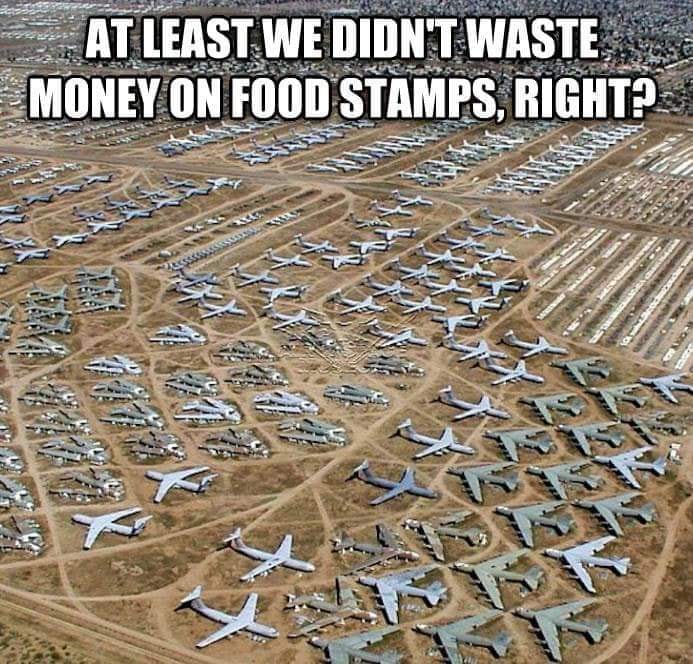
This meme uses an image of a massive aircraft graveyard, with the caption "At least we didn't waste money on food stamps, right?" to sarcastically comment on the US government's priorities, implying that the country's focus on military spending is more important than providing for the poor. The image is meant to be ironic, highlighting the absurdity of prioritizing military spending over social welfare.
detailed-analysis (gemma3-27b-vision)
Okay, let's break down this image and the accompanying text through various theoretical lenses. This is a complex image, and the analysis will reflect that.
Visual Description
The image is an aerial shot of what appears to be the “boneyard” at Davis-Monthan Air Force Base in Arizona. Hundreds, if not thousands, of retired military aircraft are meticulously arranged across a vast desert landscape. The planes are mostly gray and metallic, with many having their wings and other components removed, creating a stark, geometric pattern. The scale is immense, and the landscape is arid and dusty. The image is strikingly orderly yet simultaneously evokes a sense of obsolescence, abandonment, and even a kind of metallic graveyard. The sky is a pale, washed-out blue.
Foucauldian Genealogical Discourse Analysis
The text "At least we didn't waste money on food stamps, right?" frames the image, and is key to this analysis.
- Discourse of Scarcity & Austerity: The statement hinges on a specific discourse – the idea that government spending must be minimized, and that social welfare programs are inherently wasteful. This discourse constructs "food stamps" (SNAP benefits) as a site of budgetary excess, positioning them in opposition to military spending (represented by the aircraft). This implies that military spending is justified and not subject to the same scrutiny.
- Power/Knowledge: Foucault argued that power and knowledge are inextricably linked. The statement doesn’t present facts, but establishes a regime of truth where military expenditure is seemingly unquestionable while social programs are suspect. The image reinforces this – the sheer number of planes suggests strength, security, and a need for expenditure.
- Genealogy of Welfare vs. Defense: Tracing the genealogy of this statement reveals a long history of framing welfare as ‘handouts’ and contrasting it with the ‘necessity’ of national defense. This narrative has evolved over time, often deployed during times of economic anxiety or political polarization. This framing isn’t natural, but constructed through rhetoric and policy.
- Disciplinary Power: The image and the text work together to exert a subtle form of disciplinary power. It encourages a certain way of thinking about value, spending, and who “deserves” resources. It’s a normalizing judgment, subtly policing the boundaries of acceptable discourse.
Marxist Conflict Theory
- Class Conflict & Resource Allocation: The image and text are deeply rooted in class conflict. The massive expenditure on military hardware (planes) represents capital invested in maintaining a system that benefits certain classes (military-industrial complex, arms manufacturers, those who profit from war) at the expense of social programs designed to support the working class and the poor.
- Means of Production & Surplus Value: The planes represent the means of production in a system geared towards warfare and dominance. The argument against food stamps suggests that resources are limited, and that supporting the poor is seen as a drain on this limited surplus value, while military spending is considered a productive investment.
- Ideology & False Consciousness: The statement itself is ideological. It presents a distorted view of reality, obscuring the massive cost of military spending and framing social welfare as the real waste. This contributes to false consciousness, preventing the working class from recognizing their own exploitation and the true allocation of resources.
- Imperialism & Militarism: The sheer scale of the aircraft graveyard speaks to the United States’ long history of global military presence and intervention. It’s a physical manifestation of the costs of imperialism and a system built on maintaining power and control through force.
Postmodernism
- Simulation & Hyperreality: The boneyard could be seen as a simulation of power. It presents an image of strength and technological superiority, even though these planes are no longer actively in service. This blurs the lines between reality and representation, creating a hyperreality where the image of military might is more important than its actual function.
- Deconstruction of Grand Narratives: The image challenges the grand narrative of military exceptionalism. While it presents a visually imposing scene, it also reveals the inevitable obsolescence of even the most advanced technology. The planes are discarded, suggesting a cycle of production, consumption, and waste. This can be seen as a critique of the idea that military power is inherently beneficial or sustainable.
- Relativism & Subjectivity: The statement "At least we didn't waste money on food stamps, right?" is inherently subjective. What constitutes “waste” is a matter of perspective and value judgment. Postmodernism emphasizes that there is no objective truth, only interpretations. This challenges the statement’s claim to be a self-evident truth.
Queer Feminist Intersectional Analysis
(This is the most challenging lens to apply directly, but potential connections exist)
- War & Gendered Violence: War inherently intersects with gender. Military structures are often deeply patriarchal, and conflict disproportionately impacts women and gender non-conforming individuals. The vast investment in military hardware comes at the expense of funding for social services that address issues like domestic violence, reproductive healthcare, and gender-based inequality.
- Resource Allocation & Reproductive Justice: The same logic that frames food stamps as “wasteful” is often used to justify cuts to reproductive healthcare. Both are framed as unnecessary “costs” compared to perceived “national priorities.” This reinforces a system that controls bodies and limits access to resources.
- Intersectionality of Poverty & Marginalization: Those who rely on food stamps are often already marginalized – people of color, disabled individuals, single parents, LGBTQ+ individuals. This analysis highlights how military spending contributes to systemic inequalities by diverting resources from programs that support these communities.
- The "Family" of Nation: The rhetoric of national security often relies on a metaphor of the "nation" as a family, with the military acting as the protector. This can reinforce traditional gender roles and expectations, while marginalizing those who don't fit this idealized image. The investment in "defense" is often presented as a way to "protect the family," implicitly excluding those who are deemed outside of that circle.
In Conclusion:
This image and its accompanying text are incredibly complex and can be interpreted through multiple theoretical lenses. The analysis reveals a powerful critique of militarism, resource allocation, and the ideological forces that shape our perceptions of value and waste. The image invites us to question the priorities of our society and the ways in which power operates to maintain the status quo.
Let me know if you'd like me to elaborate on any of these points or explore other theoretical frameworks!
simple-description (llama3.2-vision)
This meme is a humorous commentary on the US military's waste of resources. The image shows a vast, sprawling graveyard of abandoned military aircraft, with the text "At least we didn't waste money on food stamps, right?" above it, implying that the US military's wastefulness is somehow more acceptable than the government's spending on social welfare programs.
tesseract-ocr
=r A Nestea See oer SS Ite haat Pins UCT LAL WIE OSG UDELL TST Le SE gC ap ry LEB, Bee Se Ne Ee AS eo ey ie mA ath ATs ae SA EN a a SE Sh ae ON oe Se,