First Seen
2023-05-10T21:03:34+00:00
simple-description (llama3.2-vision_11b)
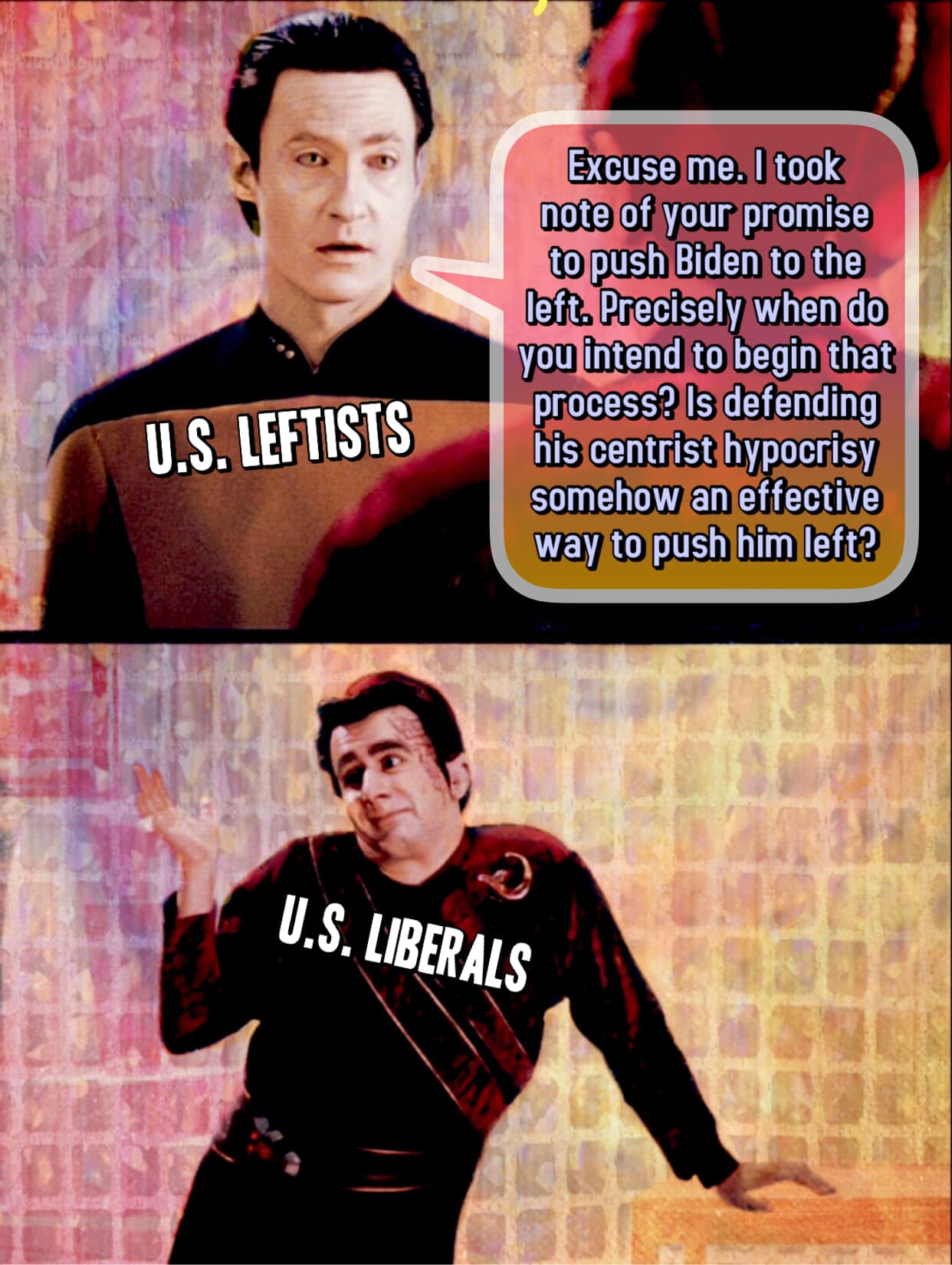
This meme is from the perspective of the Anti-Neoliberal category, which is a group of people who oppose neoliberal policies and ideologies. The meme is a humorous take on the conversation between two characters, with the "U.S. Leftists" character asking if they should start pushing Biden to the left, and the "U.S. Liberals" character responding with a sarcastic and ironic answer. The meme is poking fun at the idea that U.S. Leftists are trying to push Biden to the left, and the U.S. Liberals are responding with a humorous and sarcastic answer, implying that they are not taking the left's demands seriously.
detailed-analysis (gemma3-27b-vision)
Okay, let's break down this meme through a few theoretical lenses. Given the content, certain lenses are more applicable than others.
Visual Description
The meme is a two-panel image utilizing the "Drake Yes/No" format. Both panels feature actor Jonathan Frakes (Commander William Riker from Star Trek: The Next Generation). In the top panel, Riker appears composed and inquisitive, with text overlaid reading "U.S. LEFTISTS" and a speech bubble asking "Excuse me. I took note of your promise to push Biden to the left. Precisely when do you intend to begin that process? Is defending his centrist hypocrisy somehow an effective way to push him left?". In the bottom panel, Riker is making a grimace/facepalm gesture, with the text "U.S. LIBERALS." The background is a reddish-purple. The meme is clearly making a comparison between leftists and liberals, framing the former as critical and expecting action, and the latter as passively accepting or excusing perceived compromises.
Foucauldian Genealogical Discourse Analysis
This meme can be analyzed through a Foucaultian lens by examining the discourse surrounding "leftism" and "liberalism" as constructed categories. The meme performs a power/knowledge dynamic. It asserts a hierarchy between “leftists” and “liberals,” defining the former as principled and demanding, and the latter as complicit in maintaining the status quo. The meme doesn't present objective truths, but rather constructs a specific narrative about these groups.
The “promise to push Biden to the left” represents a discursive formation—a set of rules, practices, and expectations regarding political action. By framing the defense of Biden’s "centrist hypocrisy" as ineffective, the meme participates in the discursive policing of what constitutes legitimate political strategy. It creates a boundary around what counts as "true" leftism. The meme doesn’t address the historical genealogy of these labels, but rather performs a particular present-day understanding of them. It implicitly suggests that defending Biden is a failure to live up to the ‘promise’ of true leftist engagement.
Critical Theory
From a Critical Theory perspective, the meme can be seen as a commentary on the co-optation of progressive ideals and the limitations of electoral politics. The meme implies a critique of the tendency for political movements to be absorbed into the mainstream, compromising their radical potential. "Centrist hypocrisy" is presented as a symptom of a larger system that rewards compromise over genuine change.
The meme functions as a mini-critique of the "system" (understood as the combination of political institutions, dominant ideologies, and power dynamics) by highlighting the perceived failures of those who work within that system. It asks where and how the action to bring about real, transformative change will take place.
Marxist Conflict Theory
Through a Marxist lens, the meme exposes the internal contradictions within the broader “left” political bloc. While seemingly focused on the relationship between two political positions, the meme is subtly about power dynamics within the left. The “conflict” isn’t necessarily between left and right, but between factions on the left disagreeing over strategy.
The “promise to push Biden to the left” can be read as a demand to advance the interests of the working class. The critique of "defending centrist hypocrisy" implies that compromise with the ruling class (represented by Biden's "centrism") hinders the advancement of these interests. It speaks to the internal class dynamics of a leftist movement and the debate over how to effectively challenge capitalist hegemony.
Postmodernism
A postmodern reading would emphasize the constructed nature of the categories "leftist" and "liberal." These are not fixed, essential identities, but rather fluid and contested labels. The meme implicitly challenges the idea of a unified "left" by highlighting the internal divisions and debates. It acknowledges that meaning is not inherent in these labels, but rather is created through discourse and social interaction. The meme plays on the irony of political labeling and the disconnect between stated ideals and actual practice.
Important Note: These are just a few potential interpretations, and the meme could be read in other ways depending on the viewer's perspective and theoretical background. I've tried to provide a detailed analysis within the frameworks you requested, but these theories are complex and can overlap.
simple-description (llama3.2-vision)
The meme is a humorous exchange between two characters, one labeled "U.S. Leftists" and the other labeled "U.S. Liberals". The "U.S. Leftists" character says "Excuse me, I took note of your promise to push Biden to the left. Precisely when do you intend to begin that process? Is defending his centrist hypocrisy somehow an effective way to push him left?" The "U.S. Liberals" character responds with a dismissive and sarcastic tone, implying that the leftists' expectations are unrealistic and that the left's frustration with Biden's centrist policies is a "defining characteristic" of their "leftist" identity.
tesseract-ocr
C——Urh le =n a ROMS UNes Nl < | “Py. OOOOH OUP eeluts = PSE EMTOUS Enea 2 Fou esr to beainthat b | ess USTLEFTISTS ious gpa) Ea somehow)anleffective G } es )/ ee ary Ny