First Seen
2023-05-10T21:03:34+00:00
simple-description (llama3.2-vision_11b)
This meme is a satirical take on the anti-neoliberal movement, specifically targeting the perceived hypocrisy of politicians who speak out against social injustices while maintaining a neoliberal agenda. The meme is a screenshot of a tweet from Nancy Pelosi, where she's praising George Floyd's death as a "tragic” event, but then immediately mentioning the importance of the economy and the need for the “American people” to “get back to work” after the crisis. The meme is meant to highlight the disconnect between Pelosi's words and actions, showcasing the hypocrisy of her statements.
detailed-analysis (gemma3-27b-vision)
Okay, here's an analysis of the Twitter exchange, broken down into sections based on the requested theoretical frameworks. Note that some frameworks are more relevant than others, and some won’t apply at all. I'll also assess the level of applicability for each section.
Visual Description (Applicability: Low - Primarily a record of digital text)
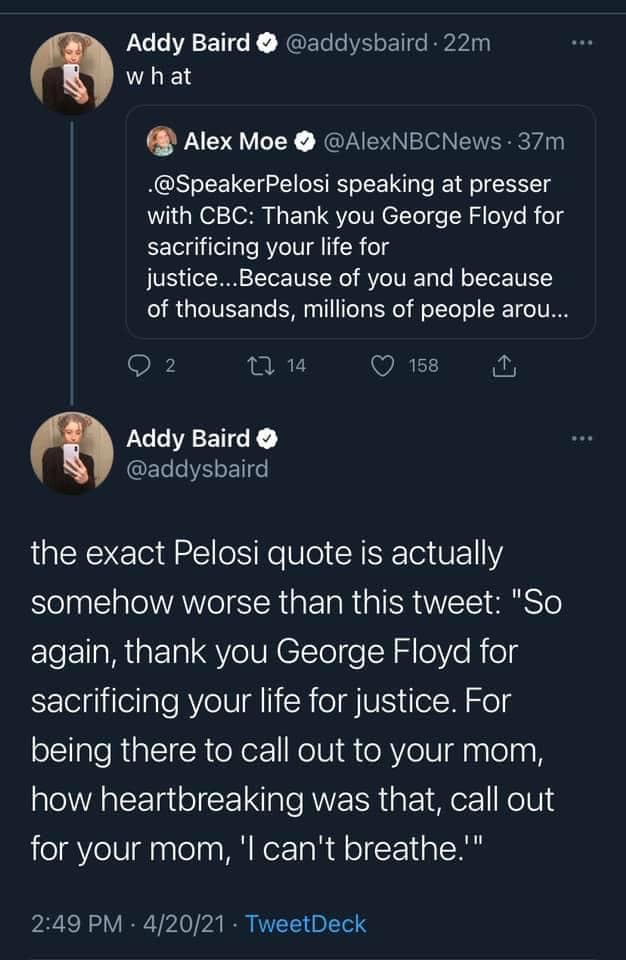
The image shows a screen capture of a Twitter exchange. There are two tweets from different accounts visible. The first is a tweet from @AlexNBCNews quoting Speaker Pelosi. It thanks George Floyd for sacrificing his life for justice, and alludes to his calling out to his mother. The second tweet is from @addybaird, responding to the first, and offering the exact Pelosi quote, claiming it is more impactful than the initial tweet. Timestamp information is visible at the bottom. The presentation is primarily text-based, and the visual elements are minimal, serving only to contextually present the tweets.
Foucauldian Genealogical Discourse Analysis (Applicability: Moderate - Examines power dynamics through language)
This exchange demonstrates how discourse shapes our understanding of tragedy and political action.
- Power/Knowledge: The initial tweet by @AlexNBCNews and the subsequent Pelosi quote construct George Floyd’s death not just as a tragedy, but as a sacrificial act in service of “justice.” This is a crucial framing. While acknowledging the loss, it implicitly positions Floyd's death within a narrative of progress and righteousness. Foucault would be interested in how this discourse, repeated and circulated, normalizes the idea of individual sacrifice in the pursuit of political goals. It shifts the focus from systemic issues to individual agency within a flawed system.
- Genealogy of "Justice": The concept of "justice" itself is not neutral. A genealogical approach would question the historical construction of what "justice" means. Who defines it? What power relations underpin its application? Does this narrative of sacrifice reinforce existing power structures or challenge them? The discourse around "justice" often obscures the inequalities that led to Floyd's death.
- Disciplinary Power: The language of sacrifice can be seen as a form of disciplinary power, framing death as a necessary component of social change. This subtly encourages a specific way of grieving and understanding the event, potentially discouraging demands for more radical systemic changes.
Critical Theory (Applicability: High - Deconstructs dominant narratives and power structures)
This exchange provides fertile ground for a critical theory analysis, particularly focused on the construction of meaning and power dynamics.
- Ideology & Hegemony: The framing of George Floyd’s death as a “sacrifice” arguably serves a particular ideological function. It can potentially obscure the structural racism and police brutality that led to his death, shifting the emphasis onto individual heroism rather than systemic flaws. Gramsci’s concept of hegemony is relevant here—how dominant ideologies become normalized and accepted as “common sense.” This tweet, and the quote it presents, contributes to that normalization.
- Representation & Symbolic Violence: The way George Floyd is represented—as a ‘sacrifice’—can be seen as a form of symbolic violence. It reduces a complex human life to a symbol used to advance a political agenda. While intending to honor his memory, the language can also erase the full humanity of the individual.
- Deconstruction: A deconstructive reading would question the binary opposition inherent in the term "sacrifice." What is being sacrificed to? What are the underlying assumptions about value and worth? It would argue that the notion of sacrifice itself is unstable and relies on a network of assumptions that need to be critically examined.
Marxist Conflict Theory (Applicability: Moderate - Focuses on class struggle, power, and economic inequality)
While not immediately obvious, a Marxist lens can be applied.
- Power Dynamics: This exchange reveals how power is exercised through language. Pelosi's (and by extension, @AlexNBCNews’s) framing of Floyd's death as a sacrifice reinforces the power structures that enable systemic injustice. The framing is coming from someone in a position of power, and serves to control the narrative.
- False Consciousness: The "sacrifice" framing could be seen as contributing to a false consciousness, diverting attention from the economic and social conditions that contribute to racial inequality and police brutality. By focusing on individual "heroism," it obscures the need for systemic change to address the root causes of the problem.
- Ideological State Apparatus: The media (represented by @AlexNBCNews) functions as an ideological state apparatus, disseminating narratives that reinforce the dominant ideology. The framing of Floyd’s death aligns with a certain political agenda, and serves to legitimize the existing power structure.
Postmodernism (Applicability: Moderate - Highlights the constructed nature of reality and knowledge)
- The Death of the Author/Meaning: A postmodern reading could argue that the “meaning” of George Floyd’s death is not fixed or inherent. It’s constructed through discourse, interpretation, and representation. The response by @addybaird emphasizes this, highlighting the difference between a summarized tweet and the original, more impactful statement.
- Simulacra & Simulation: The representation of Floyd as a ‘sacrifice’ could be seen as a simulacrum – a copy without an original. It's a symbolic representation that has become detached from the lived reality of his death.
- Fragmentation & Relativism: Postmodernism rejects the notion of a single, objective truth. Different interpretations of Floyd’s death exist, and the exchange reveals how these interpretations are constructed and circulated through social media.
Queer Feminist Intersectional Analysis (Applicability: Low - While intersectionality is relevant, it’s not central to this specific exchange)
While not the primary focus, an intersectional lens would acknowledge that race, gender, and sexuality intersect to create unique forms of oppression and vulnerability. The loss of Black life is compounded by historical and ongoing patterns of racism and discrimination. The fact that George Floyd called out for his mother adds a layer of emotional complexity, highlighting the importance of family and community. However, this exchange doesn't explicitly address issues of gender or sexuality, so an intersectional analysis would be limited in its scope.
Important Note: These analyses are interpretations, and other readings are possible. The framework you choose will influence how you understand the exchange. It's also crucial to consider the context and potential biases of the participants.
simple-description (llama3.2-vision)
This meme is a humorous comparison between a tweet from Speaker Nancy Pelosi and a tweet from a news anchor, Alex Mone, that uses a quote from George Floyd's final words in a sarcastic and ironic way. The quote is "I can't breathe" and is used in a tweet that is meant to be a humorous and satirical commentary on the news industry's tendency to use quotes from famous people in a way that is not always accurate or respectful.
tesseract-ocr
Addy Baird @ @addysbaird - 22m oo Vaal s @ Alex Moe @ @AlexNBCNews- 37m .@SpeakerPelosi speaking at presser with CBC: Thank you George Floyd for sacrificing your life for justice...Because of you and because of thousands, millions of people arou... @ 2 sand Lop t=t-} Au Addy Baird @ see @addysbaird the exact Pelosi quote is actually somehow worse than this tweet: "So again, thank you George Floyd for sacrificing your life for justice. For being there to call out to your mom, how heartbreaking was that, call out for your mom, 'l can't breathe." 2:49 PM - 4/20/21 - TweetDeck