First Seen
2023-05-10T21:03:34+00:00
simple-description (llama3.2-vision_11b)
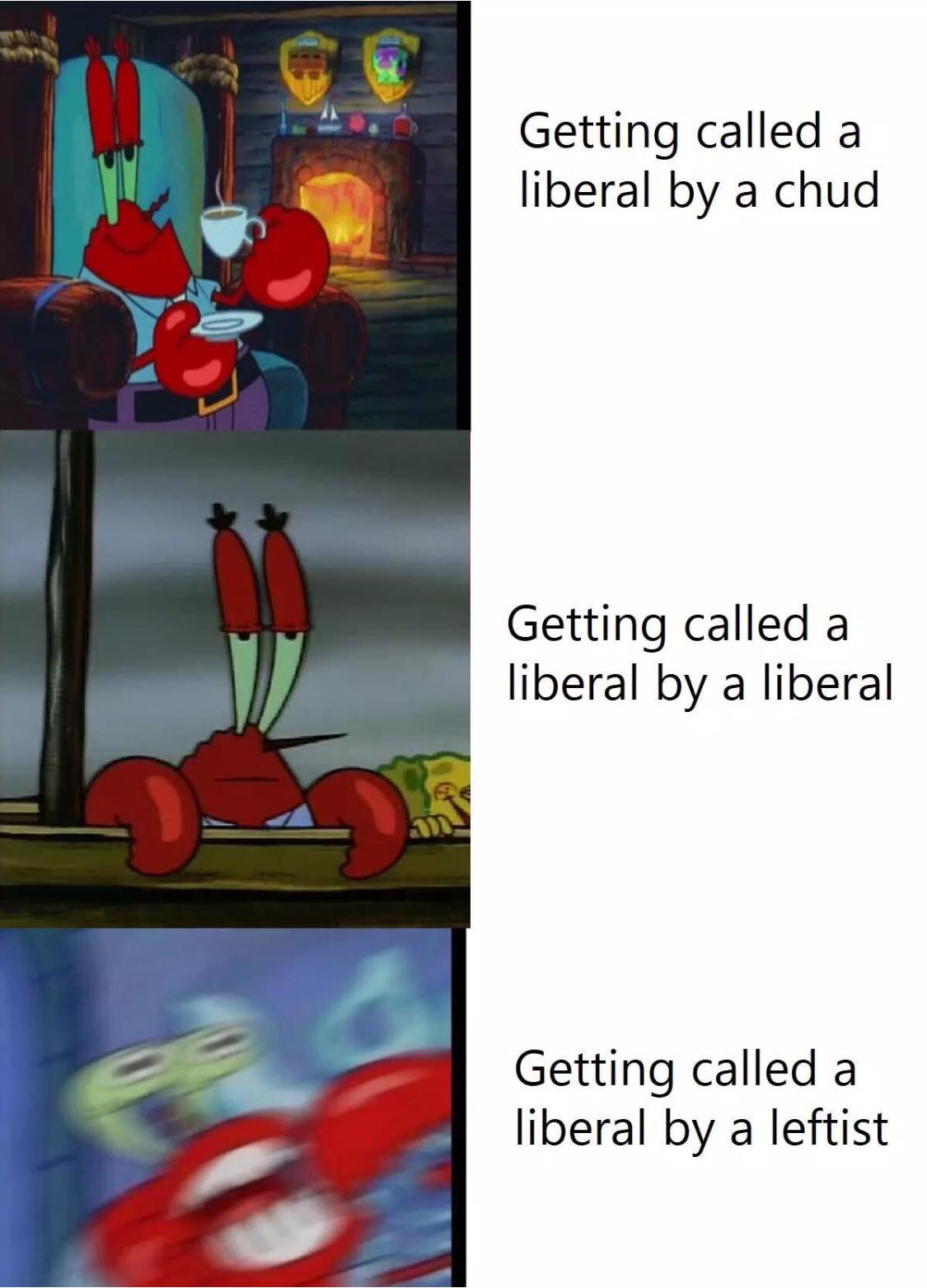
This meme is from the perspective of the "Anti-Neoliberal" category, which is a subcategory of the "Anti-Left" category. The meme is a humorous take on the stereotype that leftists are often associated with neoliberalism, and the image is a play on the idea that leftists are not as "liberal" as they claim to be. The meme is captioned "Getting called a liberal by a [insert type of left-wing activist]" and lists several types of left-wing activists, including "chud", "liberal", and "leftist", implying that these groups are not as liberal as they claim to be.
detailed-analysis (gemma3-27b-vision)
Okay, let's break down this meme through the lenses you've provided. It's a layered image reflecting internet political discourse, specifically within online leftist circles, focusing on the constant labeling and one-upping regarding ideological purity.
Visual Description
The meme consists of three panels, each featuring a character from SpongeBob SquarePants alongside a text label:
- Top Panel: Patrick Star, in a surprisingly elaborate, domestic interior, is holding a teacup. The text reads "Getting called a liberal by a chud".
- Middle Panel: Mr. Krabs is presented in a fairly straightforward, traditional illustration style. Text says, “Getting called a liberal by a liberal.”
- Bottom Panel: SpongeBob is presented obscured in blue lighting, appearing frantic. The text says “Getting called a liberal by a leftist.”
The visual contrast is intentional, with each panel escalating in distress/obscurity, suggesting a growing sense of frustration and being “othered” by those to the left. The lighting change to darker and more abstract on the bottom panel further emphasizes the growing sense of otherness.
Foucauldian Genealogical Discourse Analysis
This meme can be strongly analyzed through a Foucauldian lens. The core function of the labels ("chud," "liberal," "leftist") isn't to accurately describe political positions but to exercise power through discourse. The act of labeling creates categories and, therefore, defines who is "inside" and "outside" the acceptable group.
- Genealogy of the term "Liberal": The very meaning of "liberal" has undergone radical shifts. Historically, it denoted a commitment to individual liberty and progress, but online, it is often used as a pejorative within leftist circles, implying insufficient radicalism, complicity with capitalism, or even active opposition to true social justice. The meme highlights how this term is weaponized.
- Power/Knowledge: The meme shows how the power to name (to label someone a "liberal") is connected to knowledge (the self-proclaimed "correct" political understanding). Those who wield the label attempt to position themselves as having superior insight.
- Disciplinary Power: The meme reflects a form of "disciplinary power"—the ways in which individuals internalize norms and expectations to self-regulate their behavior. The fear of being labeled a “liberal” (even by another liberal!) suggests a pressure to conform to a certain ideological standard within these online communities.
Critical Theory
From a Critical Theory perspective, the meme exposes the ways in which seemingly abstract political categories become tools for social control and domination.
- Hegemony: The constant labeling reveals the battle over hegemony – the dominance of one ideology over others. The meme suggests an attempt to establish a specific leftist ideology as the "correct" one, while dismissing those who fall outside this narrow definition.
- Ideology: The meme deconstructs the illusion that these labels are neutral descriptors. They represent ideologies—systems of beliefs that serve particular interests—and are used to justify power imbalances. The pressure to "not be a liberal" implies a rigid ideological boundary enforced by those claiming to be more progressive.
- False Consciousness: One could argue that this constant internal squabbling distracts from the larger systemic issues. The focus on ideological purity might be seen as a form of false consciousness—preventing individuals from recognizing the root causes of their oppression.
Marxist Conflict Theory
From a Marxist perspective, this meme highlights class struggle—but translated into a cultural/ideological context.
- Internal Class Struggle: While traditional Marxism focuses on economic class, this meme demonstrates a form of internal class struggle within the "left" – a conflict over who is more authentically revolutionary.
- Ideology as Superstructure: The constant labeling of others can be viewed as part of the ideological superstructure—the cultural and political institutions that reinforce the dominant economic system. The rigid adherence to ideological purity might serve to maintain the status quo by suppressing dissent.
- Alienation: The increasingly obscure image of Spongebob indicates alienation from the social and political landscape; the alienation of those ostracized from the “left” as they are increasingly labeled and dehumanized.
Postmodernism
The meme aligns with certain postmodern themes, particularly the rejection of grand narratives and the emphasis on relativism.
- Deconstruction of Meaning: The constant shifting of the term "liberal" demonstrates the instability of language and the impossibility of fixed meaning. What it means to be "liberal" is constantly being redefined and contested.
- Hyperreality: The meme reflects a kind of hyperreality—a simulation of reality that becomes more real than reality itself. Online discourse often exists in a self-referential bubble, detached from material conditions.
- Fragmentation: The meme's panel format and escalating abstraction suggest a fragmented and chaotic political landscape. The lack of a clear, unifying vision is characteristic of postmodern thought.
Queer Feminist Intersectional Analysis
While not explicitly about queer or feminist issues, an intersectional analysis can add depth.
- Gatekeeping: The meme illustrates how within any social movement, there's a tendency to gatekeep—to define who is "truly" part of the group and to exclude those who don't meet certain criteria. This can be particularly harmful to marginalized groups.
- Internalized Oppression: The fear of being labeled a "liberal" might reflect internalized oppression—the internalization of dominant ideologies that devalue certain groups or perspectives.
- Diversity of Tactics: The meme could be seen as a critique of the tendency to demand ideological conformity, rather than embracing a diversity of tactics and perspectives within social movements.
In summary, this meme is a layered and complex commentary on online political culture. It reveals how language and power operate within these spaces, and how individuals are often defined—and confined—by labels.
simple-description (llama3.2-vision)
This meme is a humorous comparison of how people from different political backgrounds might react to being called a liberal. The image features a character from a cartoon (Mr. Krabs from SpongeBob SquarePants) in different scenarios, each with a caption describing how a person from a particular background might react to being called a liberal. The captions read: "Getting called a liberal by a chud (a person who is often anti-liberal or conservative), 'Getting called a liberal by a liberal', and 'Getting called a liberal by a leftist'."
tesseract-ocr
; ame Getting called a \G liberal by a chud ae Getting called a liberal by a liberal a= an Getting called a - liberal by a leftist = an j ——”