First Seen
2023-05-10T21:03:34+00:00
simple-description (llama3.2-vision_11b)
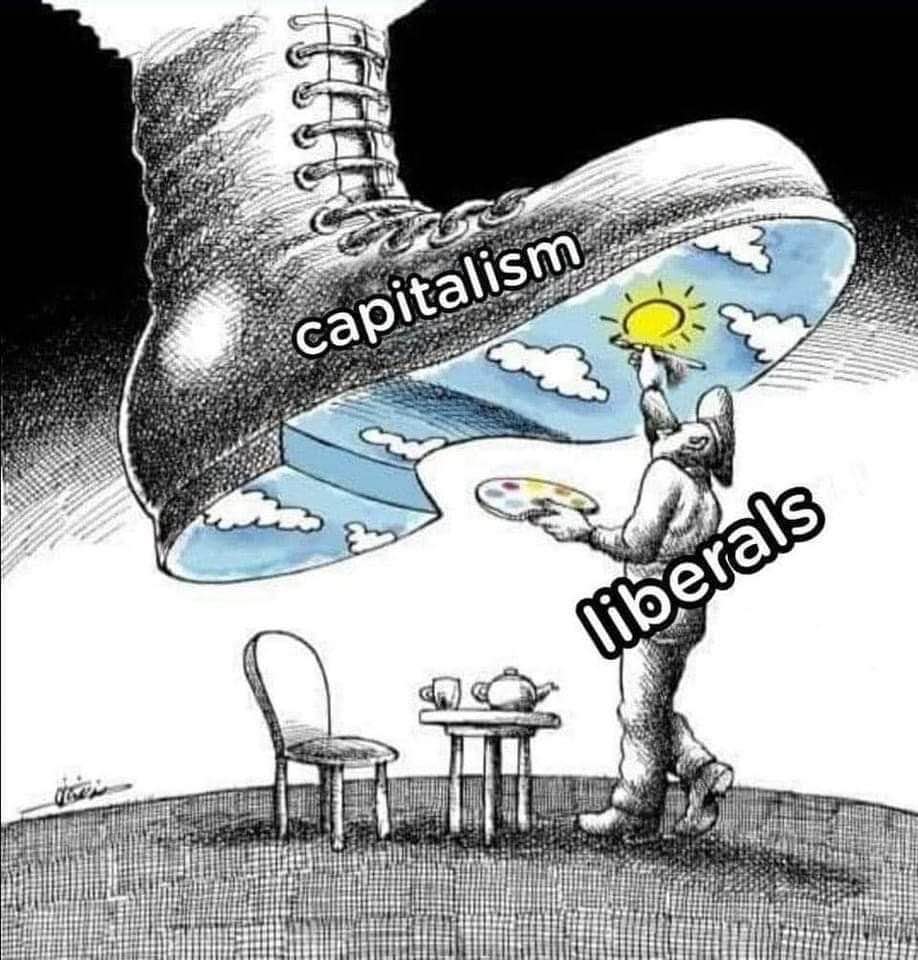
The meme is a satirical representation of the divide between neoliberalism and socialism, with the image depicting a giant shoe crushing a tiny person. The text "Capitalism" is written on the shoe, while "Socialism" is written on the person's clothing, highlighting the contrast between the two ideologies. The image is meant to illustrate the idea that capitalism is oppressive and crushing, while socialism is a liberating force.
detailed-analysis (gemma3-27b-vision)
Okay, let's break down this political cartoon through several theoretical lenses. It's a complex image, so each section will aim to unpack its implications through a specific framework.
Visual Description
The cartoon is a black and white illustration depicting a stark power dynamic. A gigantic, heavily-laced boot labeled "capitalism" is suspended in the air, seemingly cutting a swathe through a sky with serene clouds and a rising sun. Beneath the boot stands a small, almost comical figure, labeled "liberals." This figure is dressed in classic artist garb, standing on a patch of earth, clutching a palette and brush. Behind them, a chair and small tea table suggest a domestic, perhaps fragile scene. The stark contrast in scale is immediately arresting. The boot isn’t directly stepping on the figure, but its proximity and sheer size pose a clear threat, effectively casting a shadow over the artist. The composition creates a sense of vulnerability and powerlessness.
Marxist Conflict Theory
This cartoon is heavily informed by Marxist conflict theory. The core idea here is the inherent conflict between social classes. The giant boot, clearly representing “capitalism,” embodies the bourgeoisie (the owning class) and their dominant economic and political power. The smaller figure representing “liberals” represents an attempt to maintain the status quo or tinker around the edges of a fundamentally unjust system.
- Power Imbalance: The scale clearly illustrates the power imbalance. Capitalism is presented as an overwhelming force, dwarfing the efforts of liberals.
- False Consciousness: The artist figure, diligently painting as if to beautify or "fix" things, could be interpreted as representing liberals who operate within the capitalist framework, attempting reform rather than revolution. This paints them as being oblivious to the systemic problems. It suggests that liberal efforts are ultimately insufficient to challenge the root causes of inequality.
- Ideology: The act of painting can be seen as representing liberal ideology – a set of beliefs and values that justifies the capitalist system, even while acknowledging its flaws. The figure is diligently working under the threat of the boot, perpetuating the system in some way.
- The Boot as Coercion: The boot isn't simply "existing" – it's imposing itself on the scene, representing the coercive power of capital.
Foucauldian Genealogical Discourse Analysis
Applying a Foucauldian framework focuses on how power operates through discourse, rather than simply being "held" by a class. This cartoon reveals how capitalist power manifests through its normalization and the subtle shaping of discourse.
- Power/Knowledge: Capitalism isn't just an economic system but a system of knowledge that defines what's considered "normal," "successful," and "desirable." The boot’s presence isn't just about force, but about shaping the very terrain on which liberals operate. It sets the boundaries of what’s possible.
- Discipline: While the boot isn’t directly crushing the artist, it disciplines their efforts. The artist can only paint within the shadow of the boot, shaping their art and thus, their discourse, within the constraints set by capitalism.
- Genealogy: A genealogical analysis would trace the historical development of the relationship between capitalism and liberalism. How has liberalism historically served the interests of capitalism? How has it been co-opted? This cartoon presents a specific moment in that historical trajectory.
- Normalization: The scene implies that this power dynamic is normal. The boot’s presence isn’t seen as an aberration, but as an accepted part of the landscape.
Critical Theory
Building on the Frankfurt School’s tradition, Critical Theory examines how power structures are reinforced through culture and ideology. This cartoon fits within that framework by:
- Culture Industry: The artist and their painting could be seen as representative of the “culture industry,” producing aesthetic objects that distract from, rather than challenge, the underlying power structures. The painting represents a surface-level engagement with social issues that doesn’t address the root causes of inequality.
- Hegemony: Capitalism, as represented by the boot, maintains its power not just through force, but through hegemony – the dominance of a particular set of ideas and values. The cartoon suggests that liberalism has become co-opted by this hegemonic system, accepting its premises.
- Critique of Enlightenment Rationality: Critical Theory often questions the idea that reason and progress will inevitably lead to a better world. This cartoon can be read as a critique of liberal faith in incremental change and reform. The artist's diligent work is futile because it doesn't fundamentally challenge the power of capitalism.
Postmodernism
From a postmodern perspective, the cartoon’s strength lies in its deconstruction of grand narratives.
- Meta-narrative Breakdown: The cartoon rejects the idea of a single, universal path to progress. It presents a fragmented, power-imbalanced reality where grand narratives (like the promise of liberal reform) are revealed to be inadequate.
- Relativity of Truth: There’s no “objective” truth presented in the image. The power dynamic is starkly visible, but the cartoon doesn’t offer a simple solution. The meaning is open to interpretation, reflecting the postmodern emphasis on subjectivity and relativism.
- Emphasis on Power Dynamics: Postmodernism, while often associated with skepticism towards grand narratives, shares with other critical approaches a strong focus on power dynamics. This cartoon exemplifies that focus, illustrating how power operates in a specific context.
In conclusion: This cartoon is rich in symbolic meaning and can be analyzed through a variety of theoretical lenses. It presents a critique of liberalism within a capitalist system, highlighting power imbalances, the co-optation of ideology, and the limitations of reform. The image functions as a provocative commentary on the state of contemporary politics and the challenges of achieving genuine social change.
simple-description (llama3.2-vision)
The meme depicts a large, oversized shoe labeled "Capitalism" looming over a small, delicate person labeled "Liberals" who is attempting to paint a sunny day with a palette of colors. The text in the image is "Capitalism" and "Liberals". The meme suggests that the weight of capitalism is crushing the individual's ability to create and enjoy a beautiful day, implying that the burden of capitalism is overwhelming and stifling to the individual.
tesseract-ocr
| am e+ ie ey oP (a oan ee Tg os We is pee aa NaS eR NE | SS é We Rasy. Re 2S he) Ra € (ss SE F Perle «=< ee se oe re eee | 7. ts oi rc ae , TF > Ape OF peo Cos . 7 = - i i eas 3 ry ge f ee age a A oe Eee ral ante i Tl ag rh eae ema ee (ie BE aE aa OE EU i Hy i HATE sa See ee ahaa