First Seen
2023-05-10T21:03:34+00:00
simple-description (llama3.2-vision_11b)
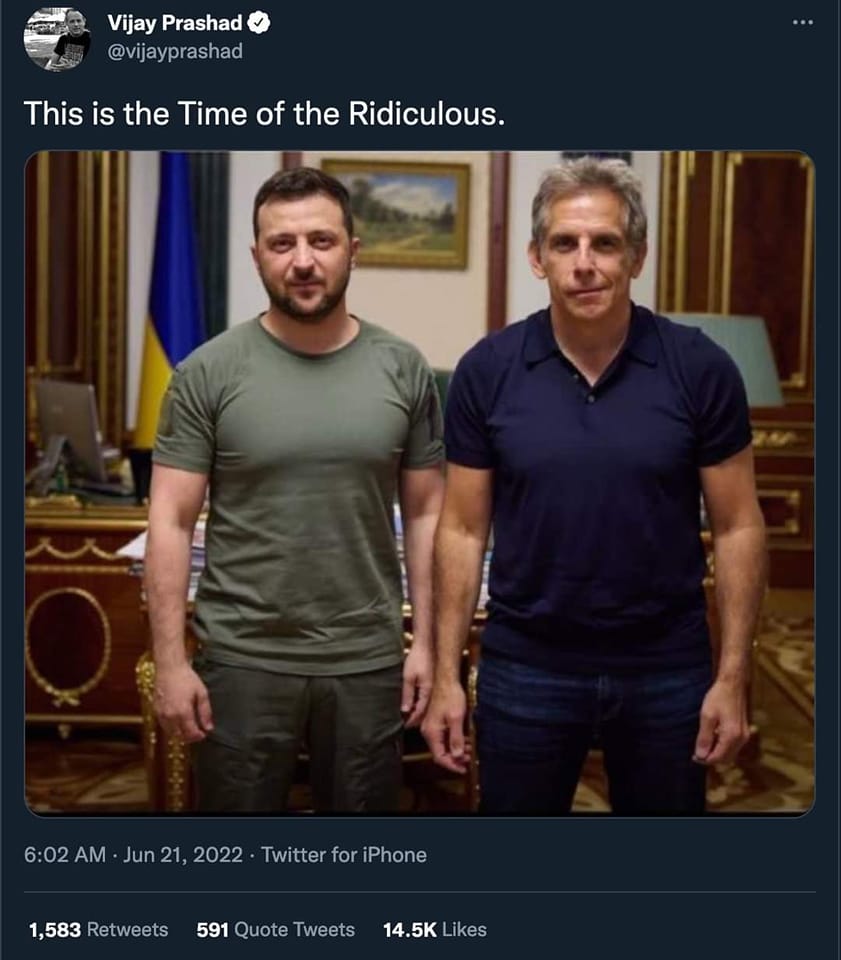
The meme is a photo of Ukrainian President Volodymyr Zelensky and actor Ben Stiller, with the caption "This is the Time of the Ridiculous". From an Anti-Neoliberal perspective, the meme is a commentary on the absurdity of the current global situation, where a leader like Zelensky, who was elected on a promise of reform and anti-corruption, is now dealing with the war in Ukraine and the US is providing military aid to Ukraine. The meme is poking fun at the absurdity of the situation and the ridiculousness of the current state of global politics.
detailed-analysis (gemma3-27b-vision)
Okay, here's an analysis of the image and its context (a Tweet from Vijay Prashad) broken down into the sections you requested, focusing on how different theoretical frameworks could apply. I'll note if a particular framework doesn't seem strongly relevant before I proceed. It's important to remember these are interpretive exercises; different analysts might emphasize different points.
Please note: This analysis is lengthy, as you've requested multiple theoretical approaches. I'm doing my best to provide a nuanced reading.
Visual Description
The image depicts two men standing side-by-side indoors. The man on the left is Volodymyr Zelenskyy, the President of Ukraine. He is wearing an olive-green military-style t-shirt, indicating a possible invocation of a wartime persona or solidarity with Ukrainian forces. The man on the right is Antony Blinken, the US Secretary of State, dressed in a dark navy polo shirt. The setting appears to be a formal, but slightly worn, room with floral wallpaper, Ukrainian flags, and a landscape painting visible in the background. The lighting is somewhat dim, creating shadows and contributing to a somber atmosphere. The composition is straightforward, emphasizing the two figures and their proximity to one another. Their body language appears relatively casual, though their expressions are serious. The use of mobile photography (as indicated by the "iPhone" tag) adds a layer of immediacy.
Foucauldian Genealogical Discourse Analysis
This is potentially quite relevant. Foucault's work emphasizes how power operates through discourse and the construction of knowledge.
- Discourses of Power: The image and Prashad's caption ("Time of the Ridiculous") immediately challenge the official narratives surrounding the US-Ukraine relationship. The dominant discourse frames the US as a benevolent supporter of a democratic Ukraine resisting Russian aggression. Prashad's statement disrupts this, suggesting a level of absurdity or even farce.
- Genealogy of 'Support': A Foucauldian genealogy could investigate how the concept of "support" has been constructed and employed in the context of international relations. What historical precedents are being drawn upon? What assumptions are embedded in the idea of one nation 'supporting' another? The image, framed by the caption, invites a critical examination of this 'support' – is it genuinely altruistic, or does it serve US geopolitical interests?
- Discipline & Normalization: The visual presentation of Zelenskyy, dressed in military attire, can be seen as a normalization of wartime conditions and a perpetuation of the "us vs. them" binary. The presence of Blinken, a representative of a powerful nation, reinforces this power dynamic.
- Power/Knowledge: The image, circulated on social media, becomes a node in a network of power/knowledge. Prashad’s caption aims to shift how we understand this relationship, attempting to deconstruct the established “truths” surrounding US-Ukraine relations.
Critical Theory
Critical Theory, particularly the Frankfurt School, is strongly applicable here.
- Ideology Critique: The image, combined with Prashad's caption, can be interpreted as a critique of the ideology justifying US involvement in Ukraine. Critical Theorists often focus on how dominant ideologies mask underlying power structures and maintain the status quo. The caption challenges the narrative of noble intervention, suggesting it might be based on something less admirable.
- Instrumental Reason: The image could be seen as demonstrating the dangers of “instrumental reason” – prioritizing efficiency and strategic goals over ethical considerations. The US's approach to Ukraine might be viewed as driven by geopolitical calculations rather than genuine concern for the Ukrainian people.
- Culture Industry: The image, circulating on a platform like Twitter, can be considered a product of the “culture industry” – the mass production of cultural artifacts that reinforce dominant ideologies. Prashad's tweet is an attempt to disrupt this process.
- Commodification of Suffering: A critical theory lens could explore if the conflict in Ukraine is being, in some ways, commodified, as narratives of suffering are used to justify specific political agendas.
Marxist Conflict Theory
Very relevant.
- Class Struggle and Imperialism: From a Marxist perspective, the conflict in Ukraine can be analyzed as a manifestation of global class struggle and imperialism. The US, as a capitalist superpower, is seen as pursuing its own interests in the region, potentially at the expense of the Ukrainian people.
- Economic Interests: The conflict could be framed as a battle for control over resources, markets, and geopolitical influence. The US's 'support' for Ukraine might be driven by a desire to maintain its position in the global capitalist system.
- State Apparatus: Both Zelenskyy and Blinken represent the interests of their respective state apparatuses. From a Marxist viewpoint, the state serves the interests of the ruling class.
- Contradictions: The image encapsulates the contradictions inherent in the relationship between a capitalist superpower (US) and a nation undergoing a complex geopolitical struggle (Ukraine).
Postmodernism
Also relevant, but requires careful interpretation.
- Deconstruction of Grand Narratives: The image and caption can be seen as a challenge to "grand narratives" – overarching explanations of history and politics. Prashad's statement suggests that the US-Ukraine relationship is not as straightforward as it's often portrayed.
- Simulacra and Simulation: The image itself could be viewed as a "simulacrum" – a copy without an original. The carefully constructed narratives surrounding the conflict in Ukraine may bear little resemblance to reality. The polished image on social media obscures the messy reality of the conflict.
- Relativism: A postmodern perspective might emphasize the lack of objective truth in the conflict. Different actors have different interpretations of events, and there is no single, authoritative account.
- Fragmentation of Meaning: The image, divorced from a broader context, can be interpreted in multiple ways. This fragmentation of meaning is a characteristic of postmodern thought.
Queer Feminist Intersectional Analysis
While this framework isn’t the most directly applicable, there are still avenues for analysis.
- Power Dynamics & Masculinity: The image presents two men in positions of power. A queer feminist analysis could explore how traditional notions of masculinity are reinforced and how those norms influence the conduct of international relations. The "strong leader" archetype is heavily present.
- Intersectionality and Geopolitics: How does the experience of this conflict differ for various groups within Ukraine (e.g., women, LGBTQ+ individuals, ethnic minorities)? These intersections are often overlooked in mainstream coverage.
- Gendered Dimensions of Conflict: War often has unique consequences for women and LGBTQ+ individuals. A queer feminist perspective would consider the gendered impacts of the conflict in Ukraine.
- Critique of the State: Queer and feminist thought often critiques the state as a patriarchal and heteronormative institution. Analyzing the relationship between these state actors through this lens could highlight the ways in which power is exercised and maintained.
Important Notes:
- Context is crucial. This analysis is based solely on the image and the caption. Knowing the broader context of the tweet, Prashad’s political views, and the ongoing conflict in Ukraine would further refine the interpretation.
- Overlapping Frameworks: These theoretical frameworks are not mutually exclusive. They can be used in combination to provide a more nuanced understanding of the image.
- Subjectivity: Interpretations are always subjective. Different analysts might emphasize different aspects of the image and arrive at different conclusions.
simple-description (llama3.2-vision)
The meme is a photo of two men standing side by side, with the caption "This is the Time of the Ridiculous." The image likely features a humorous or unexpected juxtaposition of the two individuals, with one being a well-known leader (such as a president or politician) and the other being a celebrity or actor (in this case, Dwayne "The Rock" Johnson). The caption suggests that the two individuals are somehow connected or have a shared experience that is absurd or humorous.
tesseract-ocr
Vijay Prashad @ oo = .i5 @vijayprashad This is the Time of the Ridiculous. f \J — ae F™ es ey 2 ? ‘ i , 11% — \ oo TR ‘if . ta }' 3 Pd 4 ; = — ‘ J = = , ~ * \ i b a Sa ™~ i b < | \ ae | € Ss ase ( S o * : x a ' is — 6:02 AM - Jun 21, 2022 - Twitter for iPhone 1,583 Retweets 591QuoteTweets 14.5K Likes