First Seen
2023-05-10T21:03:34+00:00
simple-description (llama3.2-vision_11b)
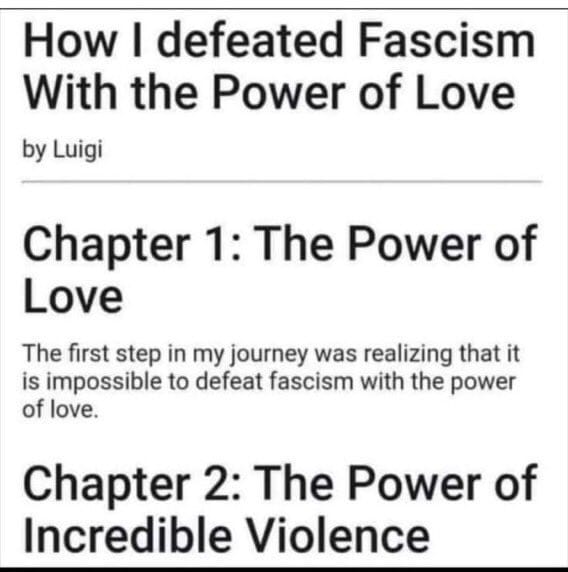
The meme is a screenshot of a Wikipedia article page, with the title "How I defeated Fascism with the Power of Love" and a humorous, ironic, and satirical take on the idea of using love as a means to defeat fascism. The text is a self-deprecating, humorous, and ironic account of a fictional story, poking fun at the idea of using love as a solution to complex, real-world problems like fascism.
detailed-analysis (gemma3-27b-vision)
Here's an analysis of the image, broken down into sections based on the requested theoretical lenses. I'll indicate when a section is not applicable.
Visual Description
The image is a screenshot of text, likely from a blog, article, or ebook. The title proclaims "How I Defeated Fascism With the Power of Love," attributed to "Luigi." There are two chapter titles visible: "Chapter 1: The Power of Love" and "Chapter 2: The Power of Incredible Violence."
The chapter descriptions are pointedly ironic. Chapter 1 states the initial step in the journey was realizing it’s impossible to defeat fascism with love, immediately contradicting the overarching title. The irony suggests a satirical or subversive intent.
Foucauldian Genealogical Discourse Analysis
This image is ripe for a Foucauldian analysis. The discourse of "defeating fascism" has been historically linked to both "love" (peace movements, humanitarian interventions) and "violence" (revolutionary action, warfare). The image sets up a seeming opposition, but then immediately undermines the connection of "love" with fascism defeat, suggesting that the discourse is deeply entwined with power and the production of truth.
The title itself performs an act of discourse—it proposes a "truth" (that love can defeat fascism) which is then immediately negated within the first line of Chapter 1. This disjunction isn’t an accident; it points to the instability of language and the ways in which our understandings of abstract concepts like “fascism” and “love” are constructed through language and social practices.
The title's "Luigi" also could be interpreted as a power gesture, playing on Italian associations with both socialist and fascist movements.
Critical Theory
From a Critical Theory perspective, the image engages with the concept of ideology. The initial title— "How I Defeated Fascism With the Power of Love"—can be seen as a representation of the dominant liberal-humanitarian ideology, which often frames conflict resolution through peaceful means.
However, the swift contradiction in Chapter 1 reveals a critique of that same ideology. It implies that simply "loving" your enemy or appealing to their better nature is insufficient to dismantle systemic oppression like fascism. The image suggests a more forceful approach may be necessary, even if it challenges conventional moral frameworks. It exposes the naivete or limitations of a purely idealistic approach to political struggle.
Marxist Conflict Theory
This image directly speaks to Marxist Conflict Theory. Fascism is inherently a product of class conflict and the desire of a ruling class to maintain power. The claim that it can be overcome by "love" is a denial of the material conditions that fuel fascist movements.
The text suggests that true resistance necessitates addressing those material conditions—likely a struggle that inherently involves conflict. The shift in Chapter 2 to "Incredible Violence" indicates a recognition that dismantling power structures built on exploitation often demands confronting force. It can be interpreted as a rejection of peaceful solutions in favor of revolutionary action.
Postmodernism
The image exhibits several key characteristics of Postmodern thought. The initial title makes a grand, totalizing claim ("defeating fascism"). However, this claim is immediately undermined, suggesting a rejection of meta-narratives. The juxtaposition of “love” and “violence” disrupts traditional binary oppositions, indicating a preference for ambiguity and complexity over simple solutions.
The use of irony is also a hallmark of Postmodernism. The image doesn't offer a straightforward answer, but instead encourages the viewer to question the very premises of the question. This meta-commentary is a key characteristic of Postmodern thought.
Queer Feminist Intersectional Analysis
While less direct, an intersectional analysis can be applied. Fascism, historically and presently, relies on enforcing rigid social hierarchies and suppressing marginalized groups (based on gender, sexuality, race, etc.). The claim that "love" can defeat it implicitly suggests inclusivity and empathy, which are often central to queer feminist struggles.
However, the text quickly undermines that claim, suggesting that confronting oppression requires more than just tolerance or acceptance. It can be interpreted as a critique of "love" as a form of passive resistance that doesn't address the structural roots of oppression. From an intersectional perspective, true liberation requires challenging all forms of domination, including those rooted in gender, sexuality, and class.
Let me know if you'd like me to elaborate on any of these sections or explore additional theoretical frameworks!
simple-description (llama3.2-vision)
The meme is a humorous take on the idea of "defeating" fascism with love. The image appears to be a book or article title, "How I Defeated Fascism with the Power of Love", but the text below it reads "In 2 volumes: The first is a 300 page novel about how I fell in love with a fascist and the second is a 1000 page novel about how I killed him." The meme pokes fun at the idea of using love as a means to defeat fascism, implying that it's an unrealistic and absurd approach.
tesseract-ocr
How | defeated Fascism With the Power of Love by Luigi Chapter 1: The Power of Love The first step in my journey was realizing that it is impossible to defeat fascism with the power of love. Chapter 2: The Power of Incredible Violence