First Seen
2023-05-10T21:03:34+00:00
simple-description (llama3.2-vision_11b)
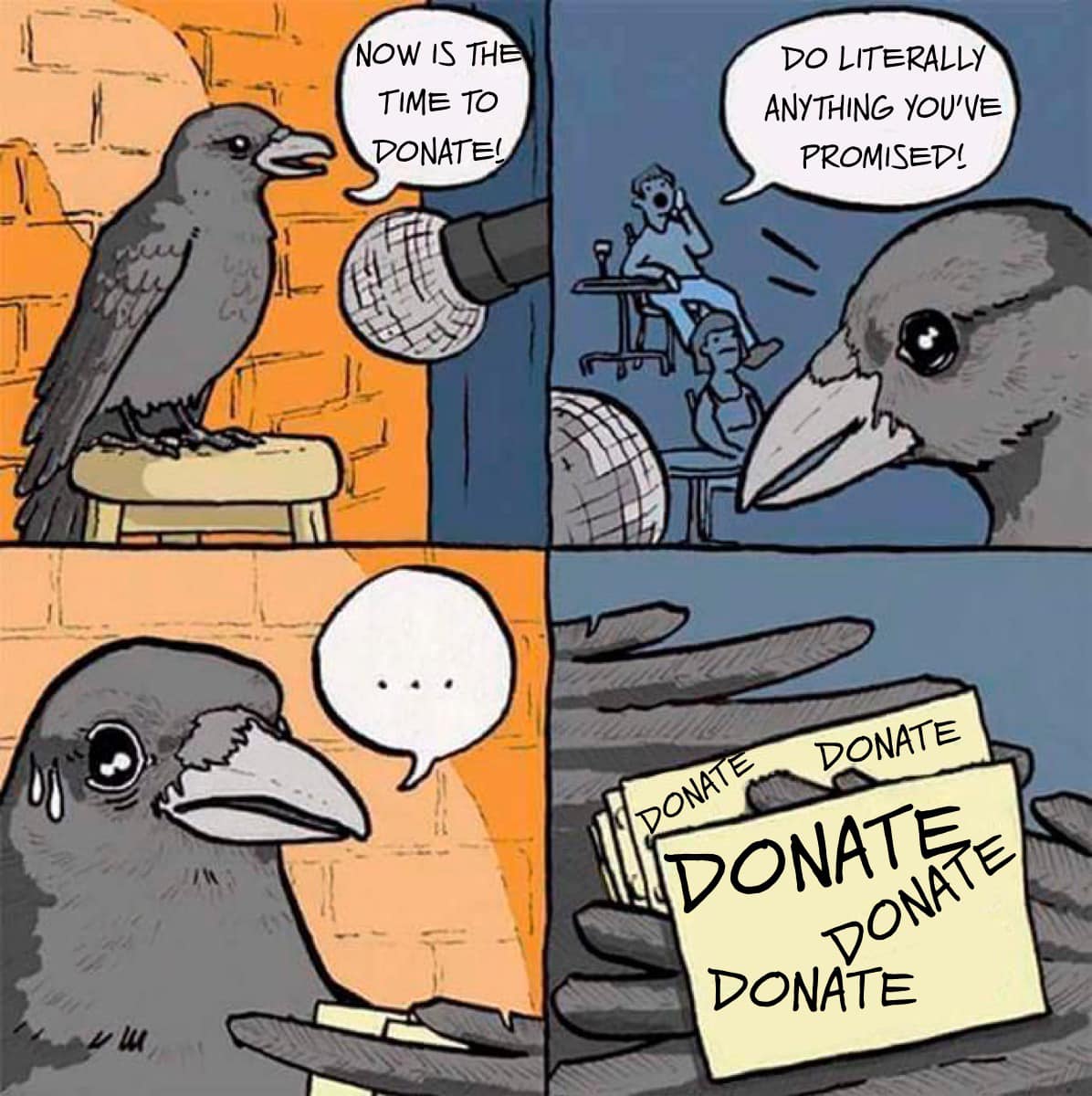
The meme is a play on the popular "I can pay my taxes with it" phrase, but with a twist. A crow is sitting on a stool, looking dejected, and a person is holding a microphone, saying "Now is the time to donate!" The crow responds with a sarcastic "I can donate it to the government" and a sign on the table reads "I can pay my taxes with it". This meme is from the anti-neoliberal perspective, poking fun at the idea that people are being forced to donate to the government, implying that the government is taking advantage of citizens' money.
detailed-analysis (gemma3-27b-vision)
Okay, let's break down this intriguing comic panel through the lenses you've provided.
Visual Description
The comic is a four-panel sequence rendered in a simple, slightly rough, cartoon style with warm orange and muted colors. The central figure is a large, dark-colored raven/crow perched on a small, somewhat ornate stool. Its expression is consistently intense and demanding.
- Panel 1: The raven is looking directly at the viewer with a stern look. Behind it is a stylized rendering of a globe. Text reads "NOW IS THE TIME TO DONATE!"
- Panel 2: The globe is now shown as a stage with tiny human figures performing on it. The raven is looking at the stage with a harsh expression. The text states "DO LITERALLY ANYTHING YOU'VE PROMISED!"
- Panel 3: A close-up of the raven's head. It's looking expectantly.
- Panel 4: The raven's claws are clutching a homemade, scrawled sign reading "DONATE" repeated multiple times. The background is dark, suggesting a sense of urgency or pressure.
Foucauldian Genealogical Discourse Analysis
This comic is ripe for a Foucauldian reading. The raven functions as a disciplinary power, not through direct force, but through the internalisation of promise and expectation.
- Discourse of Promise: The demand for "anything you've promised" constructs a discourse around obligation. Promises themselves are not neutral; they create power dynamics. The viewer feels compelled to act due to their prior commitment.
- Internalisation of Power: The raven doesn't need to enforce the donation. The viewer feels the need to act because they have internalised the expectation of fulfillment. This echoes Foucault's concept of docile bodies – individuals who self-regulate and conform to norms without explicit coercion.
- Genealogy of Philanthropy: The image could be seen as critiquing the very discourse of charitable giving. It suggests that behind the "noble" act of donating lies a demand, a pressure, and perhaps even a hidden power structure. It asks us to question how the expectation of donation is created and maintained. The image of the globe stage could be read as a metaphor for the world stage of charity and its associated power plays.
Critical Theory
Applying Critical Theory, specifically the Frankfurt School's perspective on the Culture Industry, we can see the comic as a meta-commentary on contemporary appeals for charity.
- Commoditisation of Morality: The demand for a donation frames morality as something transactional. It suggests that "doing good" is tied to fulfilling a debt rather than a genuine act of kindness.
- Ideological Reinforcement: The comic potentially exposes how the dominant ideology encourages a feeling of obligation and guilt to sustain a system of giving. It’s not about genuinely addressing systemic issues; it's about placating the viewer with the illusion of making a difference.
- Alienation: The small figures performing on the globe stage may represent those the viewer is presumably donating to, and could be seen as a symbol of alienation. The viewer is separated from the actual beneficiaries of their donation, and the act of giving is distanced from genuine human connection.
Marxist Conflict Theory
From a Marxist perspective, the comic can be interpreted as a critique of the inherent inequalities within a capitalist system, even within charitable giving.
- Exploitation of Guilt: The raven's relentless demand for donations taps into a sense of guilt and moral obligation. This guilt can be seen as a tool to maintain the status quo. The beneficiaries of the donations could be seen as a surrogate proletariat, who need the "aid" of the bourgeois.
- Superstructure and Ideology: The discourse of charitable giving is part of the superstructure (cultural institutions, ideologies) that maintains the power of the ruling class. It legitimizes the economic system by offering a “solution” to the problems it creates.
- False Consciousness: The act of donating can be seen as a symptom of "false consciousness" – the acceptance of the dominant ideology that masks the true nature of social and economic exploitation. The image implies that the viewer is being pacified by the act of donating, rather than addressing the root causes of poverty or injustice.
Postmodernism
A postmodern reading might focus on the breakdown of meaning and the questioning of grand narratives.
- Deconstruction of Charity: The comic deconstructs the conventional image of charity as purely altruistic. It exposes the underlying power dynamics and the constructed nature of the "good deed."
- Irony and Meta-Commentary: The use of a raven as the messenger is inherently ironic. Ravens are often associated with death and darkness, which subverts the expectation of a benevolent figure associated with charity. The comic itself is a meta-commentary on the very act of asking for donations.
- Simulacra and Simulation: The staged globe stage could be seen as a simulation of the world and the issues the charity claims to address. The donation becomes a symbolic act divorced from genuine impact.
Queer Feminist Intersectional Analysis
While perhaps less directly obvious, this framework can also offer a reading:
- Critique of Obligations: This approach emphasizes the ways in which societal expectations, like the expectation to donate, often disproportionately affect marginalized communities. The demand for donations can be seen as adding another layer of obligation to those already burdened by systemic inequalities.
- The Power of Demand: The raven's relentless demand can be viewed as mirroring the demands placed on marginalized individuals to perform respectability, conform to norms, and "fix" the problems created by dominant systems.
- Intersectionality and Giving: Acknowledging how giving, like any system, is not neutral. It’s important to examine how philanthropic efforts (and the demands for them) may reinforce existing power structures, benefit certain groups more than others, and fail to address the root causes of inequalities that disproportionately affect marginalized communities.
In conclusion, the seemingly simple comic panel is surprisingly complex and open to multiple interpretations. It functions as a powerful critique of contemporary culture, power dynamics, and the very notion of altruism. It encourages us to question the motivations behind charitable giving and the ways in which we are manipulated by appeals to our guilt and obligation.
simple-description (llama3.2-vision)
The meme is a humorous take on a classic joke. It features a cartoon crow on stage, speaking into a microphone. The crow says "Now is the time to donate!" but is interrupted by a fellow crow, who says "Do literally anything you've promised!" and then holds up a sign that reads "Donate".
tesseract-ocr
i flows He DO LITERALLY a | TIME To ANYTHING YOU'VE ri g Pe \ DONATE! PROMISED! | Kt 5 (i: 7/—* ee teay Vee | \ Tf J q's VAM. 4 Ail It y pn ws (Fa Pe > 1 } Res S, Yes SS ee =a 504) | i wa Jie: = a a | iH a’ Z| KE ‘~) RS Rote 4 5 DON y) _ we } a \ 0 a ei _ i e “ \\ NA Re yy DONATE | an