First Seen
2023-05-10T21:03:34+00:00
simple-description (llama3.2-vision_11b)
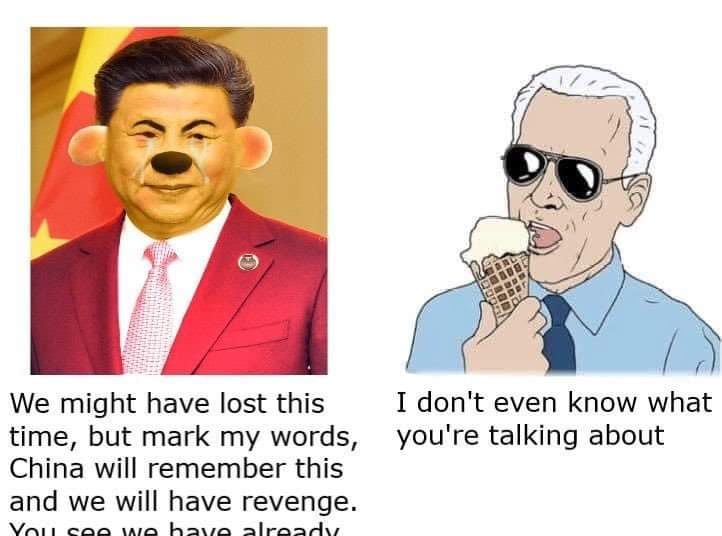
The meme is a humorous critique of neoliberalism, using a photo of Xi Jinping with a cartoonish, childlike face, and a quote that pokes fun at the idea of "reform" in China. The image features Xi Jinping with a smiling, cartoon-like face, and the quote "We might have lost this time, but mark my words, China will remember this and we will have revenge" - a satirical commentary on the idea that China's "reform" is a myth.
detailed-analysis (gemma3-27b-vision)
Okay, here's an analysis of the image, broken down into sections based on the requested theoretical frameworks, where applicable. It's important to note that applying these theories often involves interpreting and suggesting connections – it’s not necessarily about a straightforward, objective ‘truth.’
Visual Description
The image is a digital composite presenting two portraits juxtaposed with text.
- Left Portrait: A heavily stylized caricature of Xi Jinping, the President of China. He is wearing a red suit and a red pin. His features are exaggerated with large, rounded cheeks, making him resemble a cartoon character. The cartoonish modification emphasizes a simplification of his image.
- Right Portrait: A caricature of Joe Biden, the President of the United States. He is depicted in a blue suit, looking bewildered and holding a geometrically patterned ice cream cone. The geometric pattern is a contrast to the organic shape of the cone.
- Text: Below each portrait are lines of text presented as dialogue. Xi Jinping’s text reads, “We might have lost this time, but mark my words, China will remember this and we will have revenge. You see we have already…” Joe Biden's text reads, “I don’t even know what you’re talking about.”
The overall aesthetic is satirical and exaggerated. The juxtaposition of the portraits and dialogue intends to create a comedic or critical commentary, likely referencing political tensions between the US and China.
Foucauldian Genealogical Discourse Analysis
This image lends itself well to a Foucauldian reading. Focusing on discourse and power/knowledge, we can see how the image constructs and reinforces specific ways of understanding US-China relations.
- Discursive Construction of the "Other": The caricatures themselves are not neutral representations. They are specific constructions of Xi Jinping and Joe Biden. Xi is presented as calculating, vengeful (even animalistic with the cartooning). This is a discourse that portrays China as a potential threat, steeped in historical grievance. Biden is made to appear confused and clueless.
- Power/Knowledge: The image implies a power imbalance. Xi's declaration of future retribution suggests an underlying power dynamic, even if currently 'lost'. The caricature contributes to a discourse that legitimizes the projection of potential threat. Biden’s cluelessness is an exercise of soft power, as it discredits the Chinese rhetoric and paints them as irrational.
- Genealogy: A genealogical approach would trace the historical development of these discourses. What are the historical roots of the perception of China as vengeful? How has the depiction of US leadership shifted over time? The image is a moment in a long chain of representations that shape perceptions.
Critical Theory
A Critical Theory approach would examine the image as a cultural artifact that reflects and reinforces broader societal structures and ideologies.
- Ideology: The image can be seen as reproducing ideological narratives around international relations. The US-China relationship is often framed as inherently competitive or antagonistic. This image reinforces that frame, potentially obscuring the complex interplay of economic, political, and cultural factors.
- Domination and Hegemony: The contrast in the portraits and dialogue could be interpreted as a visual representation of the US exerting its hegemonic influence. By portraying China as threatening and Biden as confused, the image subtly reinforces the idea of US leadership and legitimacy.
- Culture Industry: The image itself, as a meme or digital image, is a product of the culture industry. It’s designed to be consumed, shared, and contribute to a wider cultural conversation. A critical approach would ask who benefits from this particular framing of US-China relations.
Marxist Conflict Theory
From a Marxist perspective, the image can be read as reflecting underlying class struggles and economic competition.
- Imperialism & Global Competition: The perceived tension between the US and China is rooted in a competition for global economic and political dominance. The image reflects this struggle, presenting China as a looming threat to US hegemony. The ‘revenge’ narrative implies a challenge to the existing order.
- Hegemonic Power: The US is portrayed as the dominant power, and the caricature of Biden suggests a complacency that allows this dominance to persist. The image subtly reinforces the idea of a capitalist system in which competition and conflict are inevitable.
- Ideological Struggle: The image participates in the ideological struggle between capitalist and potentially alternative systems. The demonization of China can be seen as a way to justify US economic and political policies.
Postmodernism
A postmodern reading would focus on the image's playfulness with representation, its blurring of boundaries, and its deconstruction of grand narratives.
- Simulacra and Simulation: The caricatures are simulacra – copies without originals. They are representations that have become detached from any ‘real’ Xi Jinping or Joe Biden. The image emphasizes the constructed nature of reality.
- Deconstruction of Authority: By portraying both leaders as somewhat absurd figures, the image undermines any sense of authoritative knowledge. It suggests that there are no objective truths, only interpretations.
- Irony and Parody: The image relies on irony and parody to convey its message. The over-the-top caricatures and exaggerated dialogue create a sense of distance and skepticism. It challenges the viewer to question the narratives they are presented with.
Important Considerations:
- Context is Key: The interpretation of this image would also be heavily influenced by the context in which it is viewed (e.g., social media platform, news outlet, political discussion).
- Multiple Interpretations: It's important to remember that these theoretical frameworks are tools for analysis, not definitive answers. The image is open to multiple interpretations, and these frameworks can help us explore different possibilities.
Let me know if you'd like me to elaborate on any of these sections or explore other theoretical perspectives!
simple-description (llama3.2-vision)
The meme features a photo of a Chinese leader (presumably Xi Jinping) with a cartoonish, monkey-like face, implying a mocking or satirical tone. The text accompanying the image reads: "We might have lost this time, but mark my words, China will remember this and we will have revenge. You see we have already..." The meme is likely referencing a recent event or controversy, and the tone is playful and sarcastic, with a hint of irony.
tesseract-ocr
aa (ao) Py A Vas | fh i ‘ J i Pi / \ We might have lost this I don't even know what time, but mark my words, you're talking about China will remember this and we will have revenge. Mars eon unm havin salraaAdw