First Seen
2023-06-22T03:29:35+00:00
simple-description (qwen3.5_2b-q8_0)
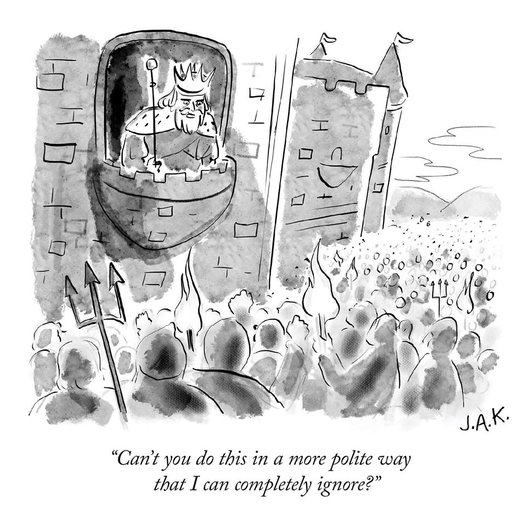
This image satirizes the social awkwardness and arrogance that often occurs when powerful figures address the masses directly without courtesy. The king is depicted standing on a high castle wall, effectively ignoring the crowd below, which makes him sound condescending and uncivil. The text "Can't you do this in a more polite way that I can completely ignore?" mocks this lack of social grace, highlighting the frustration with the intrusive behavior of the elite.
simple-description (llama3.2-vision_11b)
The meme is a cartoon of a king sitting in a throne, with a caption that reads "Can you do this in a more polite way that I can completely ignore?" The image is humorous because it pokes fun at the idea of a king being asked to be polite, but then ignoring the request. The meme is likely from the category of Anti-Neoliberal, as it critiques the idea of power and authority, and the way it is used to control and manipulate others.
detailed-analysis (gemma3-27b-vision)
Okay, here's a breakdown of the cartoon using the requested theoretical frameworks, section by section. It’s a particularly ripe image for these types of analyses!
Visual Description
The cartoon is a black-and-white drawing in a slightly sketchy, classic New Yorker cartoon style. It depicts a royal figure—a king or emperor—seated in an ornate, rounded, throne-like carriage raised above a tumultuous scene of chaos and protest. The carriage is adorned with carvings or symbols. Below, a large crowd of indistinct, shadowy figures appear to be in a state of uprising or protest, with smoke or debris rising around them. There are what appear to be arrows or other projectiles directed upwards toward the carriage. The scene is framed by tall, blocky structures resembling ancient monuments or city walls.
The caption reads: "Can't you do this in a more polite way that I can completely ignore?" This is what is being said by the royal figure.
The artist’s signature is “J.A.K.”
Foucauldian Genealogical Discourse Analysis
This cartoon is powerfully resonant with Foucault’s ideas. The image provides a visual representation of power dynamics, knowledge, and the construction of truth.
- Power/Knowledge: The king embodies power, but the cartoon highlights how that power is maintained not through brute force alone, but through a discourse of indifference and the demand for “politeness” as a way to silence dissent. He isn't concerned with the reasons for the uprising, only with the manner in which it is expressed. It's a demand that the oppressed accommodate the comfort of the oppressor.
- Genealogy: The setting, with its ancient-looking monuments, evokes a history of power structures. The cartoon implies this isn’t a new situation; it’s a reiteration of historical patterns of oppression and the demand for its quiet continuation. Foucault would ask us to examine how this demand for “politeness” has been historically constructed as a tool of control.
- Discipline and Punish: The uprising suggests a breakdown of a disciplinary regime (as described in Discipline and Punish). However, the king’s response demonstrates a desire not to reimpose harsh punishment, but to reassert control by making the expression of resistance uncomfortable for himself. He wants to restore a "polite" order that allows him to ignore the underlying problems.
- Panopticism: The raised carriage functions visually like the tower of a panopticon, allowing the king to survey (and potentially control) the masses, but also making him isolated and seemingly unaware of the true conditions of his kingdom.
Critical Theory (Frankfurt School)
This cartoon aligns strongly with the themes of the Frankfurt School.
- Domination and Rationality: The king's request exposes a perverted form of rationality. He isn't interested in addressing the legitimate grievances that are causing the uprising, but in managing the appearance of order. This is a form of instrumental rationality—using reason to achieve a specific goal (maintaining the status quo) without regard for ethical considerations.
- Culture Industry: The demand for “politeness” can be seen as a form of cultural control, a way to pacify and normalize oppression. It suggests a desire for a “culture” where dissent is expressed in a way that doesn't disrupt the comfort of the ruling class.
- False Consciousness: The cartoon implies that the masses may be unaware of the true extent of their oppression or have internalized the values of the ruling class. The king's assumption that a "polite" uprising can be ignored speaks to a belief that the masses are fundamentally irrational and can be easily controlled.
- Enlightenment Dialectic: The cartoon seems to suggest a failure of the Enlightenment project. The promise of reason and progress has been distorted, resulting in a system that perpetuates inequality and oppression.
Marxist Conflict Theory
The cartoon is a classic illustration of class conflict.
- Base and Superstructure: The uprising represents a conflict over the "base" (the economic and material conditions of society), while the king's response focuses on maintaining the "superstructure" (the ideological and political institutions that uphold the existing power relations).
- Class Struggle: The cartoon explicitly depicts a struggle between the ruling class (represented by the king) and the oppressed masses.
- Ideology: The demand for “politeness” functions as an ideology that masks the underlying power imbalance and justifies the status quo. It’s a way to convince the oppressed that their grievances are illegitimate or that they can be addressed through peaceful and accommodating means.
- Alienation: The uprising suggests a sense of alienation and disempowerment among the masses. They feel that their voices are not being heard and that their needs are not being met.
Postmodernism
The cartoon can be analyzed through a postmodern lens by focusing on themes of power, representation, and the instability of meaning.
- Deconstruction: The cartoon deconstructs the traditional notion of authority and legitimacy. The king’s request exposes the arbitrary nature of power relations and the constructedness of social norms.
- Simulacra and Simulation: The demand for "politeness" can be seen as a simulacrum—a copy without an original. It's a performance of civility that masks the underlying reality of oppression.
- Meta-narratives: The cartoon challenges the meta-narrative of a benevolent and just ruler. It exposes the hypocrisy and self-interest that often lie beneath the surface of power.
- Discourse and Power: (Similar to Foucault, but focusing on the fragmented nature of meaning.) The cartoon shows how power operates through discourse, shaping our understanding of reality and legitimizing the status quo.
Queer Feminist Intersectional Analysis
While not the most immediately apparent, an intersectional analysis is still relevant.
- Power Imbalances: The cartoon is fundamentally about power imbalances, and feminist and queer theory both focus on understanding how power operates in society, particularly along lines of gender, sexuality, and other social categories.
- Silencing and Erasure: The king’s demand for “politeness” can be seen as a form of silencing—a way to suppress dissent and maintain the status quo. This is particularly relevant to feminist and queer theory, which both emphasize the importance of giving voice to marginalized groups.
- Intersectionality: While the cartoon doesn’t explicitly depict any specific marginalized groups, the demand for "politeness" can be interpreted as a demand for conformity that disproportionately affects those who challenge dominant norms, particularly LGBTQ+ individuals and people of color. The demand for "politeness" often functions as a way to police behavior and maintain existing power structures.
- Critique of Civility: Both feminist and queer theory often critique the concept of "civility" as a tool of oppression. "Civility" can be used to demand that marginalized groups moderate their demands for justice and equality in order to avoid upsetting those in power.
I hope this detailed breakdown, using multiple theoretical frameworks, is helpful! Let me know if you’d like me to elaborate on any specific aspect or framework.
simple-description (llama3.2-vision)
This meme features a medieval-style illustration of a king sitting in a window, looking out at a crowd of people below. The king is wearing a crown and holding a sceptre, but his expression is one of annoyance. The text at the bottom of the image reads, "Can't you do this in a more polite way that I can completely ignore?"
tesseract-ocr
gt, |S -£ Ge oO if i} [ a / ST CIN 4 i/) = a Naat No ae } Tee || f= ie PAG eA 4a. Takka \ ae ope ag sre 4 we Some al Va Ryall @=\ ay pene. V6) UG Fay a Ne JAK: “Can't you do this in a more polite way that I can completely ignore?”