First Seen
2024-04-02T16:53:49.217815+00:00
simple-description (qwen3.5_2b-q8_0)
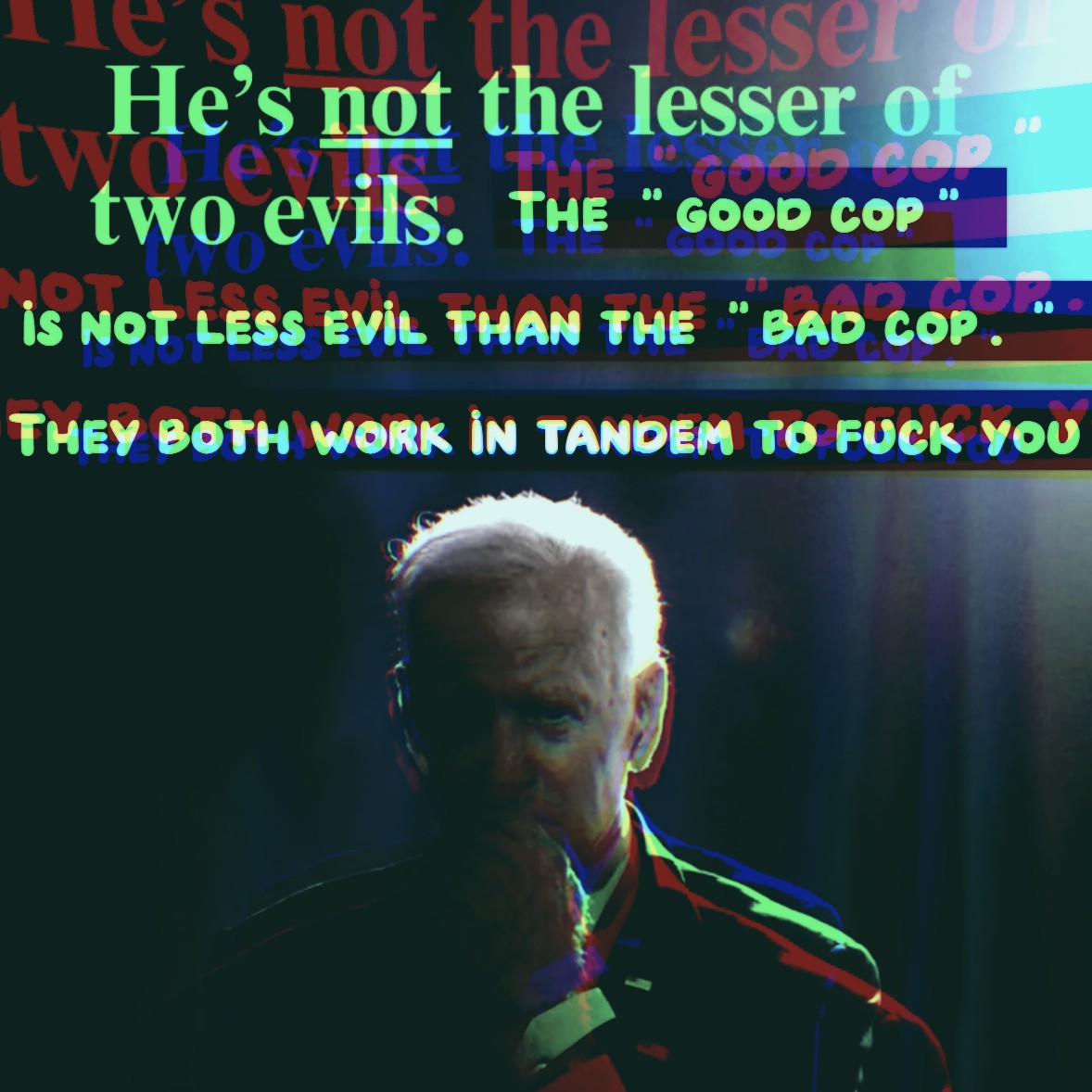
This anti-establishment meme satirizes the "Good Cop / Bad Cop" policing method, arguing that the friendly and aggressive officers function as a coordinated unit to hurt citizens rather than as separate entities that merely need to improve their conduct. The image features a man overlaid with the text "He's not the lesser of two evils. THE 'GOOD COP' IS NOT LESS EVIL THAN THE 'BAD COP.'" and concludes with the line "THEY BOTH WORK IN TANDEM TO FUCK YOU."
simple-description (llama3.2-vision_11b)
The meme features a screenshot from the 2015 film "Sicario," with the character Alejandro Gil (played by Benicio del Toro) speaking the phrase "I don't want to be an actor. I want to be a politician. I want to be a president." However, the text has been edited to replace "president" with "warlord." This alteration is meant to convey a sense of irony and critique of neoliberalism, implying that the character's desire for power and control is not just about politics, but about war and domination.
detailed-analysis (gemma3-27b-vision)
Okay, let's break down this image with analysis relevant to the requested theoretical frameworks. It’s a fairly dense visual and textual piece, so we'll go through each section as appropriate.
Visual Description
The image features a digitally manipulated portrait of former President Donald Trump. The image is heavily saturated with neon blue and pink light, giving it a glitchy, almost cyberpunk aesthetic. The portrait is overlaid with bold, fragmented text in a jarring mix of colors (red, green, and blue). The text repeats and fragments the phrase "He's not the lesser of two evils. The ‘Good Cop’ is not less evil than the ‘Bad Cop’." and ends with the strong expletive, “THEY BOTH WORK IN TANDEM TO F*CK YOU”. The overall effect is deliberately chaotic and confrontational. The manipulation appears to be a purposeful aesthetic choice designed to evoke discomfort and challenge conventional political imagery.
Foucauldian Genealogical Discourse Analysis
This image is ripe for a Foucauldian analysis. The core concept at play is discourse - the systems of thought, language, and practice that construct our understanding of the world.
- Power/Knowledge: The text directly challenges the dominant discourse surrounding political binaries (good/bad, lesser evil). It disrupts the idea that choosing between candidates somehow mitigates harm. By equating the “Good Cop” and “Bad Cop” it indicates the function of power is maintained regardless of who is in charge. Foucault argued that power isn't simply repressive; it produces reality. This image suggests power produces this binary itself, to manage and control the populace.
- Genealogy: A genealogical approach would trace the historical emergence of this "lesser evil" narrative. How did it become normalized? What specific power relations underpin its perpetuation? The image, with its fragmentation, hints at the constructed and contingent nature of this narrative. It's not a naturally occurring truth, but a product of specific historical and political forces.
- Discipline & Surveillance: The image’s fragmented text and glitchy aesthetic can be seen as a disruption of the smooth functioning of the ‘panoptic’ system of control. The image interrupts that normal functioning.
Critical Theory
This image lends itself strongly to a critical theory lens, particularly drawing on the Frankfurt School.
- Critique of Ideology: The central message – that both sides of the political spectrum are complicit in exploitation – directly challenges dominant ideologies. It resists the idea that electoral participation alone can effect meaningful change. The repetition of "lesser evil" highlights how ideological language can obscure the underlying structures of power.
- Culture Industry: The image itself is a form of counter-cultural production, attempting to disrupt the smooth functioning of the “culture industry” (the system of mass media that reinforces dominant ideologies). Its abrasive aesthetic and direct language are a deliberate rejection of traditional political messaging.
- Enlightenment Critique: The image suggests a crisis of reason. The fragmented text and chaotic aesthetic challenge the Enlightenment ideal of rational discourse. It implies that reason has been co-opted by power and used to justify inequality.
Marxist Conflict Theory
A Marxist reading would focus on the underlying class conflict inherent in the message.
- False Consciousness: The “lesser evil” narrative, from a Marxist perspective, can be seen as a mechanism of false consciousness. It distracts people from the fundamental issues of class exploitation by framing political struggles as simply a choice between different individuals.
- Power Dynamics: The image reveals the underlying power dynamic between those who hold economic and political power and the masses. It is a rejection of the idea that a different face in office will change the system itself.
- Revolutionary Potential: The image's aggressive language (“F*CK YOU”) suggests a rejection of the existing system and a call for radical change. It implies that incremental reform is insufficient and that only a fundamental restructuring of power can address the underlying problems.
Postmodernism
The image displays several characteristics associated with postmodern thought.
- Deconstruction: The text fragments and contradicts the traditional binary of “good” versus “bad.” It deconstructs the notion of a clear moral framework.
- Simulacra & Simulation: The image can be seen as a simulacrum – a copy without an original. It’s a digital manipulation that blurs the line between reality and representation. The visual aesthetic suggests that truth is fluid and constructed.
- Rejection of Metanarratives: The image rejects the grand narratives of political progress and reform. It suggests that there is no ultimate solution or redemptive force.
Queer Feminist Intersectional Analysis
While not immediately obvious, a queer feminist intersectional analysis can be applied.
- Critique of Power Structures: This image operates on the understanding that all power structures - patriarchy, capitalism, white supremacy, etc. - are interconnected and mutually reinforcing. The message is that no matter who is in power, these systems continue to oppress and exploit marginalized groups.
- Rejection of “Good”/“Bad” Binary: The image deconstructs the binary of “good”/“bad” which is often used to justify oppression. This connects to queer and feminist thought that challenges norms and expectations.
- Emphasis on Collective Liberation: The bluntness and aggression in the language ("F*CK YOU") is a rejection of polite discourse and a call for radical change. This connects to the idea of collective liberation from all forms of oppression.
I hope this thorough breakdown, organized by theoretical framework, is what you were looking for! Let me know if you'd like me to elaborate on any particular aspect.
tesseract-ocr
meee Lt) | fe é Ra ete ary TO aT te cy. (7.1 THEY BOTH WORK IN TANDEM To FUCK YoU Ya PS Fr N \
simple-description (llama3.2-vision)
This meme is an image of a person (presumably a police officer) with a shocked or confused expression, accompanied by a quote from the 2012 film "The Dark Knight Rises". The text reads: "I am the night. I am vengeance. I am the [insert police officer's name here]. I am not the [insert police officer's name here]". However, the actual text in the meme is a quote from the film "The Dark Knight" (2008) and is actually "I am the night. I am vengeance. I am the Batman".