First Seen
2024-04-02T16:55:24.923152+00:00
simple-description (qwen3.5_2b-q8_0)
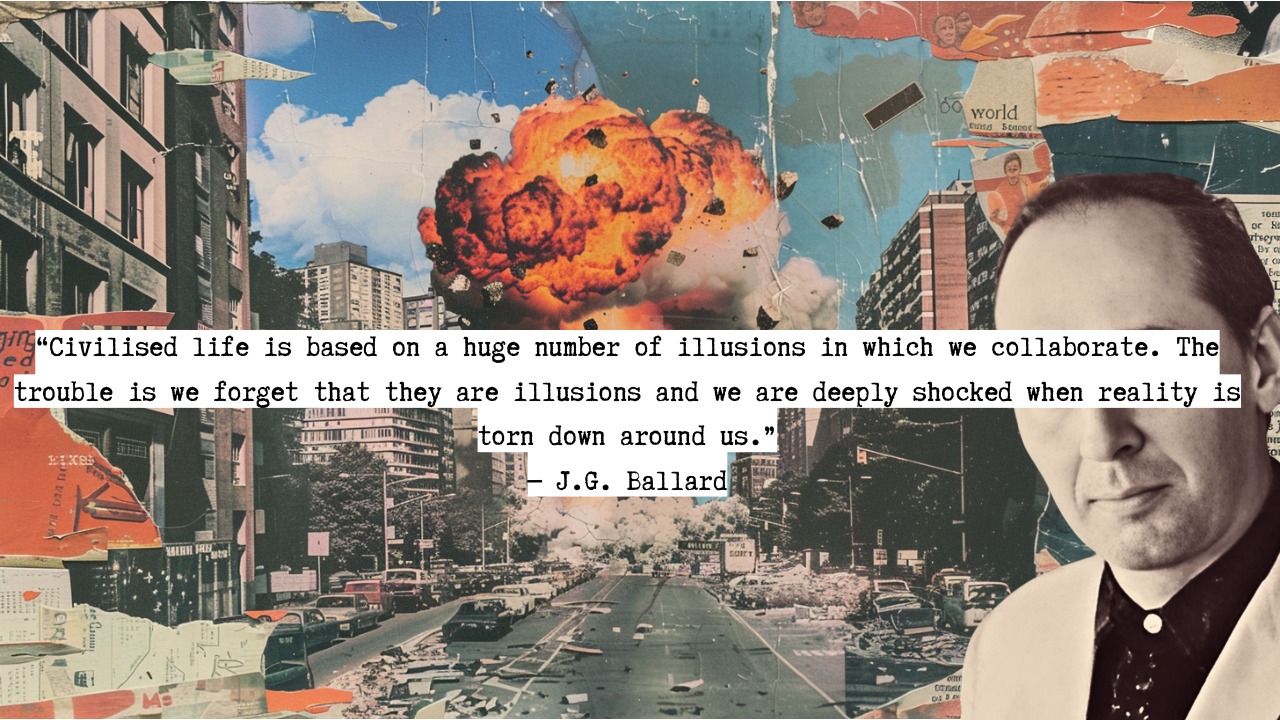
This meme utilizes the philosophical views of J.G. Ballard, who is often associated with the critique of the capitalist order. The chaotic collage depicts a city in the midst of a war to symbolize the destruction of the "illusion" of progress and stability. For an anti-neoliberal viewer, the text serves as a grim warning: we live in an economy based on a false narrative of collaboration, which is about to be violently dismantled by the harsh, unvarnished reality of the financial crisis.
simple-description (llama3.2-vision_11b)
The meme is a satirical image that critiques neoliberalism, a economic ideology that emphasizes free market principles and individualism. The image juxtaposes a chaotic and destructive cityscape with a quote from J.G. Ballard's novel "The Atrocity of the Alien" that critiques neoliberalism's effects on society. The image's text, "The world is a very strange and very very very strange place" is likely a quote from the novel.
detailed-analysis (gemma3-27b-vision)
Okay, let's break down the image using the requested theoretical lenses. Given the content, many of these lenses are highly applicable.
Visual Description
The image is a striking collage, composed of several distinct visual elements layered together. The central focus is a dramatically rendered illustration of an urban disaster – a city street decimated, with an explosion or significant structural collapse. Debris and wreckage litter the scene, and there's a strong sense of chaos and destruction. The color palette is dominated by reds, oranges, and grays, intensifying the sense of urgency and potential danger. The illustration is rendered in a stylized, slightly retro aesthetic, reminiscent of pulp magazine covers or mid-century modernist artwork.
Alongside this central image are fragments of photographs and text. A grainy black-and-white portrait of a man (likely the author, J.G. Ballard, as indicated by the quote) is juxtaposed with the devastation. The background features portions of architectural photographs, seemingly urban landscapes, and snippets of text from what appear to be news articles or printed material. The overall composition feels fragmented and deliberately chaotic, as if these elements are being torn apart and reassembled. The use of collage effectively suggests disruption, fragmentation, and the breakdown of established structures.
Postmodernism
This image is deeply rooted in postmodern aesthetic and philosophical principles. The use of collage itself is a core characteristic of postmodern art, rejecting the idea of a singular, unified, original work. The juxtaposition of images and text disrupts narrative coherence and challenges the viewer to create their own meaning.
The image embodies the postmodern rejection of grand narratives and totalizing systems of thought. The destruction depicted suggests the collapse of societal structures and the erosion of established values. The fragmented composition can be interpreted as representing the fragmented nature of experience in the late 20th and early 21st centuries.
The quote, "Civilized life is based on a huge number of illusions in which we collaborate. The trouble is we forget they are illusions and are deeply shocked when reality is torn down around us," is quintessential postmodern. It questions the authenticity of “civilization” and reveals it as a constructed reality, reliant on shared delusions. The shock felt when this reality is shattered is a key element of the postmodern condition.
Critical Theory
From a Critical Theory perspective, this image can be understood as a critique of modernity and its promises. The catastrophic scene doesn't just show physical destruction, it symbolizes the breakdown of the rational, ordered, and progressive project of modernity.
The quote highlights how society is built on a foundation of “illusions” – ideologies and narratives that mask power dynamics and social inequalities. The shock experienced when reality “is torn down” suggests a moment of awakening – a realization of the constructed nature of social norms and the underlying structures of domination.
The image invites us to question the underlying assumptions of our civilization and to recognize the ways in which we are complicit in maintaining illusory systems. It echoes Frankfurt School critiques of the culture industry, where manufactured desires and false consciousness are used to control and manipulate the population.
Marxist Conflict Theory
From a Marxist perspective, the image depicts the inevitable contradictions and crises of capitalist society. The devastation can be interpreted as a representation of the destructive forces inherent in a system driven by profit and competition.
The quote suggests that the "illusions" upon which civilized life is based are, in fact, ideological constructs used to maintain the existing power structure. The shock experienced when reality is "torn down" could be seen as a moment of class consciousness – a recognition of the exploitative nature of the system.
The image highlights the vulnerability of urban infrastructure and the fragility of social order in the face of economic or political upheaval. The debris and wreckage can be interpreted as the material consequences of class conflict and systemic failure.
Foucauldian Genealogical Discourse Analysis
Applying a Foucauldian lens, the image and quote challenge the notion of a stable and objective "reality." Instead, the image suggests that "reality" is constructed through discourse – through the language, narratives, and power relations that shape our understanding of the world.
The "illusions" referenced in the quote are not merely errors of perception, but rather the dominant discourses that define what is considered normal, acceptable, and true. These discourses are not neutral; they are always intertwined with power and serve to legitimize certain social arrangements while marginalizing others.
The catastrophic scene can be seen as a moment of disruption – a breaking down of the dominant discourses and the revealing of the underlying power structures that have been obscured. The image suggests that the collapse of "civilized life" is not necessarily a tragedy, but rather an opportunity to deconstruct the existing order and create new forms of knowledge and social organization.
Queer Feminist Intersectional Analysis (Applicable, but more nuanced)
While not immediately obvious, this image can be interpreted through a Queer Feminist Intersectional lens. The devastation depicted can be read as symbolizing the breakdown of traditional power structures, including patriarchal systems and heteronormative norms.
The quote about illusions and their shattering resonates with the experience of marginalized groups who have long been subjected to dominant narratives that erase or distort their experiences. The shock felt when reality is "torn down" can be seen as a moment of liberation – a reclaiming of agency and the construction of new, more inclusive realities.
The image invites us to consider the ways in which societal norms and values are often constructed to maintain hierarchies of power and privilege. By exposing the illusory nature of these structures, the image opens up space for alternative ways of being and relating. The fragility of the constructed world also highlights the vulnerability of those who are most marginalized within it.
I hope this detailed breakdown is helpful! Let me know if you'd like me to elaborate on any of these points or explore other theoretical perspectives.
tesseract-ocr
_— Al ; nO | | idea + uaa. ee ; ae ae f = . Pet roe A Se teks Se — ye ‘| sy ae ears 7 ¢ el Se ee , N w x me — < ee BP oid | eo _— f Ea: « & ¥ ; 3 a di ae : 5 tL ae iA _ | “@ os ~ NY t RI ee nm a Ny d vo ; oy oe if a Sls Sy , 4 foam > Nr 2 he . PN Ge ree { » Ei | “7a a ge: Ble er oe Eo E a WTO A “Civilised life is based on a huge number of illusions in which we collaborate. The _ trouble is we forget that they are illusions and we are deeply shocked when reality is| ‘ = ag H <> oom torn down around us.” §t)| Maa i aN | F q ie Me el ons a fe - q Va “s cea J.C. Ballard_je oa / 4 ‘ ee tie | Niges = nue SE a eee f 2. Aare | ee ae we J SCOR AN LS reo ee ieee ee l Gi 1) a eng: 7 pee er Se > a ue eg Ee ae ee ait es
simple-description (llama3.2-vision)
This meme is a humorous image of a city street with a massive explosion in the background, juxtaposed with a photo of a man looking concerned. The text overlayed on the image reads: "Civilised life is based on a huge number of illusions in which we collaborate. The trouble is we forget that they are illusions and we are deeply shocked when reality is torn down around us." The quote is attributed to J.G. Ballard.