First Seen
2025-05-12T06:19:20.687671+00:00
simple-description (qwen3.5_2b-q8_0)
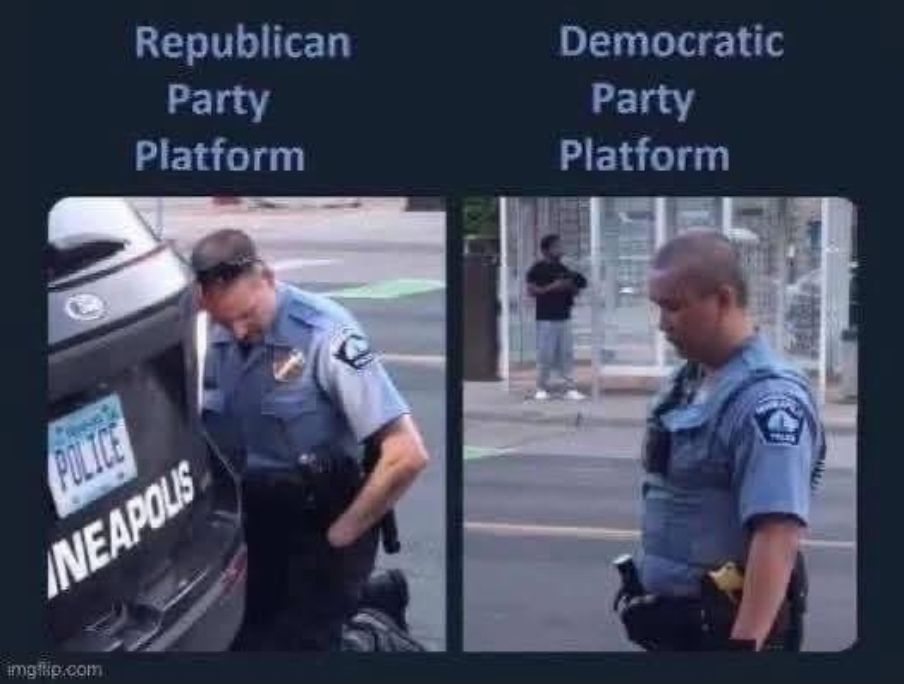
This meme contrasts the "Republican Party Platform" on the left with the "Democratic Party Platform" on the right. On the left, a police officer is depicted hunched over the trunk of a car, a posture often associated with aggressive government actions or corruption. On the right, a police officer stands alone, appearing distant or unresponsive. The text suggests a critique of the aggressive government efforts labeled on the left versus the perceived lack of active engagement on the right.
detailed-analysis (gemma3_27b-it-q8_0)
Okay, let's break down this meme from an anti-neoliberal perspective, using the lenses you've requested. It’s important to note that "anti-neoliberal" isn’t a singular, unified ideology, but rather a constellation of critiques often drawing from Marxist, poststructuralist, and other critical traditions. I'll focus on the themes most central to that broad framework.
Visual Description
The meme juxtaposes two images of police officers, ostensibly depicting the “platform” of the Republican and Democratic parties respectively.
- Republican Platform (Left): Shows a police officer leaning against a police car, seemingly checking something at his waist. The car is identified as being from the Minneapolis Police Department. The image has a strong association with the murder of George Floyd, as the backdrop is the site of that event, and the pose suggests a potential act of force or control. The body language is closed off, authoritative.
- Democratic Platform (Right): Shows a different police officer standing in a similar urban setting, looking downwards. A civilian is blurred in the background. The body language is less immediately confrontational, but still implies observation and potential control.
The clear intention is to present the Democratic platform as slightly less overtly violent/oppressive than the Republican platform, but still fundamentally linked to policing.
Foucauldian Genealogical Discourse Analysis
From a Foucauldian perspective, the meme highlights the historical construction of power relations through discourses of law and order, security, and criminality.
- Discipline & Punish: Both images represent the continuation of disciplinary power. Foucault argued that modern power doesn't simply repress, but produces subjects through normalization. The police, as a visible manifestation of the state, are central to this process. Both images – Republican and Democrat – show this force in action.
- Governmentality: The meme suggests that how the state governs is being debated (Republican vs. Democrat), but not whether it governs through these mechanisms of control. The very framing implies that the question is not about abolishing policing, but about modulating its expression.
- Genealogy of the Police: Tracing the historical development of the police reveals its roots in controlling populations (especially marginalized ones) and maintaining social order in the wake of social upheaval. The Minneapolis connection points to this history—the city becoming a flashpoint for racial justice activism.
Critical Theory
The meme, viewed through the lens of Critical Theory (particularly the Frankfurt School), can be interpreted as a critique of the "instrumental reason" embedded within the political system.
- Repressive Tolerance: Both parties offer versions of "tolerance" that ultimately reinforce existing power structures. The Democrat's 'less harsh' policing is a form of repressive tolerance, giving the illusion of progress while maintaining the fundamental structures of control.
- Culture Industry: The meme is itself a product of the culture industry, a simplified representation of complex political realities. It encourages a focus on superficial differences (the degree of policing) rather than questioning the entire system.
- Domination: Critical theorists would see both images as indicative of a system of domination, where the state apparatus (embodied by the police) maintains control over the population, reproducing inequality.
Marxist Conflict Theory
This is perhaps the most potent lens for the anti-neoliberal reading of the meme.
- State as Instrument of Class Rule: Marxists would see the police as an inherently class-based institution, serving to protect the interests of the capitalist class by suppressing dissent and maintaining the conditions for exploitation. Both police images demonstrate this function.
- False Consciousness: The meme's framing could be interpreted as creating a “false consciousness” by suggesting that a shift to the Democratic platform offers a real solution to systemic problems. This distracts from the need to fundamentally challenge the capitalist system.
- Revolutionary Potential: The image from Minneapolis, referencing the George Floyd protests, hints at the potential for revolutionary struggle. The implicit message is that merely modifying policing isn't enough; a systemic transformation is needed.
- Commodity Fetishism: The police force is presented as a sort of "service" or "commodity" that can be bought by the public through voting for a party. This obscures the underlying power dynamics that give rise to policing in the first place.
Postmodernism
From a postmodern perspective, the meme's effectiveness lies in its deconstruction of the idea of a stable political “platform.”
- Deconstruction of Binary Oppositions: The meme establishes a binary (Republican/Democrat) but ultimately undermines it by demonstrating the shared underlying structures (policing) that connect both sides.
- Simulacra and Simulation: The images can be seen as simulacra, representations of power that lack a real referent. They are signs pointing to other signs, obscuring the actual material conditions of power.
- Rejection of Grand Narratives: The meme implicitly challenges the grand narratives of both parties, suggesting that neither offers a truly transformative solution to the problems of social injustice.
Queer Feminist Intersectional Analysis
While less direct, this perspective adds critical nuance:
- Intersectionality of Oppression: The police disproportionately target and harm marginalized communities, including people of color, LGBTQ+ individuals, and the poor. The meme, especially when linked to the context of Minneapolis, points to this intersectional violence.
- Carceral Feminism: A queer feminist perspective would likely critique the Democratic Party's reliance on carceral solutions (increased policing, stricter laws) even when framed as progressive interventions.
- Challenging Normative Power: The police embody and enforce normative standards of behavior (gender, sexuality, race). The meme implicitly challenges these norms by showing the police as agents of control and oppression.
In conclusion: From an anti-neoliberal standpoint, the meme isn’t simply a comparison of two parties. It’s a critique of the entire political system, which is seen as fundamentally aligned with maintaining capitalist power relations through repressive state apparatuses like the police. It gestures towards the need for more radical forms of social transformation beyond merely shifting between different expressions of the same system. It's a cynical but effective piece of political commentary.
simple-description (llama3.2-vision_11b)
This meme is a commentary on the perceived differences between the Republican and Democratic parties in the United States. The image juxtaposes a police officer in a Republican-style uniform (e.g., a "Don't Tread on Me" patch) with a police officer in a Democratic-style uniform (e.g., a "Black Lives Matter" patch). The text "Republican Party Platform: Police Can Do Anything" and "Democratic Party Platform: Police Must Follow Law" highlights the contrast between the two parties' approaches to law enforcement.
detailed-analysis (gemma3-27b-vision)
Okay, let's analyze the image through the requested theoretical lenses. This image is complex and deeply resonant, particularly in the context of the events surrounding George Floyd's murder and the subsequent protests. Here's a breakdown, with sections only for applicable theories.
Please note: This is an interpretation based on the visual information and the title provided ("Republican Party Platform" vs. "Democratic Party Platform"). The creator is presenting these as symbolic associations; it's important to acknowledge this inherent framing.
Visual Description
The image presents two side-by-side photographs, each associated with a political party.
- Left (Republican Platform): A police officer is leaning against a police vehicle (identified as "Minneapolis Police"), with his hand on his gun. The image is grainy and appears to be taken from a low angle, suggesting a sense of confrontation or dominance. A partially visible figure is on the ground.
- Right (Democratic Platform): A police officer is kneeling on the ground. The image is slightly more distant, and the surroundings appear more urban. The officer's stance is more subdued, seemingly suggesting a posture of humility or repentance.
The stark contrast between the two images is the primary visual message. The framing suggests a direct comparison of how each party seemingly views/treats/is associated with policing.
Foucauldian Genealogical Discourse Analysis
This image is ripe for Foucauldian analysis. Michel Foucault’s work examines the relationship between power, knowledge, and discourse.
- Discipline & Surveillance: The officer leaning against the car (Republican side) embodies a classical panoptic disciplinary power. The officer’s stance, hand on the weapon, implies control and the potential for force. This evokes a history of policing focused on maintaining order through surveillance and punishment.
- Genealogy of Policing: Foucault would ask us to trace the historical development of policing practices, seeing them not as neutral tools for maintaining order, but as historically contingent formations of power. The Republican image visually evokes the historical roots of US policing—the legacy of slave patrols and the suppression of dissent.
- Biopower: The kneeling officer (Democratic side) suggests a potential shift in the exercise of power. Kneeling can be seen as an attempt to perform contrition or empathy, signifying a move toward acknowledging and addressing the harm caused by policing, and thereby exercising “biopower” – the control of life itself. However, this can also be seen as performative and superficial.
- Discourse & Truth: The image presents a discourse about the role of policing in society. By associating the Republican party with aggressive power and the Democratic party with a more conciliatory approach, it constructs a particular "truth" about their differing ideologies.
Critical Theory
The image prompts a critical examination of power structures and social norms.
- Ideology: The image is itself an ideological statement. By linking political parties to specific policing practices, it reinforces certain beliefs about their respective approaches to law and order, justice, and social control.
- Hegemony: The image hints at a struggle for hegemony—the dominant ideology in society. The image suggests that both parties are trying to establish their preferred narrative around policing. The Democratic side attempts to position itself as empathetic and progressive, challenging the traditional power dynamics associated with policing.
- Social Control: The images demonstrate how the state (through policing) exercises social control. The Republican side suggests a control maintained through force and intimidation. The Democratic side implies a control that attempts to integrate social justice concerns.
- Deconstruction: A critical theorist would deconstruct the image's inherent binaries (aggressive vs. empathetic, control vs. reconciliation), revealing the complexities and contradictions within each position.
Marxist Conflict Theory
From a Marxist perspective, the image highlights class conflict and the role of the state in maintaining the status quo.
- State as Instrument of Oppression: Marxist theory sees the state, and its tools like policing, as serving the interests of the ruling class. The Republican side's image visually embodies this, depicting police as protectors of property and enforcers of social order that benefits those in power.
- Class Struggle: The image implies that the Democratic platform is attempting to address the grievances of marginalized groups, while the Republican platform maintains the existing power structures. The kneeling officer can be seen as a symbolic gesture towards pacifying social unrest.
- Ideological Hegemony: Both parties utilize ideology to maintain their power. The images can be viewed as attempts to create a dominant narrative about policing and social control.
Queer Feminist Intersectional Analysis
From this perspective, the image demands a consideration of how policing impacts marginalized communities, particularly Black and Brown bodies, and how that intersects with other forms of oppression.
- Violence & Policing: The Republican image immediately evokes the history of police violence against Black people, particularly in the context of the George Floyd protests. The officer’s stance and proximity to someone on the ground highlight the potential for brutality.
- Intersectionality: The image begs the question of how race, class, gender, and sexuality intersect in the context of policing. Black queer and trans individuals are disproportionately targeted by police, and the image acknowledges the way systemic violence affects multiple vulnerable populations.
- Challenging Power: The kneeling officer, from a queer/feminist perspective, can be read as a symbolic gesture, but also as potentially co-opted and performative. Does this signal a genuine commitment to dismantling oppressive systems, or simply an attempt to appear progressive?
- Representation and Discourse: The image, as a symbolic representation, reinforces existing power dynamics and narratives around policing. A critical analysis would question whose voices are absent and how this impacts the discourse.
Disclaimer: These analyses are interpretations, and other readings are certainly possible. This image is complex and emotionally charged, and its meaning is open to debate.
simple-description (llama3.2-vision)
The meme is a comparison between the Republican and Democratic parties' approaches to law enforcement. It features two images of a police officer, one with the words "Republican Party Platform" above it and the other with "Democratic Party Platform" above it. The first image shows the officer struggling to get a boot off his foot, while the second image shows the same officer easily removing his boot. The text above the images reads: "Republican Party Platform: Cops can't even get a boot off their own foot. Democratic Party Platform: Cops can't even get a boot off their own foot."