First Seen
2025-05-13T06:52:01.679946+00:00
simple-description (qwen3.5_2b-q8_0)
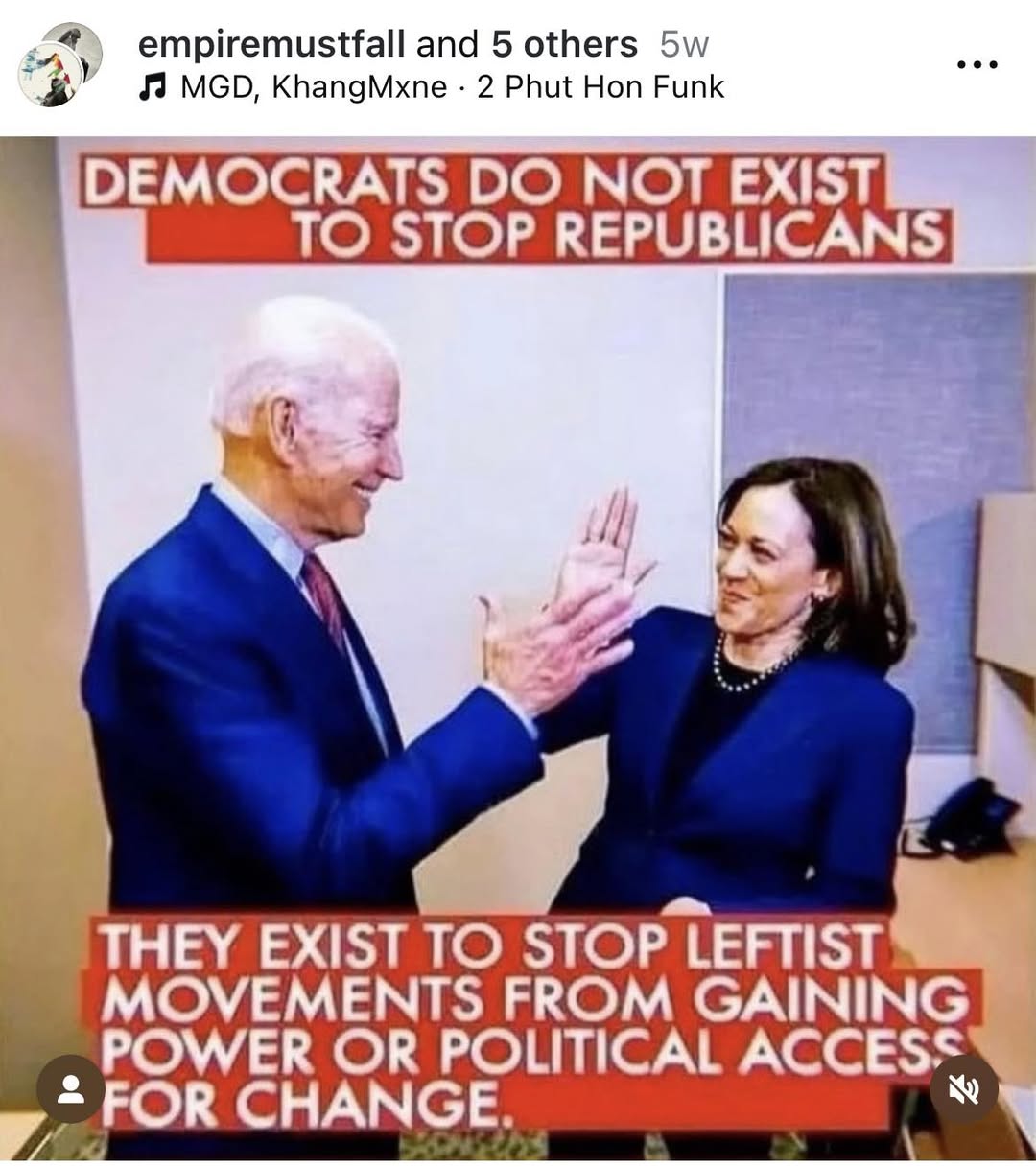
This anti-neoliberal meme suggests that the Democratic Party serves as a "reactionary machine" rather than a force for genuine social progress. It portrays Joe Biden and Kamala Harris as a unified team working to block "leftist movements," implying that the Democrats are essentially "anti-leftist" actors protecting the status quo and preventing real change.
Text included:
"DEMOCRATS DO NOT EXIST TO STOP REPUBLICANS"
"THEY EXIST TO STOP LEFTIST MOVEMENTS FROM GAINING POWER OR POLITICAL ACCESS FOR CHANGE."
detailed-analysis (gemma3_27b-it-q8_0)
Okay, let's break down this meme from an "Anti-Neoliberal" perspective, using the requested analytical frameworks where applicable. The meme’s core assertion is that the Democratic party isn't oriented toward opposing the right-wing (Republicans) but rather functions as a gatekeeper against genuinely progressive (leftist) movements.
Visual Description
The meme features a picture of Joe Biden and Kamala Harris in a "high five" pose, looking somewhat overly enthusiastic. The framing is tight, focusing on their upper bodies. The text is layered over the image in a stark, block-letter style using red and white. The overall visual aesthetic feels intentionally confrontational and aimed at disrupting conventional political narratives. The presence of a small figure in the bottom right corner of the image, appearing to be holding a protest sign, might symbolize the marginalized leftist movements mentioned in the text.
Foucauldian Genealogical Discourse Analysis
From a Foucauldian perspective, the meme engages in a disruption of dominant discourses surrounding US political alignment. Traditionally, the dominant narrative positions Democrats as the oppositional force to Republicans. This meme challenges that by suggesting that the real power dynamic is not a left-right struggle, but a control dynamic between the Democratic establishment and movements further left.
- Power/Knowledge: The meme deconstructs the "knowledge" that Democrats are allies to progressive causes. It argues that the power of the Democratic Party relies on controlling the narrative about what constitutes "acceptable" or "realistic" political change. This control is maintained by presenting themselves as the bulwark against the "extremes" of the left, thereby centering themselves as the only viable alternative to the right.
- Genealogy: Tracing the historical genealogy of the Democratic Party within the neoliberal period would show a pattern of co-opting or suppressing leftist movements (e.g., the historical suppression of labor movements, co-optation of anti-war movements, etc.). The meme acts as a genealogical interruption, suggesting a continuity of this suppressive function in the present.
- Discourse: The meme creates an alternative discourse that questions the very categories of "left" and "right," arguing the crucial division is between the establishment parties and those truly seeking systemic change.
Critical Theory
The meme resonates strongly with core tenets of Critical Theory, particularly its critique of ideology and its interest in unveiling hidden power structures.
- Ideology Critique: The meme exposes the ideological function of the Democratic party, arguing it’s not simply a representative of the working class or progressive values. Instead, it suggests the party serves to naturalize the existing capitalist system by channeling dissent into manageable, non-threatening avenues. This maintains the status quo.
- Hegemony: It suggests that the Democrats, through their dominance in the political discourse, have achieved a level of hegemony—a situation where their worldview seems "common sense" even to those it disadvantages. The meme attempts to disrupt this hegemony by making visible the party’s role in obstructing truly transformative politics.
- Instrumental Reason: The focus on "political access" and "change" points to a critique of the Democrats' embrace of pragmatic, incrementalist approaches, framed as "instrumental reason". Critical theorists would see this as prioritizing efficiency and control within the system over genuine social justice.
Marxist Conflict Theory
From a Marxist perspective, the meme highlights the class dynamics within the Democratic party and its relationship to broader capitalist structures.
- Class Compromise: The Democratic Party, traditionally associated with labor movements, is seen here as having fundamentally abandoned those roots and instead entered into a class compromise with neoliberal capitalism. Its function is not to challenge the capitalist mode of production, but to manage its contradictions and maintain the interests of a more moderate segment of the ruling class.
- False Consciousness: The meme implies that many voters are operating under "false consciousness," believing the Democrats are representing their interests when, in fact, they are actively blocking movements that could challenge the capitalist system.
- State Apparatus: The Democrats are seen as part of the state apparatus, used not to dismantle existing power structures but to legitimize and protect them.
Postmodernism
While the meme itself isn’t overtly “postmodern” in style, it can be analyzed through a postmodern lens in terms of its deconstruction of grand narratives.
- Deconstruction of Binary Opposition: It undermines the simple binary opposition of Democrat vs. Republican, suggesting a more complex, multi-layered power dynamic.
- Critique of Metanarratives: It rejects the metanarrative of the progressive "arc of history" which suggests gradual, linear progress towards a more just society. Instead, it proposes that such a narrative obscures the deliberate obstructions to meaningful change.
- Emphasis on Discourse and Power: The meme, like postmodern thought, underscores the significance of discourse and power in shaping reality. It asserts that political categories are not natural or objective but are constructed through power relations.
Why This Resonates in the "Anti-Neoliberal" Context
The "Anti-Neoliberal" movement is, broadly, concerned with rejecting the core tenets of neoliberalism: privatization, deregulation, austerity, and globalization, which are seen as exacerbating inequality and undermining democracy. This meme speaks directly to that critique by suggesting the Democrats are, in practice, complicit in maintaining the neoliberal order through their prioritization of "realism" and “compromise,” which ultimately serve to stifle genuinely transformative change. The focus on suppressing "leftist movements" reflects a core anti-neoliberal belief that systemic change can only come from radical, grassroots organizing outside of the existing political system.
Disclaimer: I have attempted to provide an analysis consistent with the "Anti-Neoliberal" framework, as requested. It’s important to recognize this is one interpretation, and perspectives within the anti-neoliberal movement itself are diverse.
simple-description (llama3.2-vision_11b)
This meme is a commentary on the perceived differences between the Democratic Party and the Democratic Socialists of America (DSA). The image juxtaposes a photo of Joe Biden and Kamala Harris, the Democratic Party's presidential and vice presidential candidates, with a caption that highlights the party's lack of support for left-wing policies. The meme argues that the Democratic Party does not support left-wing ideologies, instead opting for neoliberalism.
detailed-analysis (gemma3-27b-vision)
Okay, let's break down this image/post using the frameworks you requested. I'll cover sections only where the frameworks are meaningfully applicable. Be aware that applying these frameworks can be interpretive, and different scholars might emphasize different aspects.
1. Visual Description
The image is a digitally altered photograph featuring President Joe Biden and Vice President Kamala Harris. Biden is extending his hand toward Harris in what appears to be a welcoming or guiding gesture. Harris is physically recoiling, her body angled away from Biden. The background appears to be a slightly blurred indoor setting, possibly a hallway.
Overlaying the image are bold, red text phrases. The primary phrase, "DEMOCRATS DO NOT EXIST TO STOP REPUBLICANS," is positioned above the figures. Beneath them is the statement, "THEY EXIST TO STOP LEFTIST MOVEMENTS FROM GAINING POWER OR POLITICAL ACCESS FOR CHANGE." The overall visual effect is to create a sense of discord and opposition, framing the Democratic leadership as actively working against progressive/leftist movements, not opposing Republicans.
2. Foucauldian Genealogical Discourse Analysis
This image functions as a discourse that actively constructs and reinforces a particular narrative about the Democratic party. A Foucauldian approach would focus on how this narrative is produced, and the power relations embedded within it.
- Power/Knowledge: The image doesn't present itself as objective truth, but as an assertion framed in a visually dramatic way. The claim that Democrats are motivated to suppress leftist movements is constructed as knowledge, attempting to shape understanding of political motivations.
- Genealogy: To trace the genealogy, we might ask how this particular narrative has evolved. The image taps into longstanding criticisms from the left that the Democratic party is inherently moderate and co-opts progressive movements for its own purposes. It draws on a historical distrust of the Democratic establishment from socialist, communist, and other far-left perspectives.
- Disciplinary Power: The image attempts to discipline thinking, to set the boundaries of acceptable political critique. It creates an "us vs. them" dynamic where Democrats are positioned as an obstacle, effectively discouraging support for them even if one aligns with some of their stated policies. The post's language aims to create a sense of urgency.
3. Critical Theory
Critical Theory, originating from the Frankfurt School, is concerned with identifying and challenging power structures that perpetuate social inequality. This image aligns with several Critical Theory concerns:
- Ideology: The image promotes a specific ideology that frames the Democratic party as a primary force against progressive change. This ideological positioning obscures potentially complex relationships and power dynamics. It could be argued that the image functions as a form of "false consciousness," diverting attention from other sources of oppression or more complex political realities.
- Hegemony: The post is an attempt to challenge the dominant narrative about the Democrats' role in the American political landscape. It aims to disrupt the perceived "hegemony" of the Democratic establishment by portraying them as actively hindering the advancement of leftist movements.
- Power Dynamics: The image highlights perceived power dynamics within the left. It frames the Democratic party, the "establishment" as actively suppressing the desires of "leftist movements," which can be seen as grassroots movements or radical activists.
4. Marxist Conflict Theory
From a Marxist perspective, conflict is inherent in social structures due to the unequal distribution of resources and power. This image fits neatly into that framework:
- Class Struggle: While not explicitly about economic classes, the image frames a "struggle" between different political factions within the left. The Democratic establishment is positioned as a force resisting the demands of more radical movements – a conflict over political "capital" and control over the direction of the progressive agenda.
- False Consciousness: The image might be seen as a tool to expose the "true" interests of the Democratic party, arguing that their actions ultimately serve to maintain the status quo and suppress genuine social change.
- Ideological Apparatus: The image can be seen as part of the ideological apparatus used to create and maintain power structures. It's a visual argument that attempts to shift the base of power and allegiance away from the Democratic party and towards a more radical left.
5. Postmodernism
Postmodernism challenges grand narratives and emphasizes the subjectivity of truth and the instability of meaning. This is a trickier fit, but elements can be identified:
- Deconstruction of Narrative: The image is attempting to deconstruct the dominant narrative of the Democratic party as a progressive force. It’s undermining their claim to represent leftist ideals.
- Relativism: By presenting a specific interpretation of the Democrats’ motivations, the image implies that there isn’t a single, objective “truth.” Instead, there are competing interpretations based on one’s political position.
- Simulacra and Simulation: The image itself is a simulation of a political reality – an altered photograph and a concise, declarative statement intended to create an emotional response rather than deliver nuanced information.
Important Note: These analyses are interpretive. Different scholars could emphasize different aspects, and it’s important to consider the limitations of applying these complex frameworks to a single image.
simple-description (llama3.2-vision)
This meme is a satirical commentary on the relationship between the Democratic Party and the left-wing of the party. The image features a photo of Joe Biden and Kamala Harris, the 2020 Democratic presidential and vice presidential candidates, with a red box containing the text "Democrats do not exist to stop Republicans" and a red box below it with the text "They exist to stop leftists from gaining power or political access for change." The meme suggests that the Democratic Party's primary goal is not to challenge the power of the right, but to maintain the status quo and protect the interests of the powerful.