First Seen
2025-06-12T21:18:21.288993+00:00
simple-description (qwen3.5_2b-q8_0)
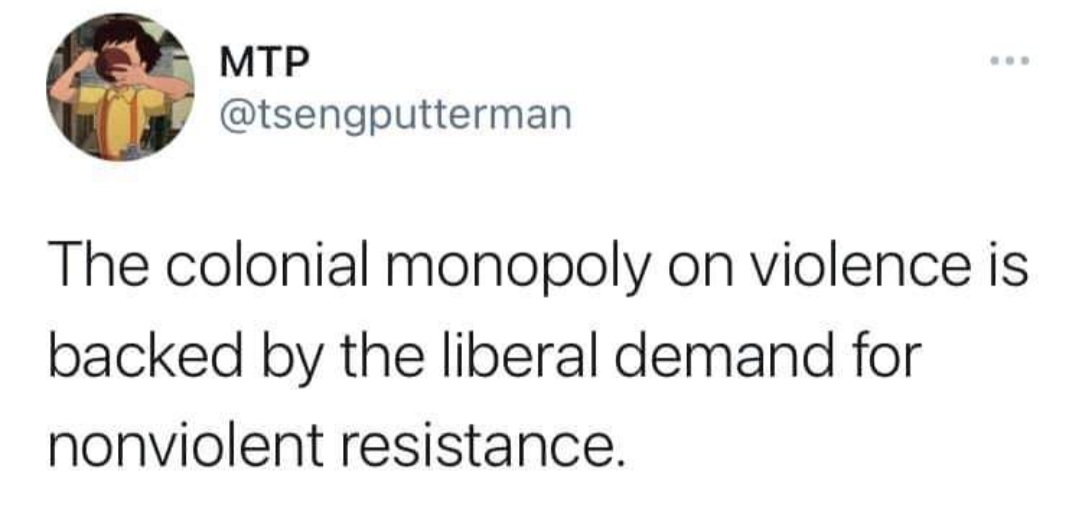
This anti-neoliberal meme serves as a critique of the idea that demanding nonviolence is a valid political stance when it is used to defend colonialism. The text reads: "The colonial monopoly on violence is backed by the liberal demand for nonviolent resistance." It argues that those in power (colonialists) are hypocritical because they hold the power to use force while activists insist on nonviolence, rendering their demands for peace illegitimate.
detailed-analysis (gemma3_27b-it-q8_0)
Okay, let's break down this meme through the lens of an anti-neoliberal framework, exploring the relevant theoretical perspectives.
Image Description
The image features a character from the cartoon Hey Arnold!, with a hand to his forehead in a gesture of distress. This character, Helga Pataki, is generally known for her aggressive, often violent, emotional outbursts, particularly directed at Arnold. The ironic usage of her image is key to the meme's meaning, which will be explored below.
Critical Theory
This meme is deeply rooted in Critical Theory, particularly the Frankfurt School's critiques of instrumental reason and the co-option of dissent. The central argument asserts that the insistence on "nonviolent resistance" from liberal forces functions not to dismantle structures of power, but to reinforce them.
Here's how:
- Reproduction of Power Dynamics: The demand for nonviolence, according to this perspective, is not neutral. It frames violence as inherently illegitimate, a framing already established by those in power (the "colonial" force). By accepting this framing, the oppressed are effectively disarmed – not just physically, but strategically. They are asked to play by the rules of the system that oppresses them.
- Pacification & Control: The "colonial monopoly on violence" isn't simply about physical force (though that’s part of it). It's about the power to define what counts as violence, and to control the narrative around conflict. Insisting on nonviolence allows the colonizer to easily demonize and suppress any resistance that deviates from this prescribed norm.
- Co-optation of Resistance: Critical theorists argue that liberalism often co-opts radical demands, neutralizing them by integrating them into the existing system. The demand for nonviolence is seen as such a co-option – a way to make resistance palatable and, ultimately, ineffective. It allows the colonial power to claim the moral high ground.
Marxist Conflict Theory
From a Marxist perspective, the meme points to the fundamental contradiction inherent in a system built on exploitation and domination.
- Class Struggle & State Violence: The “colonial monopoly on violence” represents the state’s (acting on behalf of the ruling class) control over the means of coercion – police, military, legal system. This violence is necessary to maintain the capitalist system and suppress any challenges to its power.
- False Consciousness & Ideology: The call for nonviolent resistance is framed as part of the ideological apparatus that maintains the status quo. It’s a way to foster “false consciousness” – the belief that change can be achieved within the existing system, without fundamentally challenging the underlying power relations. It obscures the fact that systemic change often requires disruption, and that the ruling class will always use violence to protect its interests.
- Hegemony: The meme suggests that liberal ideas about nonviolence have achieved a degree of "hegemony" – they are widely accepted as common sense, even by those who are oppressed. This hegemony prevents people from seeing the legitimacy of more radical forms of resistance.
Foucauldian Genealogical Discourse Analysis
Applying a Foucaultian lens:
- Discourse & Power/Knowledge: The meme analyzes the discourse surrounding violence and resistance. Foucault argues that power isn’t simply repressive; it’s also productive. It produces knowledge and shapes our understanding of the world. The discourse that defines violence as inherently wrong and resistance as necessarily nonviolent is a power/knowledge regime. It's a system that creates its own truth and legitimizes certain forms of action while delegitimizing others.
- Genealogy & Historical Contingency: Foucault's genealogical method involves tracing the historical origins of concepts to reveal their contingency. This meme implies that the notion of nonviolent resistance isn't a timeless ethical principle, but a historical construct that emerged in specific power relations. The “colonial” element of the statement implies this origin and the continued reinforcement of these ideals.
- Biopower: The control over what is considered "legitimate" resistance can be seen as an exercise of biopower – the way in which power operates on the level of life itself. By dictating the terms of resistance, the colonial power controls how people can even attempt to live and fight for their freedom.
Why Helga Pataki?
The use of Helga’s image is crucial. She is a character known for her emotional (and sometimes physical) aggression, which she often represses. The image implicitly suggests that the supposed "peacefulness" of nonviolent resistance is itself a form of repression – a suppression of the legitimate anger and frustration of the oppressed. It challenges the idea that violence is always inherently negative, suggesting that sometimes it's a natural and understandable response to injustice.
In essence, the meme is a sharp critique of how liberal ideology can function as a tool for maintaining colonial power structures, and a provocation to reconsider the strategic value of various forms of resistance.
simple-description (llama3.2-vision_11b)
The meme is a screenshot of a tweet that reads: "The colonial monop[...]" which is cut off. The full text is not visible, but the part that is visible reads: "The colonial monop[...]" which is cut off. The full text is not visible, but the part that is visible reads: "The colonial monop[...]" which is cut off.
detailed-analysis (gemma3-27b-vision)
Okay, let's break down this tweet through the requested theoretical lenses. Given the succinctness of the text, the analyses will lean toward interpretations and potential applications of the theories, rather than extensive, definitive readings.
Visual Description
The image is a typical social media post. A circular profile picture (of a cartoon-like figure) accompanies a username "@tsengputterman," alongside a brief, provocative statement. The design is sparse, common to platforms like X (formerly Twitter). This simplicity reinforces the message’s immediate accessibility but also suggests it is intended for rapid consumption and circulation in a digitally mediated environment.
Critical Theory
This tweet immediately draws on key tenets of Critical Theory, particularly within the Frankfurt School tradition. It implicitly critiques power structures and the ways in which they are maintained.
- Power Dynamics: The core of the statement centers on the “colonial monopoly on violence.” This speaks to the historical and ongoing asymmetrical power relationships between colonizers and colonized. The statement argues violence isn’t simply committed by colonizers but is allowed to them, and framed as their legitimate right, while the colonized are often denied the right to respond in kind, even defensively.
- Hegemony: The connection between the “colonial monopoly” and the “liberal demand for nonviolent resistance” is where the most interesting critical analysis lies. It suggests that the demand for nonviolence, even when originating from well-intentioned sources, can serve to reinforce colonial power structures. By setting the terms of acceptable resistance, it effectively disarms those who are resisting oppression and allows the powerful to maintain control.
- Ideology: It implies that the framing of nonviolence as universally applicable is an ideological construct that masks the power imbalances at play. The statement asks whether the insistence on nonviolence might be a way of pacifying dissent and preserving the status quo.
Marxist Conflict Theory
From a Marxist perspective, this statement aligns with the idea that history is driven by class conflict and struggles for power.
- Oppressor/Oppressed: The “colonial monopoly on violence” establishes a clear dynamic between oppressor (the colonizer) and oppressed (the colonized). Violence is seen not just as physical harm, but as a tool of control and exploitation.
- False Consciousness: The critique of "liberal demand for nonviolent resistance" can be seen as uncovering a form of false consciousness. The demand for nonviolence, while perhaps seemingly moral, may prevent the oppressed from realizing their true revolutionary potential and challenging the material conditions of their exploitation. It suggests that the insistence on nonviolence obscures the structural violence inherent in colonialism.
- Revolution: Implies that true liberation requires a direct challenge to the existing power structures, and that nonviolence may unintentionally serve to perpetuate those structures.
Foucauldian Genealogical Discourse Analysis
A Foucauldian approach would focus on how the concepts of "violence" and "nonviolence" have been historically constructed and how these constructions are linked to power.
- Discourse and Power: The statement highlights how discourse—the ways we talk about and understand violence and nonviolence—is not neutral. It is tied to power relations. The “colonial monopoly on violence” isn't simply about physical acts; it’s about the discourse that legitimizes certain forms of violence while delegitimizing others.
- Genealogy: A genealogical analysis would trace the historical origins of these discourses. For example, one could explore how the concept of “civilized” violence versus “barbaric” violence was used to justify colonialism. The demand for nonviolence, then, might be seen as a continuation of this historical construction, framing certain forms of resistance as unacceptable.
- Power/Knowledge: This tweet implicitly links power and knowledge. The ability to define what constitutes "violence" and to demand "nonviolence" is a form of power. This power shapes our understanding of resistance and limits the possibilities for challenging the status quo.
Postmodernism
A postmodern reading would challenge the idea of universal truths or objective meanings.
- Deconstruction: The statement implicitly deconstructs the binary opposition between violence and nonviolence. It suggests that the terms are not fixed or neutral, but are socially constructed and used to maintain power relations.
- Relativism: It challenges the assumption that nonviolence is always the most ethical or effective form of resistance. While not necessarily advocating for violence, it suggests that the context and power dynamics must be considered.
- Meta-narratives: It resists the idea of a single, grand narrative about resistance. Instead, it suggests that resistance must be understood in its specific historical and cultural context.
Queer Feminist Intersectional Analysis
While the statement doesn’t explicitly mention gender or sexuality, an intersectional reading can still be applied.
- Interlocking Systems of Oppression: Colonialism is rarely simply about land and resources. It also operates through patriarchal, racial, and often homophobic structures. The “colonial monopoly on violence” affects different groups in different ways.
- Disrupted Violence: Historically, colonial violence often involves targeting and disrupting Indigenous ways of life which include cultural practices and familial systems.
- Silencing: The demand for nonviolent resistance, when applied to colonized peoples, can also be a way of silencing their voices and experiences. It can deny them the agency to define their own strategies for liberation.
In Conclusion
The tweet, while brief, is a complex statement that lends itself to multiple interpretations through various theoretical lenses. It provides a critical commentary on the ways in which power operates, the construction of ideologies, and the limitations of conventional approaches to resistance. It encourages us to question the assumptions behind our concepts of violence and nonviolence and to consider the broader context of colonialism and oppression.
Let me know if you'd like me to elaborate on any of these analyses or explore additional theoretical frameworks!
simple-description (llama3.2-vision)
The meme is a humorous image that uses a popular internet meme format to poke fun at the idea of a "colonial" or "colonizer" type of person who is actually just a "liberal" or "leftist" who is trying to be a "colonizer" type of person. The image shows a character from the popular animated TV show "Adventure Time" saying "I'm a colonizer, I'm a colonizer" in a funny and exaggerated way, implying that someone who is trying to be a "colonizer" type of person is actually just a "liberal" or "leftist" who is trying to be a "colonizer" type of person.