First Seen
2025-07-11T17:01:40+00:00
simple-description (qwen3.5_2b-q8_0)
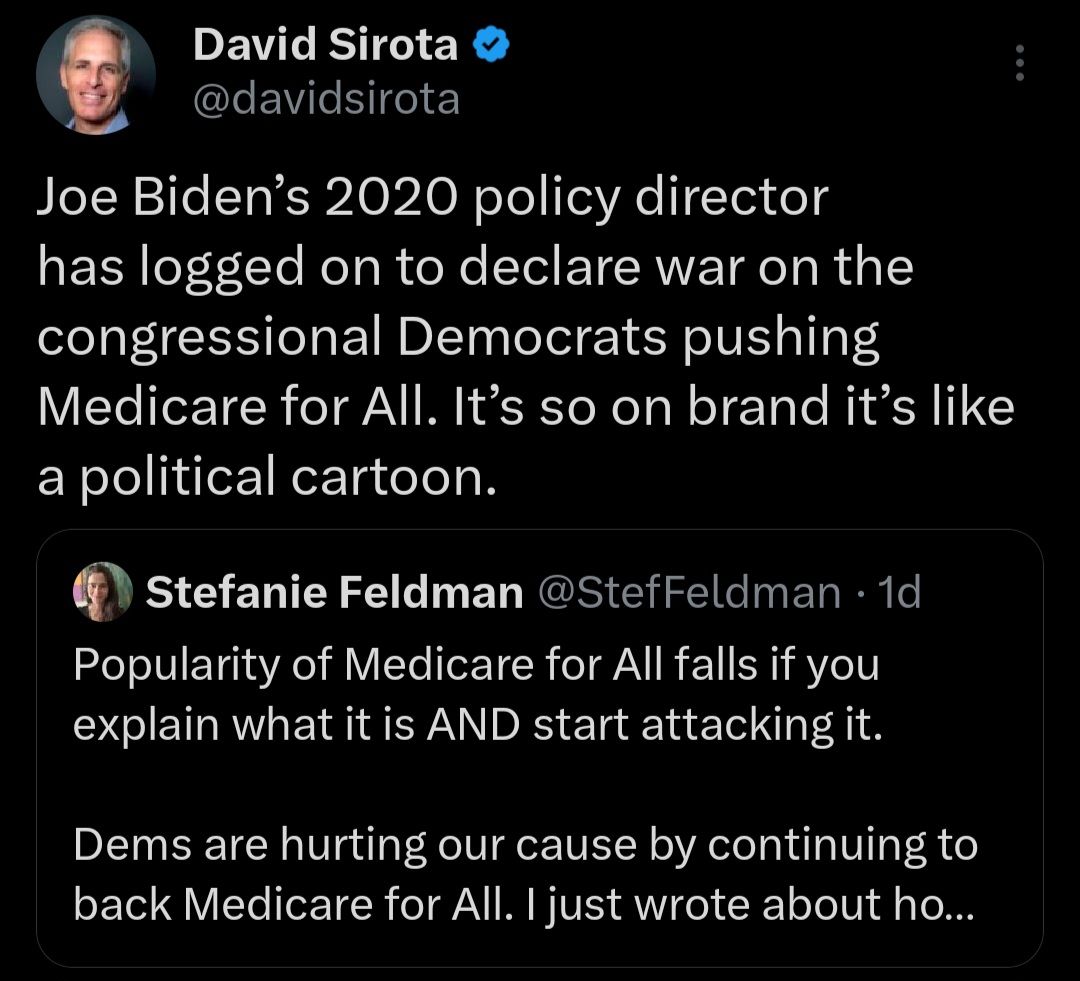
This meme illustrates an anti-neoliberal clash between two opposing views on healthcare policy and political discourse. The first speaker, David Sirota, frames attacking a politician’s policy as harmless art to downplay the seriousness of the debate. In contrast, the second speaker argues that engaging with policies like Medicare for All and actively attacking opponents is essential for supporting a progressive cause. She suggests that Democrats are "hurting their own cause" by attacking politicians instead of just discussing health care reform.
detailed-analysis (gemma3_27b-it-q8_0)
Okay, here's an analysis of the provided Twitter exchange, framed from an Anti-Neoliberal perspective, using the requested theoretical lenses where applicable. I’ll organize it into sections based on the headings you provided. Since this is largely a political statement, the theoretical application will emphasize the political arguments within those frameworks.
Context: Anti-Neoliberalism
Before diving in, it's crucial to define "Anti-Neoliberalism" as the lens here. This isn't simply being "left-of-center." Anti-Neoliberalism is a broad political project that critiques the pervasive influence of neoliberal policies (deregulation, privatization, austerity, free trade) that came to dominate global politics in the late 20th and early 21st centuries. It argues that these policies have led to increased inequality, erosion of the social safety net, and a decline in democratic participation. Key tenets include skepticism of free markets, a focus on collective action, and a demand for robust state intervention to address social and economic problems. It's often associated with, but not limited to, democratic socialists, socialists, and progressive movements.
Visual Description
The "meme" consists of a Twitter exchange. The first tweet is from David Sirota, a prominent progressive journalist and former policy advisor to Bernie Sanders. The image accompanying the tweet is a headshot of Sirota himself. He's announcing that a policy advisor from the Biden administration (from 2020) is actively working against congressional Democrats who are pushing for Medicare for All. He frames this as predictably "on brand" – meaning, consistent with the perceived ideological direction of the Biden administration.
The second part is a quote tweet from Stefanie Feldman, reacting to this. She contends that support for Medicare for All is dwindling because progressive advocates are spending too much time defining and defending the idea, and, implicitly, critiquing its limitations, rather than rallying support. She frames the Democratic Party as actively sabotaging its own potential success on this issue.
Foucauldian Genealogical Discourse Analysis
This exchange showcases the power of discourse in shaping what is considered “reasonable” or “possible” in American politics. Foucault’s genealogy traces the historical construction of concepts and categories. Here, the discourse around healthcare has been strategically shaped by neoliberal forces over decades. This began with framing healthcare as a commodity – something to be bought and sold in a market, rather than a right. This “truth” of the market was reinforced through policies like the expansion of private health insurance, the deregulation of insurance companies, and the emphasis on individual responsibility.
Biden’s advisor actively engaging against Medicare for All is a continuation of this discourse. By actively undermining it, the advisor reinforces the idea that a universal, single-payer system is unrealistic, unaffordable, or undesirable. It’s a defense of the existing "regime of truth."
Feldman's tweet is also revealing. She suggests that how we talk about Medicare for All is impacting its success. This highlights the power of discourse: the way something is framed—even with good intentions—can undermine its political viability. By constantly needing to justify Medicare for All (responding to criticisms before they're even fully formed), proponents are implicitly accepting the terms of debate set by neoliberal ideology.
Critical Theory
From a Critical Theory perspective (drawing from the Frankfurt School), this exchange demonstrates the reproduction of ideology. The Biden administration (representing the dominant institutional power) is actively working to neutralize a potentially transformative political project. The critique points to the "culture industry" and how it produces consensus around existing power structures.
Medicare for All represents a challenge to the existing capitalist mode of production—specifically, the commodification of healthcare. A universal healthcare system would disrupt the profit motives of insurance companies and pharmaceutical corporations. The actions of Biden's advisor can be seen as protecting these interests.
Furthermore, Feldman’s point touches on the idea of “false consciousness.” The argument is that people are conditioned to accept the status quo—in this case, a broken and expensive healthcare system—because they are unaware of the systemic forces that perpetuate it. By constantly debating the details of Medicare for All, we distract from the fundamental question of whether healthcare should be a human right.
Marxist Conflict Theory
The core of this situation is a class conflict. Medicare for All challenges the economic interests of the capitalist class (specifically, those who profit from the current healthcare system). The Biden administration, while nominally representing the interests of all citizens, is beholden to the interests of capital.
Biden’s advisor represents the bureaucratic arm of the capitalist state, tasked with maintaining the existing economic order. The pushback against Medicare for All isn’t about policy details; it’s about protecting the profits of the healthcare industry.
From a Marxist perspective, this highlights the limitations of electoral politics. Even with a Democratic president, the fundamental power dynamics of capitalism remain intact. True systemic change requires a challenge to the underlying economic structure, not just incremental reforms within it.
Postmodernism
(This is the weakest fit, but can be applied.)
Postmodern thought emphasizes the deconstruction of grand narratives and the rejection of universal truths. In this context, the idea of Medicare for All as a singular “solution” can be seen as a grand narrative. Feldman's point can be viewed through a postmodern lens. She suggests that simply presenting the “truth” of Medicare for All isn’t enough. The issue isn't about truth, but about how it's constructed, disseminated, and received within a fragmented and skeptical public sphere. There is no universally accessible "truth" about healthcare, only competing narratives.
However, from an Anti-Neoliberal view, a wholesale embrace of postmodern skepticism can be problematic. It can lead to paralysis and a rejection of any attempt to build collective political action around shared goals.
Queer Feminist Intersectional Analysis
(Less directly applicable but still relevant.)
The healthcare system disproportionately harms marginalized groups (people of color, LGBTQ+ people, disabled people, etc.). Medicare for All, as a universal system, addresses these inequalities by ensuring that everyone has access to care, regardless of their identity or social location.
The pushback against Medicare for All, therefore, is not neutral. It actively perpetuates systems of oppression.
From a queer feminist perspective, the focus on “defining” Medicare for All can sometimes reproduce hierarchies. For example, endless debates over coverage for trans healthcare or reproductive rights can be used to divide the coalition and weaken the overall movement. The focus needs to be on universal access, not on pitting different groups against each other.
In conclusion:
From an Anti-Neoliberal viewpoint, this exchange is a stark illustration of the challenges facing progressive movements in the United States. The forces of neoliberalism are deeply entrenched in the political system, and the Democratic Party, despite its progressive rhetoric, is often complicit in maintaining the status quo. The debate isn’t about the merits of Medicare for All, but about the power dynamics that prevent meaningful change. The message is a call for a more radical and uncompromising approach to building a just and equitable healthcare system.
simple-description (llama3.2-vision_11b)
The meme is a screenshot of a Twitter conversation between David Sirota, a journalist and author, and David Sirota's Twitter account, where he comments on a tweet from a user named "Stefanie Feldman" who is a former staffer for Joe Biden. The tweet is a response to a tweet from David Sirota, where he says that Joe Biden's 2020 policy director has declared war on the Democratic Party's push for Medicare for All, citing a tweet from a Democratic Party staffer. The tweet is a response to a tweet from a user named "Stefanie Feldman" who is a former staffer for Joe Biden.
detailed-analysis (gemma3-27b-vision)
Okay, here's an analysis of the Twitter exchange, broken down into the requested theoretical frameworks where applicable. Given the nature of the content (a political argument on social media), some sections will be more robust than others.
Visual Description
The image is a screenshot of two Twitter posts.
- Top Post: Displays a profile picture of David Sirota, with the username @davidsirota. The text reads: "Joe Biden's 2020 policy director has logged on to declare war on the congressional Democrats pushing Medicare for All. It's so on brand it's like a political cartoon."
- Bottom Post: Features a profile picture of Stefanie Feldman with the username @StefFeldman. The text reads: "Popularity of Medicare for All falls if you explain what it is AND start attacking it. Dems are hurting our cause by continuing to back Medicare for All. I just wrote about how…" (The post is truncated indicating a link or continuation to an article).
The overall visual presentation is typical of Twitter - concise text overlaid on profile pictures. The tone conveyed through the text is critical and polemical.
Foucauldian Genealogical Discourse Analysis
This Twitter exchange is ripe for Foucauldian analysis.
- Discourse on Healthcare: The primary discourse at play is that surrounding healthcare, specifically universal healthcare. The conflict isn’t just about a policy, but about how we talk about and understand healthcare. The exchange reveals differing ideas about what constitutes "good" healthcare policy, and the terms in which that discussion is framed.
- Power/Knowledge: The profiles involved carry weight. David Sirota was a policy director for Biden, giving his critique a particular authority. Stefanie Feldman's post, framing the argument about popularity, implies a strategy of framing the discussion to maintain support. This is a demonstration of how knowledge (understanding of what "sells" politically) is intertwined with power (the ability to shape the narrative).
- Genealogy of Medicare for All: A genealogical approach would examine how the idea of “Medicare for All” came to be, how its meaning has shifted over time, and what other historical discourses (e.g., the history of social insurance, the growth of the healthcare industry) have influenced its formation. This exchange is a moment in the history of this discourse.
- Disciplinary Power: The idea that "explaining" M4A hurts its popularity suggests an attempt to discipline the discourse, to limit how the policy is discussed to maintain its perceived appeal.
Critical Theory
Critical Theory, in its broad sense, focuses on challenging dominant structures of power and ideology.
- Ideology of Pragmatism vs. Idealism: The exchange touches on the tension between pragmatic political strategy and idealistic policy goals. Sirota’s framing suggests Biden’s team prioritizes political viability over a bolder vision of healthcare. Feldman directly challenges this, pointing to the dangers of explaining the policy in depth, implying that the narrative surrounding M4A is more important than its details.
- Critique of the Political System: The underlying implication is a critique of the American political system, which is seen as prioritizing compromise and “realistic” solutions over transformative change. The exchange implies a disillusionment with the limitations of mainstream Democratic politics.
- Commodification of Healthcare: The debate about how to "sell" Medicare for All subtly touches on the commodification of healthcare. Framing it as a popularity contest underscores the focus on market forces and consumer preferences rather than a fundamental right.
Marxist Conflict Theory
Conflict theory, particularly from a Marxist perspective, sees society as driven by class struggle and the competition for resources.
- Class Interests in Healthcare: The healthcare system is inherently tied to class interests. Those who profit from the current system (insurance companies, pharmaceutical companies, private hospital chains) actively resist universal healthcare proposals like Medicare for All. The conflict in this exchange can be seen as a manifestation of this broader class struggle.
- Ideological Struggle: The debate about how to present Medicare for All is an ideological struggle. The dominant ideology favors market-based healthcare, so proponents of universal healthcare must contend with entrenched beliefs and narratives.
- State as a Tool of the Ruling Class: Sirota’s critique can be interpreted as a challenge to the Democratic Party establishment, which is seen as serving the interests of corporations and the wealthy.
Postmodernism
Postmodernism, while less directly applicable, can offer some insights.
- Deconstruction of Narratives: Feldman’s point about popularity falling when explaining M4A suggests that the narrative surrounding the policy is more important than the policy itself. This is a postmodern emphasis on the constructed nature of reality.
- Relativism of Truth: The exchange implies that there’s no objective “truth” about healthcare policy. What matters is how a policy is framed and perceived by different audiences.
- Simulacra and Simulation: The focus on "selling" M4A could be seen as a form of simulation, where the image and narrative of the policy become more important than the policy's actual content.
Note: The application of these theories is interpretive and can vary depending on the specific lens used. This analysis aims to highlight the connections between the Twitter exchange and key concepts within these frameworks.
simple-description (llama3.2-vision)
The meme is a tweet from David Siro… that Joe Biden’s 2020 policy director has declared war on the Congressional Democrats pushing Medicare for All. It’s like a political cartoon. The tweet is meant to be humorous and satiric, suggesting that it’s like a political cartoon, which is a way to comment on the current situation.