First Seen
2025-06-16T22:55:00.794407+00:00
simple-description (qwen3.5_2b-q8_0)
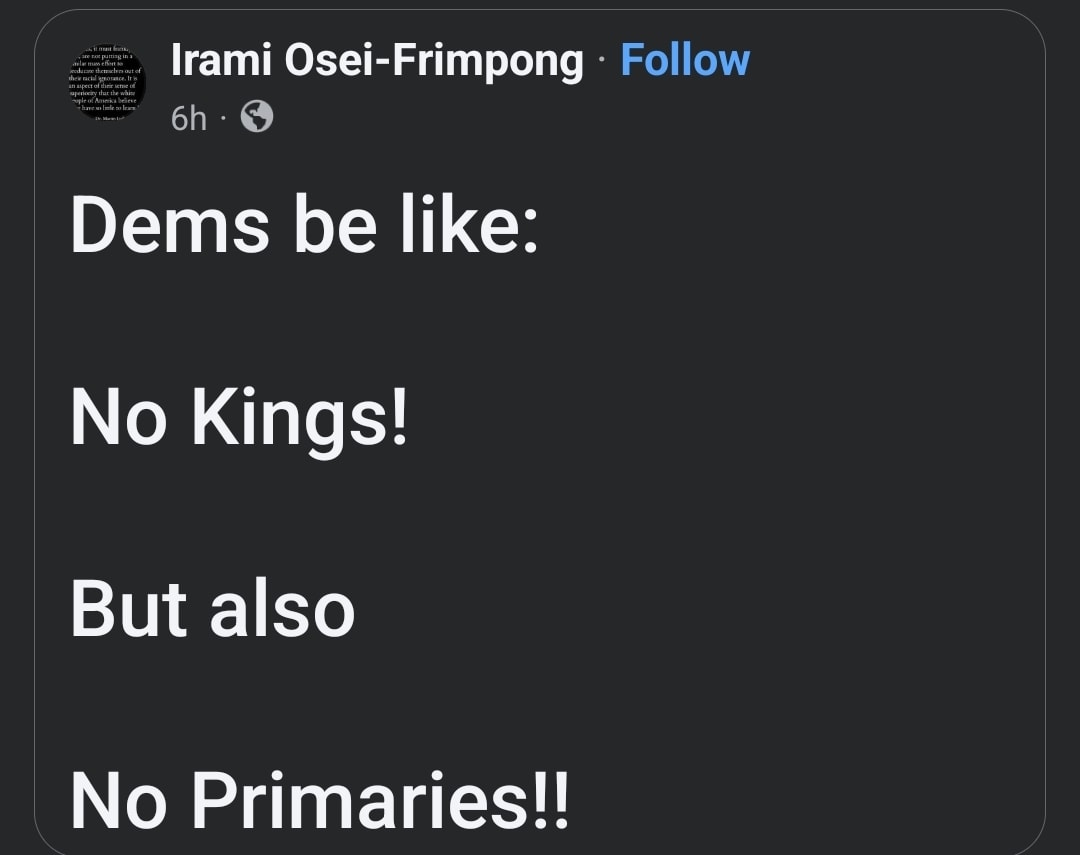
This anti-neoliberal meme satirizes political opponents who claim they are trying to curb massive corporate and foreign influence ("No Kings!"), but they are equally resistant to democratic choice in their own internal elections ("But also / No Primaries!!"). From this perspective, it highlights a cynical view where groups argue that just as free markets should be regulated, the very "voting machines" of parties must also be controlled—implying that true economic freedom requires removing market-based choices like primaries entirely.
detailed-analysis (gemma3_27b-it-q8_0)
Okay, let's break down this meme ("Dems be like: No Kings! But also No Primaries!!") from an anti-neoliberal perspective, utilizing relevant theoretical frameworks where applicable.
Understanding the Anti-Neoliberal Lens
Before diving into the meme, it's vital to understand the anti-neoliberal position. Anti-neoliberalism generally critiques the political-economic policies promoting free market capitalism, deregulation, privatization, and austerity. It sees these policies as leading to increased inequality, the erosion of social safety nets, and the dominance of corporate power. Critically, it often views the Democratic party as complicit in the continuation of neoliberal policies, albeit in a more moderate, managed form than the Republican party. Anti-neoliberals often advocate for more radical shifts toward social democracy, democratic socialism, or other anti-capitalist alternatives. The emphasis is on challenging concentrated power and expanding democratic control over economic life.
Visual Description
The meme is a simple text-based post shared on a social media platform (X, formerly Twitter). It consists of two lines of text:
- "Dems be like: No Kings!"
- "But also No Primaries!!"
The double exclamation mark at the end of the second statement intensifies the sentiment. The background is dark, and there is a small snippet of text along the left side. This overall simplicity suggests a quick, pointed commentary intended for online circulation.
Critical Theory
This meme resonates with Critical Theory, specifically with the Frankfurt School's analysis of the "culture industry." The 'culture industry' argument suggests that mass culture, even ostensibly progressive elements, can function to reproduce existing power structures. In this case, the meme is criticizing the symbolic gestures of the Democratic party.
- Critique of Symbolic Politics: The “No Kings!” declaration is interpreted as a symbolic rejection of authoritarianism, hierarchy, or traditional power. However, the immediate follow-up, “But also No Primaries!!” subverts this seeming progressiveness. By blocking meaningful primary challenges, the Democratic party prevents genuinely different candidates, and thus potentially different policies, from gaining traction. It's a surface-level rejection of "kings" while preserving the power of the existing "establishment."
- False Consciousness: Critical Theory posits that dominant ideologies can create a “false consciousness” where people unwittingly support systems that are detrimental to their interests. The meme suggests that the Democrats cultivate this false consciousness by appealing to ideals of anti-authoritarianism while actively maneuvering to maintain their own control.
- Reification: The idea of rejecting 'kings' without fostering structures that truly democratize power (like open primaries) reifies the existing power dynamic. It treats the appearance of resistance as a substitute for real change.
Marxist Conflict Theory
A Marxist lens immediately highlights the class conflict at play, even if it’s veiled by symbolic gestures.
- The Illusion of Choice: The refusal to allow meaningful primaries limits the range of options presented to voters. From a Marxist perspective, this isn’t about “democracy” in an abstract sense; it’s about controlling the political expression of class interests. The Democratic party, while often appealing to working-class voters, ultimately serves the interests of capital by preventing genuinely radical alternatives from gaining power. Limiting primary challenges ensures that candidates aligned with this status quo are consistently selected.
- Party as Bourgeois Instrument: From a Marxist perspective, political parties, regardless of stated ideology, often function as instruments of the ruling class. The meme suggests that the Democratic party, despite its rhetoric, actively suppresses challenges to its internal power structure, effectively preventing the expression of truly working-class interests.
- Hegemony: This also connects to the concept of hegemony—the dominance of a ruling class's ideology—where the Democratic party, by controlling the narrative and limiting choice, maintains its dominant position.
Postmodernism
A postmodern reading of the meme focuses on the deconstruction of meaning and the skepticism towards grand narratives.
- Empty Signifiers: "No Kings!" can be seen as an "empty signifier" – a term lacking intrinsic meaning that is filled with meaning by the context in which it is used. In this case, it’s appropriated by the Democrats but ultimately devoid of substantive change.
- Critique of Authenticity: The meme highlights the tension between appearance and reality. The Democrats present themselves as anti-establishment, but their actions (blocking primaries) betray this image. Postmodern thought is suspicious of authenticity and challenges the idea that appearances reliably reflect underlying truths.
- Irony and Parody: The meme itself is a form of ironic commentary, parodying the way Democrats project an image of progressiveness while perpetuating the status quo.
In Summary
From an anti-neoliberal viewpoint, this meme is a concise and cutting critique of the Democratic Party. It exposes the hypocrisy of superficially rejecting authoritarianism while simultaneously suppressing democratic processes within the party. The meme isn't simply an attack on Democrats; it’s a critique of the way symbolic gestures are used to mask the continuity of power and prevent genuine systemic change. It reflects a deep-seated distrust of the establishment and a demand for more radical, structural reforms.
simple-description (llama3.2-vision_11b)
The meme is a humorous commentary on the perceived divide between the Democratic and Republican parties, with the implication that the Democratic Party is more liberal than the Republican Party. The meme states "Dems be like" and lists a series of absurd and humorous statements that the Democratic Party would never say, such as "No Kings!" and "No Primaries!" The text is meant to be ironic and satirical, poking fun at the idea that the Democratic Party would ever say such absurd things.
detailed-analysis (gemma3-27b-vision)
Okay, here's an analysis of the image, broken down into the sections you requested, with each section only included if applicable.
Visual Description
The image is a screenshot of a post, likely from a social media platform, featuring stark white text on a black background. At the top, a circular avatar is visible with a blurred graphic within. Above that, is the name "Irami Osei-Frimpong" with a "Follow" button, and a timestamp of "6h" (likely meaning 6 hours ago). The main text of the post reads in progressively larger font sizes:
- "Dems be like:"
- "No Kings!"
- "But also"
- "No Primaries!!"
The increasing font size draws the eye and suggests an intensifying sentiment. The contrast between the white text and black background creates a bold, declarative tone.
Foucauldian Genealogical Discourse Analysis
This post lends itself to a Foucauldian reading. The statement "No Kings!" and "No Primaries!!" are not simply expressions of political preference but are discourses that construct and challenge power relations within the Democratic party.
- Power/Knowledge: The statement "No Kings!" resists the concentration of power in a single leader (a 'king') within the Democratic party, suggesting an awareness that even well-intentioned leadership can become oppressive. The rejection of "Primaries!!" challenges the established method for determining candidates and therefore, the mechanisms by which power is legitimized.
- Genealogy of the Discourse: Investigating the "genealogy" of this discourse would involve tracing how the concepts of "kings" and "primaries" have been historically constructed within the American political system. What narratives have justified or criticized these concepts? How have they been used to include or exclude certain groups?
- Disciplinary Power: The statement implies a critique of the ways in which the Democratic Party disciplines its voters and candidates through the primary system. Rejecting primaries can be seen as an attempt to disrupt the norms that govern political participation.
Critical Theory
This post engages with core tenets of Critical Theory, particularly regarding ideology and the critique of power structures.
- Ideology Critique: The statement challenges the implicit assumption that a hierarchical, leader-driven party structure ("kings") and a standardized selection process (primaries) are natural or inevitable. It questions the very foundations of how the Democratic Party operates and the ideological assumptions that underpin those operations.
- Emancipation: The call for "No Kings!" and "No Primaries!!" can be interpreted as a demand for a more egalitarian and participatory political system. The post suggests a desire to move beyond hierarchical structures and embrace a more democratic form of governance.
- Habermas and the Public Sphere: While subtle, this post operates within the realm of public discourse. By publicly stating these preferences, the poster is attempting to contribute to the formation of public opinion and potentially shape the direction of the Democratic Party.
Marxist Conflict Theory
A Marxist interpretation would focus on the power dynamics and class struggles inherent in the political process.
- Class Struggle within the Party: The rejection of established leadership ("kings") can be seen as a challenge to the power held by those who control the party apparatus. This apparatus often represents the interests of specific classes or factions within society.
- Contradictions of the System: The call for abolishing primaries highlights the contradictions inherent in the American electoral system, which often prioritizes fundraising and establishment support over grassroots movements and genuine representation.
- Ideological Hegemony: The statement pushes back against the ideological hegemony that normalizes hierarchical leadership and standardized election processes. It suggests a desire to dismantle the existing power structures and create a more equitable system.
Postmodernism
A postmodern reading focuses on the deconstruction of grand narratives and the emphasis on localized, fragmented experiences.
- Rejection of Universal Truths: The post implicitly challenges the notion that there is a single "right" way to organize a political party or select candidates. It acknowledges that different approaches may be valid depending on the specific context.
- Deconstruction of Authority: The phrase "No Kings!" dismantles the traditional notion of charismatic, centralized leadership. It suggests a skepticism towards authority and a preference for horizontal, decentralized forms of organization.
- Emphasis on Contingency: The statement suggests that political structures are not fixed or immutable but are contingent and subject to change. It rejects the idea that there is a natural or inevitable order to political affairs.
Queer Feminist Intersectional Analysis
This section is more nuanced and depends on reading the statement through a lens of marginalized experiences.
- Challenge to Hierarchical Systems: Queer and feminist theory often critique hierarchical systems of power, as these systems disproportionately affect marginalized groups. The rejection of "kings" could be interpreted as a rejection of patriarchal or authoritarian forms of leadership.
- Disruption of Normative Structures: The challenge to primaries, which can reinforce dominant narratives and exclude marginalized voices, aligns with feminist and queer critiques of established political processes.
- Intersectionality: The rejection of both "kings" and "primaries" suggests a desire to dismantle multiple forms of oppression. This is a particularly intersectional stance, as it recognizes the interconnectedness of various forms of social injustice.
Disclaimer: It's important to remember that these interpretations are not definitive. The meaning of this post is open to debate, and different readers may arrive at different conclusions. The analysis above offers a range of possible interpretations based on various theoretical frameworks.
simple-description (llama3.2-vision)
This meme is a humorous commentary on the perceived differences between the Democratic and Republican parties. The image is a simple text-based meme with a dark background and white text. The text reads: "Dems be like: No Kings! But also: No Primaries!!"