First Seen
2023-06-11T01:51:57+00:00
simple-description (qwen3.5_2b-q8_0)
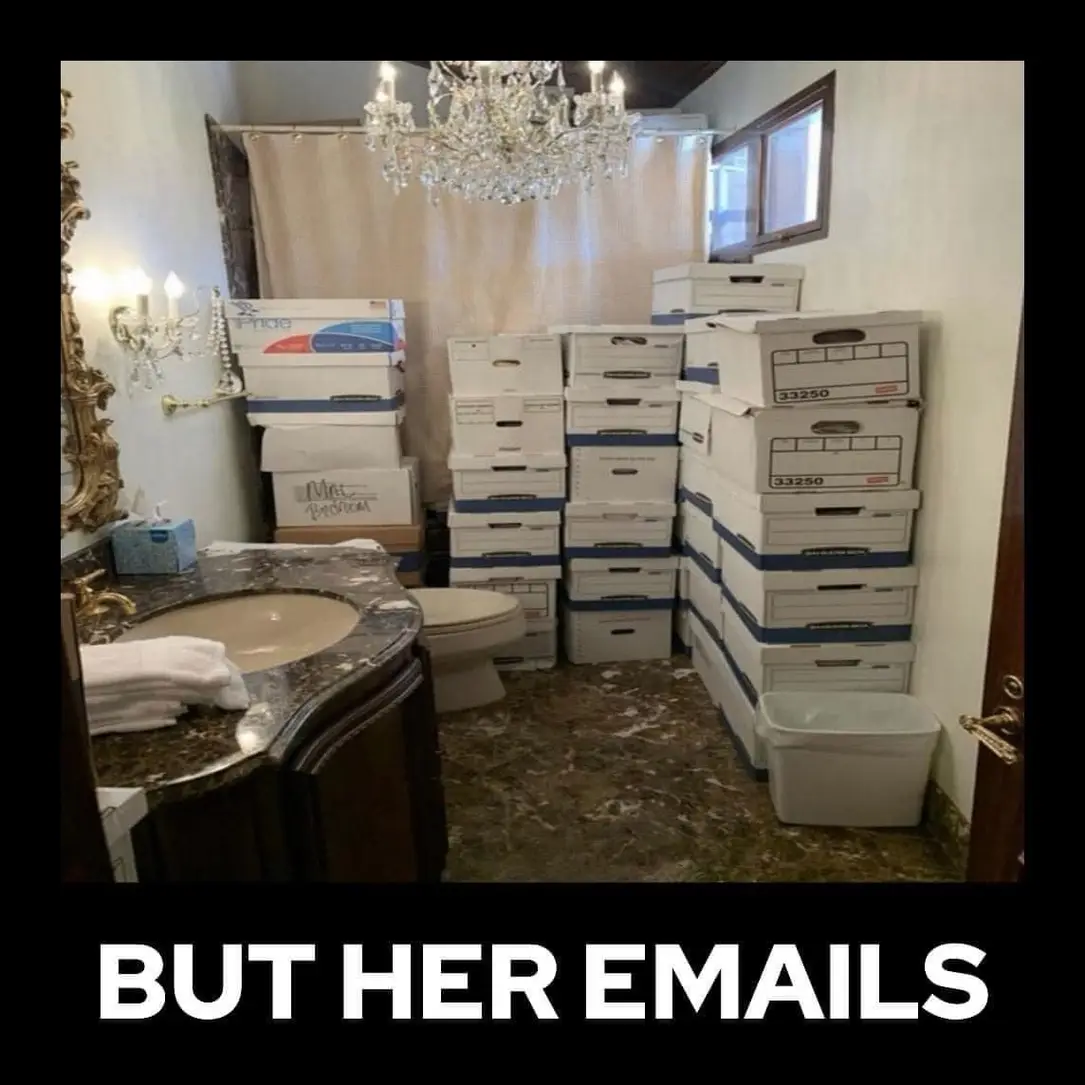
The meme depicts a lavishly furnished bathroom, complete with a crystal chandelier and marble vanity, that is being packed away into hundreds of white and blue storage boxes. The text overlay pivots this visual of overwhelming physical clutter with the word "BUT HER EMAILS."
In an Anti-Neoliberal context, which often critiques the emphasis on material ownership and individualism, the joke suggests that while the physical space feels stuffy and unmanageable, the digital self (represented by the inbox) remains the true authority or the vital thing that cannot be boxed away. It implies that information and digital agency are more important than the accumulation of physical boxes.
simple-description (llama3.2-vision_11b)
The meme is an image of a bathroom with a toilet and a sink, but instead of a toilet, there's a large stack of documents with a sign that says "Classified" and a caption "Classified documents in the bathroom? Sounds like a 2024 Biden campaign strategy".
detailed-analysis (gemma3-27b-vision)
Okay, let's break down this image and the text "BUT HER EMAILS" using the lenses you’ve provided. Given the strong association of the phrase with the Hillary Clinton email controversy, the interpretation will naturally lean toward that context.
Visual Description
The image depicts a small, cramped, and rather neglected-looking room. The space is filled floor-to-ceiling with stacks of labeled cardboard boxes. The boxes appear to be filled with documents or records, suggesting some sort of archival storage. The room's decor is somewhat dated and ornate – a floral shower curtain, a decorative, though dusty chandelier, and patterned flooring. A toilet is partially visible, confirming this as a bathroom. The overall impression is one of disorganized accumulation, of something being hidden away, and of a space not intended for this level of storage. The lighting is dim, contributing to a claustrophobic and perhaps unsettling atmosphere.
Foucauldian Genealogical Discourse Analysis
This image and caption function powerfully within a Foucauldian framework. The boxes represent not just physical records, but archives – sites where power relations are solidified. Foucault argued that archives are never neutral collections of information; they are actively constructed to establish what counts as knowledge and truth, and to exclude other possibilities. The phrase “BUT HER EMAILS” points to a specific discourse surrounding Hillary Clinton, where email communication became a battleground for control over narrative and truth.
The focus on emails is significant. It’s not the information contained within those emails that was the central issue, but the form of the communication itself. The insistence on examining emails served as a tactic to delegitimize Clinton’s authority, framing her actions as deceptive or secretive. The boxes symbolize the overwhelming amount of documentation that was produced and scrutinized in this process, creating a spectacle of investigation designed to exert power and control. The very act of archiving, of categorizing and storing these emails, becomes a form of power/knowledge, shaping how Clinton and her actions were perceived.
Critical Theory
From a Critical Theory perspective, the image reflects a broader phenomenon of how institutions and power structures utilize information control as a means of maintaining dominance. The obsessive focus on the emails – symbolized by the mountains of boxes – distracts from substantive policy concerns or larger systemic issues. This is a classic example of a “manufactured controversy,” where a relatively minor issue is blown out of proportion to discredit a political opponent.
The image’s claustrophobic quality hints at the suppression of other narratives or voices. The sheer volume of documentation creates an illusion of thoroughness, but it can also serve to bury the real issues. It also speaks to a culture obsessed with evidence, verification, and the constant need to scrutinize and dissect information, a hallmark of modern surveillance society.
Marxist Conflict Theory
While the image doesn't explicitly depict economic conflict, a Marxist lens can illuminate the underlying power dynamics. The "email controversy" played out as a form of symbolic struggle between different political factions, each vying for control over the narrative.
The archival process itself, the collecting, classifying, and analyzing of emails, requires resources – personnel, technology, and funding. These resources were deployed strategically by specific groups to advance their political goals. The framing of the controversy as a matter of “trust” or “security” served to justify these expenditures and legitimize the power wielded by those conducting the investigation. In this sense, the mountains of boxes represent a form of capital – informational capital – that was deployed in the service of political struggle.
Postmodernism
A Postmodern reading would focus on the deconstruction of "truth" and "objectivity" inherent in the image and its caption. The sheer volume of boxes suggests the impossibility of ever fully knowing the "truth" about the emails, or about anything. The archiving process is inherently subjective, based on what is deemed relevant or important by those in power. The boxes themselves become a symbol of the fragmented, unstable nature of knowledge in the postmodern era.
The caption's minimalist phrasing, “BUT HER EMAILS,” is typical of postmodern irony and self-reflexivity. It suggests a skepticism toward grand narratives and an awareness of the constructed nature of reality. The phrase also functions as a meme, relying on shared cultural knowledge and a sense of inside joke to create meaning.
Queer Feminist Intersectional Analysis
While less overtly present, a Queer Feminist Intersectional analysis can be applied. The targeting of Hillary Clinton, a high-profile female politician, can be viewed through the lens of gendered political attacks. The obsessive scrutiny of her emails and personal life reflects a pattern of holding women in power to a higher standard of accountability than their male counterparts.
The metaphor of the overflowing archive can also be interpreted as a symbolic representation of the burden placed on women to constantly justify their actions and defend themselves against accusations. The boxes symbolize the weight of societal expectations and the pressure to conform to prescribed gender roles.
The fact that the controversy became so sensationalized and entered the realm of meme culture points to the ways in which women’s political achievements are often trivialized or reduced to superficial scandals.
Let me know if you'd like me to elaborate on any of these interpretations or explore other theoretical frameworks.
simple-description (llama3.2-vision)
This meme is a play on the phrase "but her emails" from the 2016 US presidential election. The image shows a bathroom filled with boxes of documents, implying that someone (likely a politician) has a large amount of paperwork that needs to be managed. The text at the bottom, "but her emails", is a humorous reference to the idea that a person's email management is not as important as the amount of paperwork they have.
tesseract-ocr
R ee ry ws ) — i) ie Mer, a. | a < _ — a eo = di eat : BUT HER EMAILS