First Seen
2023-05-10T21:03:34+00:00
simple-description (llama3.2-vision_11b)
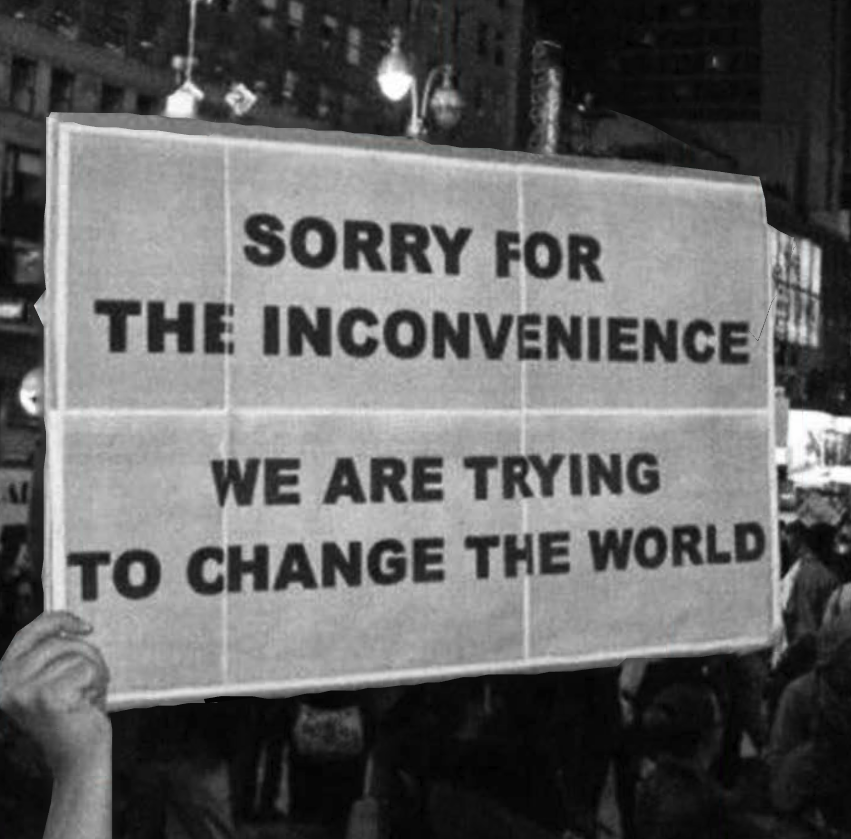
The meme is a humorous critique of neoliberalism, a political and economic ideology that emphasizes individualism and free market capitalism. The image features a sign with the text "Sorry for the inconvenience" and "We are trying to change the world" - a tongue-in-cheek acknowledgment of the chaos and disruption caused by neoliberal policies, while also acknowledging the need for a more equitable and just society.
detailed-analysis (gemma3-27b-vision)
Okay, let's break down this image using the lenses you've requested.
Visual Description
The image is a black and white photograph capturing a protest sign held aloft in a crowd. The sign is rectangular, appearing to be made of a series of individual, grid-like tiles. The text on the sign reads, in bold, capitalized black letters, "SORRY FOR THE INCONVENIENCE / WE ARE TRYING / TO CHANGE THE WORLD." The crowd is blurred, suggesting movement and a large gathering. The sign is the primary focus, held by a hand that is partially visible. The background shows faint hints of buildings and streetlights, indicating an urban setting. The overall effect is raw and direct, typical of protest imagery.
Foucauldian Genealogical Discourse Analysis
This sign is fascinating from a Foucaultian perspective. The phrase "Sorry for the inconvenience" immediately acts as a disciplinary technique. It pre-emptively acknowledges the disruption caused by the protest and, surprisingly, apologizes for it. Instead of demanding space or asserting the right to dissent, it frames the act as potentially causing a nuisance. This is a subtle power dynamic. Foucault would argue this apology isn't about genuine remorse, but a negotiation of power. It acknowledges the dominant discourse of order and convenience and attempts to re-negotiate it, saying, "Yes, we disrupt, but the goal (changing the world) justifies it."
A genealogical approach would explore how the idea of "inconvenience" as a category of social control has developed historically. What societal norms dictate what constitutes an “inconvenience”? How has the state and capital used such categorization to suppress dissent? The sign therefore performs this negotiation in the very act of protest. It’s not simply a statement of intent but a deployment of discourse to shape the terms of engagement. The apology is part of the protest itself.
Critical Theory
From a critical theory standpoint, particularly in the Frankfurt School tradition, the sign reflects a critique of the rationalized, instrumental logic of modern society. The phrase "Sorry for the inconvenience" is a stark contrast to the radical potential of “changing the world.” It’s as though the protesters are attempting to navigate the pre-existing structures of power with politeness, even while challenging them. This can be interpreted as a form of "false consciousness," or, more nuancedly, a pragmatic tactic employed by actors aware of the deep integration of power into everyday life.
The sign encapsulates a tension between revolutionary aspiration and the constraints imposed by a system that prioritizes order and efficiency. It speaks to the problem of how to effect change within a system that actively resists transformation. The phrasing highlights the difficulty of breaking free from established norms and the pressure to conform, even in acts of resistance. Is it a strategic move to gain acceptance or a symptom of the system's pervasiveness?
Marxist Conflict Theory
From a Marxist perspective, this sign symbolizes the inherent conflict between the ruling class (those who benefit from the status quo) and the oppressed (those seeking change). The “inconvenience” represents the disruption to the smooth functioning of capitalist production and social order. The ruling class would perceive the protest as an impediment to profit and control, while the protesters view it as a necessary step toward a more equitable society.
The very act of protesting creates a conflict, but the apology suggests an attempt to minimize the perceived threat to the established power structures. It's a way to lessen the potential backlash, but also, to appeal to a broader base of support. This suggests the protesters are aware of their material conditions and the power dynamics that govern their lives. The attempt to "change the world" represents a fundamental challenge to the existing relations of production and the unequal distribution of resources.
Postmodernism
A postmodern reading would emphasize the deconstruction of grand narratives and the fluidity of meaning. The sign itself is a meta-statement about protest. It acknowledges the performativity of activism, the act of disrupting the norm, and the inherent paradox of seeking radical change while apologizing for causing discomfort.
The phrase "Sorry for the inconvenience" is ironically deployed. It subverts the traditional expectation of a straightforward, assertive protest message. The sign doesn't demand change; it requests understanding, framing the act of revolution in terms of politeness and compromise. This blurring of boundaries and embrace of ambiguity is characteristic of postmodern thought. The sign suggests that meaning is not fixed but is constructed through language and social interaction.
Queer Feminist Intersectional Analysis
From a queer feminist intersectional perspective, the sign's apology is particularly intriguing. The "inconvenience" caused by protest disproportionately impacts marginalized groups who are already experiencing systemic oppression. For example, a protest that blocks access to essential services may be more burdensome for disabled people or those living in poverty. Therefore, the apology could be interpreted as a performative gesture that obscures the real consequences of disruption for these communities.
Moreover, the "changing the world" could be examined through an intersectional lens. Whose world are they trying to change? Does this vision of change include the needs and concerns of all marginalized groups, or does it reinforce existing power structures? The sign's message, while seemingly universal, needs to be interrogated in terms of whose voices are centered and whose are silenced. A queer feminist perspective would emphasize the need for a more inclusive and transformative vision of change that addresses the root causes of oppression and challenges all forms of domination.
Hopefully, this provides a comprehensive breakdown of the image through the requested lenses. Let me know if you'd like me to elaborate on any specific aspect.
simple-description (llama3.2-vision)
This meme is a humorous take on the concept of an "inconvenience" being a catalyst for change. The image is likely a photo of a protest or demonstration, with a sign or placard held up by a person in the crowd. The text on the sign reads, "Sorry for the inconvenience, we are trying to change the world."
tesseract-ocr
SORRYFOR = | THE INCONVENIENCE } TO CHANGE THE WORLD