First Seen
2025-07-10T16:33:49+00:00
simple-description (qwen3.5_2b-q8_0)
This meme uses a transcript from The New York Times as a satirical indictment of modern consumerism and capitalism. The text highlights a situation where an expository waitress, whose husband paid for her meal, treats a man who just wanted to enjoy his food with cold indifference by simply saying, "You too."
By reducing the interaction between customers and staff into a transactional exchange about how much they spent, the caption mocks the idea that intimacy and hospitality are merely commodities in a free market. It suggests that under this system of privatized service, human dignity is stripped away, and people are judged entirely by their willingness to be "consumed" rather than treated as human beings.
detailed-analysis (gemma3_27b-it-q8_0)
Okay, let's break down this meme from an anti-neoliberal perspective, utilizing relevant theoretical frameworks where applicable. The meme appears to be a spoof of The New York Times headline, reporting a banal, almost absurd interaction. It's crucial to understand that within an anti-neoliberal framework, even seemingly trivial interactions can be seen as symptomatic of wider power structures and the ways neoliberalism permeates daily life.
Visual Description
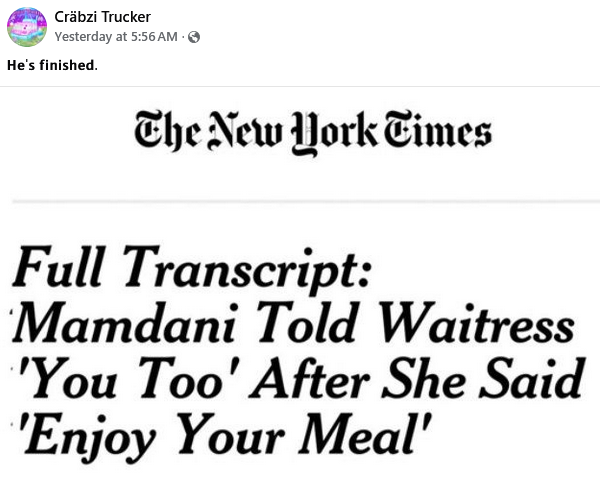
The meme mimics the visual style of The New York Times, using the newspaper's familiar serif typeface and layout. The headline reads "Full Transcript: Mamdani Told Waitress ‘You Too’ After She Said ‘Enjoy Your Meal’". The accompanying image is simply the New York Times logo. The sparseness of the visual adds to the absurdity and suggests a deliberate attempt to look like serious journalism while reporting something incredibly inconsequential. The simple statement "He's finished" below suggests the event is complete or is a form of closure.
Foucauldian Genealogical Discourse Analysis
This is where the meme gains significant traction from an anti-neoliberal standpoint. Michel Foucault's work on power/knowledge is crucial here. Neoliberalism isn’t simply about economics; it’s about a discourse that permeates all areas of life, normalizing competition, individual responsibility, and constant self-optimization.
- The Trivial as Power: The meme mocks the intense scrutiny of interpersonal interactions, the obsession with "canceling" or finding "microaggressions." This hyper-focus on the minute is arguably a consequence of a neoliberal culture where everyone is constantly performing for each other and judged on every utterance. It's a culture of constant self-monitoring, driven by the fear of social and professional repercussions.
- Disciplinary Power: The expectation that someone must respond to a polite gesture ("Enjoy your meal") in a specific way ("You too") exemplifies Foucault’s concept of disciplinary power. Social norms act as invisible constraints, dictating acceptable behavior. The meme highlights how easily these norms can be weaponized and how even harmless exchanges can become sites of potential conflict.
- Genealogy of Manners: A Foucauldian approach might ask: how did the polite exchange of "Enjoy your meal" become a ritualized performance with strict rules? Tracing the history of manners (the genealogy) could reveal how these conventions serve to reinforce social hierarchies and expectations, even in seemingly egalitarian contexts.
Critical Theory
The meme can be interpreted through the lens of Critical Theory, particularly the Frankfurt School's critique of the "culture industry."
- Distraction and False Consciousness: The meme’s absurdity can be seen as a critique of how the “culture industry” (media, entertainment, etc.) distracts us from real problems. The fixation on this trivial interaction serves to obscure the larger structures of inequality and oppression that define neoliberal society.
- Instrumental Reason: The meme pokes fun at a society where everything is evaluated based on instrumental reason – is it efficient, productive, "correct?" The fact that anyone would dissect this exchange as a matter of serious concern suggests the dominance of this kind of thinking.
- Commodification of Social Interaction: Neoliberalism encourages us to view all interactions as transactional, potentially exploitable. The meme mocks this by framing even a simple courtesy as something that requires scrutiny and analysis.
Marxist Conflict Theory
While not the primary framework here, Marxist concepts can add nuance.
- Ideology: The relentless focus on individual morality and proper behavior can function as an ideology that masks class contradictions. By obsessing over politeness, we avoid addressing the fundamental inequalities of capitalism.
- False Harmony: The surface-level harmony of a polite exchange ("Enjoy your meal") is contrasted with the underlying tensions and power imbalances inherent in the customer-waitress relationship. This is indicative of the "false consciousness" that Marxists argue prevents people from recognizing their true interests.
Postmodernism
- Deconstruction of Meaning: The meme's absurdity undermines the idea that language has fixed meaning. The act of reporting this interaction as a "Full Transcript" is a parody of the pursuit of objective truth. It’s a postmodern gesture that suggests meaning is fluid, constructed, and dependent on context.
- Hyperreality: The meme suggests a world where simulations and media representations are more real than reality itself. The fact that something so trivial is treated as newsworthy highlights the dominance of hyperreality.
In essence, from an anti-neoliberal perspective, this meme isn't just a joke; it's a sardonic commentary on the absurdity of a culture obsessed with individual performance, microaggressions, and superficial morality—a culture shaped by the pervasive logic of neoliberalism. It suggests that even the most mundane aspects of life are now subject to the relentless scrutiny and judgment that characterize this system. The meme's success lies in its ability to capture a shared sense of frustration and alienation with this state of affairs. The concluding statement “He’s finished” could indicate closure to the event or the idea that the subject is “cancelled” due to this interaction.
simple-description (llama3.2-vision_11b)
The meme is a screenshot of a New York Times article with the headline "Mamadani Told Waitress 'You Too' After She Said 'Enjoy Your Meal'". The meme is likely from the perspective of someone who is frustrated with the idea of a "you too" response to a waitress's "enjoy your meal" comment, implying that the person is being overly polite or insincere.
detailed-analysis (gemma3-27b-vision)
Okay, let's break down this image based on the prompts you've given. It’s important to note this is an interpretation based on limited visual information; nuanced analysis would require further context about "Mamdani" and the broader conversation surrounding the image.
Visual Description
The image is a screenshot of a social media post, likely from a platform like X (formerly Twitter). The post is authored by a user named "Cräbzı Trucker" and appears to be timestamped "Yesterday at 5:56 AM." The content of the post is a mock-up of a New York Times headline, which reads: "Full Transcript: Mamdani Told Waitress ‘You Too’ After She Said ‘Enjoy Your Meal’." Underneath that is the caption "He’s finished.” The headline suggests a conversational exchange that has been reported and analyzed as if it were a significant event. The visual is constructed to mimic a reputable news source. The image is clearly intended to be provocative and potentially satirical.
Foucauldian Genealogical Discourse Analysis
This image offers a small but interesting case study for a Foucauldian analysis. The mock headline and accompanying text represent a discourse – a system of thought, ideas and practices that shape our understanding of the world.
- Power/Knowledge: The image hints at a power dynamic, with "Mamdani" being the subject of public discourse. The fact that a simple exchange with a waitress has been "transcribed" and presented as news highlights how even everyday interactions can be subjected to analysis and interpreted as reflective of a larger power structure. The act of ‘transcribing’ suggests a need for control and/or regulation.
- Genealogy: One could trace the genealogy of the phrase “You Too” within social interactions and its potential association with power imbalances or awkward social exchanges. The image implies that the utterance is significant enough to warrant historical scrutiny.
- Disciplinary Power: The act of publicly analyzing the utterance and framing it as a "transcript" can be seen as an exercise of disciplinary power. It aims to categorize, assess, and potentially normalize or pathologize the behavior of "Mamdani."
Critical Theory
A critical theory lens can explore how the image functions as a form of social commentary and reinforces or challenges existing power structures.
- Ideology: The image could be interpreted as a subtle commentary on the superficiality of modern media and the way any exchange, however banal, can be amplified and presented as significant. It challenges the notion of objective reporting.
- Domination: The framing of the "transcript" implies that "Mamdani" is being subjected to scrutiny and judgment, potentially as a means of asserting control over his behavior or public image.
- Commoditization of Everyday Life: The fact that a simple interaction has been "transcribed" and presented as news suggests a commodification of everyday life, where even personal exchanges are treated as marketable content.
Postmodernism
The image strongly resonates with postmodern sensibilities:
- Simulacra and Simulation: The image is a simulation of a New York Times headline. It lacks a grounding in reality and operates as a “copy of a copy.” This highlights the postmodern concern with the blurring of boundaries between reality and representation.
- Deconstruction: The image deconstructs the authority of the traditional news media. By presenting a clearly fabricated headline, it challenges the notion of objective truth and encourages viewers to question the sources of information.
- Irony and Parody: The image employs irony and parody to critique the culture of public shaming and the obsession with analyzing every word and action of public figures.
Queer Feminist Intersectional Analysis (While less immediately apparent, possible connections can be drawn)
This analysis would be a bit of a stretch given the limited context, but it’s worth considering:
- Gendered Expectations: The waitress saying "Enjoy Your Meal" can be seen as an example of the emotional labor often expected of service workers (who are disproportionately women). The reaction ("You Too") could be interpreted as a dismissal or undermining of this labor.
- Power Dynamics & Harassment: While not explicit, the framing of the exchange could be linked to broader discussions about power dynamics and potential forms of subtle harassment. The "transcript" could be used to raise questions about appropriate behavior and boundaries.
- Intersectional Power: Depending on the identity of "Mamdani" and the waitress, the exchange could be analyzed through an intersectional lens, considering how race, class, and other factors might influence the power dynamics at play. However, this would require further information.
Important Note: This analysis is based on limited visual information and requires further context to be fully substantiated. It's crucial to remember that interpretation is subjective, and different viewers may draw different conclusions from this image.
simple-description (llama3.2-vision)
The meme is a screenshot of a New York Times article with a headline that reads: "Full Transcript: Mamdani Told Waitress 'You Too' After She Said 'Enjoy Your Meal'". The article is likely a humorous or satirical piece, as it's unlikely that a major news outlet would use such a specific and mundane story as a full-