First Seen
2023-05-24T22:38:57+00:00
simple-description (qwen3.5_2b-q8_0)
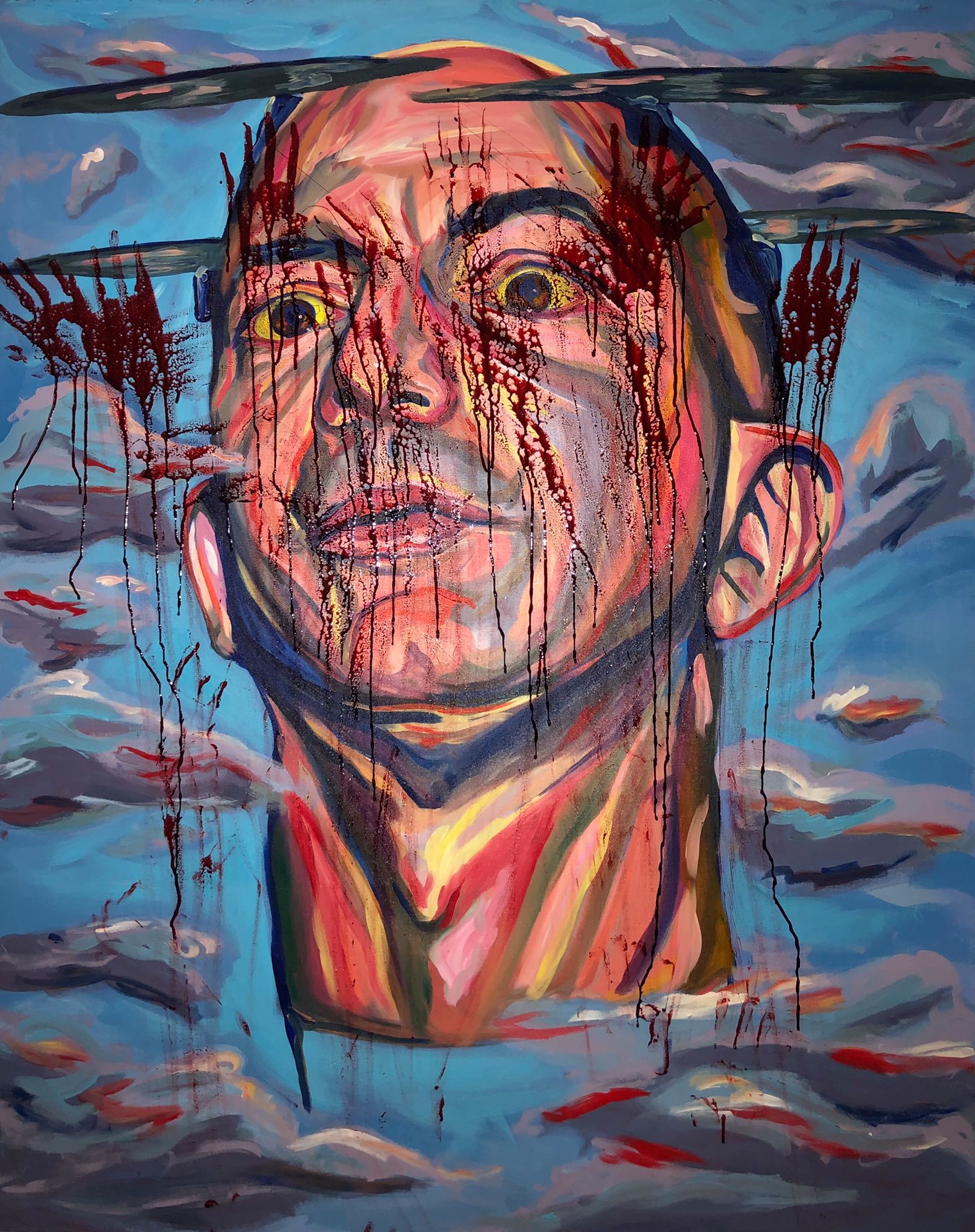
This image is a visual representation of the "Bald Trump" meme, a popular internet graphic that the 'anti-oligarch' community uses to symbolize the loss of political dominance and financial power. The painting depicts a head of Donald Trump in a swimming pool, where the red drips falling down are interpreted as blood or corruption. The horizontal lines above the water serve as the 'sky' or financial barrier that is being 'balded' by the water, representing the oligarch's power being stripped away. There is no text visible within the artwork itself.
simple-description (llama3.2-vision_11b)
The meme is a photo of a painting of a face with a grotesque, distorted expression, with a caption "Anti-Oligarch" written above it. The image is meant to convey a sense of disgust and disdain for those in power, with the face's twisted features and dark colors evoking a feeling of anger and rebellion.
detailed-analysis (gemma3-27b-vision)
Okay, let's break down this striking and disturbing image through the requested lenses. It's a complex piece, and each theoretical framework will highlight different aspects.
1. Visual Description
The image is a close-up, distorted portrait of a man, rendered in a highly expressive and unsettling style. The composition is dominated by the figure's head and neck, which fill most of the canvas. The man's face is contorted in what appears to be extreme distress, perhaps fear or pain. His eyes are wide and intense, seemingly staring directly at the viewer.
Key visual elements:
- Color Palette: The painting utilizes a dramatic and somewhat unnatural color scheme. The man's skin tones are primarily reddish-pink, with stark contrasts and highlights. The background is a swirling, turbulent combination of blues, purples, and grays, resembling a stormy sky or underwater scene.
- Distortion: The man’s facial features are exaggerated and distorted, contributing to the overall sense of unease and psychological turmoil. Lines are bold and expressive, and the anatomy seems somewhat fragmented.
- Red Streams: Perhaps the most striking element is the multitude of thick, black/red streaks or "tears" flowing from the man's eyes. These lines are highly symbolic and could represent pain, anguish, trauma, or a metaphorical bleeding of emotions.
- Brushwork: The brushstrokes are loose and visible, adding to the sense of energy and emotional intensity. The painting has a raw, almost visceral quality.
- Dark Horizontal Stripes There are two dark horizontal stripes going across the top of the painting.
2. Foucauldian Genealogical Discourse Analysis
Michel Foucault’s work emphasizes the relationship between power, knowledge, and discourse. Analyzing this image through a Foucauldian lens:
- Discourse of Suffering/Madness: The painting appears to represent a breakdown or a state of intense emotional or psychological distress. It can be seen as participating in a historical discourse surrounding 'madness' or 'insanity,' which Foucault examines in his works like Madness and Civilization. Historically, society has constructed categories of 'normal' and 'abnormal' behaviour, and this painting could be interpreted as a visual representation of the ‘abnormal’ experience.
- The Panoptic Gaze: The direct, intense gaze of the figure could be interpreted as resisting or reacting to a pervasive "panoptic gaze"—a sense of being constantly observed and judged. Alternatively, it could be a manifestation of internal self-scrutiny and self-punishment.
- Power/Knowledge: The 'tears' or streams could represent the imposition of power through knowledge. Perhaps the individual is 'bleeding' from the weight of expectations, societal norms, or oppressive systems. The painting questions how these systems create and maintain control.
- Genealogy: A genealogical approach would trace the historical origins and transformations of the concepts and practices surrounding mental illness and emotional expression. The image could be understood as a visual critique of the ways these concepts have been constructed and used to control and marginalize individuals.
3. Critical Theory (Frankfurt School)
The Frankfurt School (Adorno, Horkheimer, Marcuse) emphasizes the role of ideology and mass culture in perpetuating social domination.
- Alienation: The distorted and anguished figure could be seen as a representation of modern alienation – the sense of disconnection, meaninglessness, and powerlessness experienced by individuals in capitalist society.
- Commodification of Emotion: The raw emotionality displayed in the painting could be interpreted as a critique of the commodification of emotion in mass culture. The painting shows the emotional response, but could be saying something about how it is often exploited and reduced to a spectacle.
- The Culture Industry: One could argue that the image resists the superficiality and homogenization of the culture industry. It refuses to offer easy answers or simplistic representations of emotion, instead presenting a complex and unsettling vision of the human condition.
- Loss of Authenticity: The image's chaotic, distorted aesthetic could symbolize the loss of authenticity in a modern, media-saturated world.
4. Marxist Conflict Theory
Viewing the painting through a Marxist lens focuses on class struggle and power dynamics.
- Oppression and Trauma: The anguish of the figure could symbolize the suffering inflicted upon the working class by capitalist exploitation. The 'tears' might represent the emotional toll of poverty, alienation, and social injustice.
- Internalized Oppression: The figure’s internal struggle could represent the internalization of oppressive ideologies. The individual is seemingly torn apart by forces both external and internal.
- Critique of Ideology: The painting may be a critique of the dominant ideologies that maintain class power. By exposing the raw emotional consequences of social inequality, it challenges the legitimacy of the existing order.
- Dehumanization: The distortion of the figure's face could symbolize the dehumanizing effects of capitalist production, where individuals are reduced to mere commodities.
5. Postmodernism
Postmodern thought is characterized by skepticism toward grand narratives, a focus on fragmentation, and an embrace of ambiguity.
- Rejection of a Unified Self: The distorted figure could be interpreted as a visual representation of the fragmented and unstable nature of the self in postmodernity. There is no stable, coherent identity, only a collection of shifting and contradictory experiences.
- Ambiguity and Open Interpretation: The painting refuses to offer a clear, unambiguous meaning. The viewer is invited to interpret the image in multiple ways, embracing the uncertainty and complexity of the human condition.
- Critique of Representation: The painting could be seen as a meta-commentary on the very act of representation. It challenges the idea that art can ever fully capture or express the truth of human experience.
- Intertextuality: The image may allude to or reference other artistic or cultural works, creating a web of intertextual connections. The viewer is invited to recognize these connections and to consider the ways in which art is always situated within a larger cultural context.
6. Queer Feminist Intersectional Analysis
This lens examines how various forms of oppression (based on gender, sexuality, race, class, etc.) intersect and create unique experiences of marginalization.
- Vulnerability and Marginalization: The figure's exposed anguish could symbolize the vulnerability of individuals who are marginalized due to their gender, sexuality, or other identities.
- Intersectionality of Suffering: The ‘tears’ might represent the cumulative effects of multiple forms of oppression.
- Deconstructing Masculinity: The painting challenges traditional representations of masculinity by depicting a male figure in a vulnerable and emotionally raw state.
- Reclaiming Emotional Expression: The painting could be seen as an attempt to reclaim emotional expression as a form of resistance against patriarchal norms that often discourage men from expressing their feelings.
It is important to note that these are just interpretations, and the meaning of the painting is ultimately open to the viewer’s own experience and perspective. The image is rich and complex, and it can be analyzed from many different angles.
simple-description (llama3.2-vision)
The meme is an image of a man's face with blood and tears streaming down his face, with a caption that reads "When you're 99% sure you're right but 100% sure you're wrong". The image is meant to convey the feeling of being unsure of oneself and being both confident and uncertain at the same time.
tesseract-ocr
— ae a —. ————== we = y wf, 7 = ‘ \ [| hy ) \ * Ww aT 5 ao %, \ 2 i a 7 Sy 2 er 4 ae a bh. ( PAS 4 pe Ss s 3 id = a ee | da See tN } Sey Caen as Me =) Z K eo Oy io Be ae bf Se aU Lal, , oe eas | fap aay / WW 3 Oe ale real “BS 6 HB | Hat { bee | | ee aig WR 1 OE Ha oa Wh oe co eee | 1 , B ANS mel, | ae Gf ae It £7 ete bal ag VAI She ol Te ¥! 4 yal # if been — : mi D tege { fi : -—-enintiae 7 , ‘ : j ‘ =a : ee eal é EM —_— — <s En 4 —_