First Seen
2023-05-24T22:38:57+00:00
simple-description (qwen3.5_2b-q8_0)
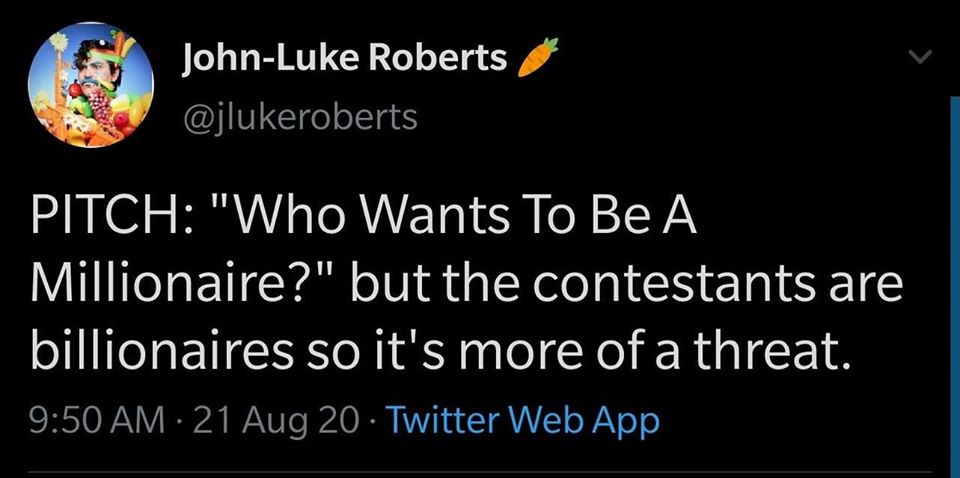
This image satirizes the typical "billionaire pitch" often used by anti-oligarchs to mock wealthy elites. The tweet plays on the idea that rich people are desperate for more money, but it flips the script by suggesting that "being a millionaire" is now a "threat" because the actual contestants are already billionaires. Using the text "PITCH: 'Who Wants To Be A Millionaire?' but the contestants are billionaires so it's more of a threat," the meme highlights the absurdity that the wealthy class has transcended financial ambition, turning a sales pitch into a dangerous force.
simple-description (llama3.2-vision_11b)
The meme is a screenshot of a Twitter post that says "PITCH: 'Who Wants to Be a Millionaire?' but the contestants are billionaires. Explain why they're so eager to give away their money."
detailed-analysis (gemma3-27b-vision)
Okay, let's break down this tweet by John Luker Roberts through the lenses you've requested.
Visual Description
The image is a screenshot of a tweet from Twitter. It features a profile picture of a brightly colored, elaborately decorated face resembling a carnival or circus performer. The tweet itself is a pithy observation presented as a television show pitch: "PITCH: 'Who Wants To Be A Millionaire?' but the contestants are billionaires so it's more of a threat." The tweet includes a timestamp, date (Aug 21, 2020), and platform information ("Twitter Web App"). The overall aesthetic is one of ironic commentary, playing on established pop-culture formats.
Marxist Conflict Theory
This tweet is strongly rooted in Marxist conflict theory. At its core, the joke highlights the absurdity of a system that allows for extreme wealth accumulation while presenting a facade of opportunity or "winning" (the premise of "Who Wants To Be A Millionaire?").
- Class Conflict: The humor derives from the reversal of roles. Instead of striving for wealth, the contestants already possess it in abundance. The premise becomes a threat, not a competition, demonstrating that the game is rigged in favor of those already holding power.
- Ideology Critique: The tweet implicitly critiques the ideology that justifies wealth inequality. The "game" of becoming a millionaire is presented as an aspiration—a meritocratic ideal. By revealing it to be a farce when played by those already wealthy, the tweet exposes the illusion.
- Power Dynamics: The “threat” isn’t a physical one; it's the reinforcement of existing power structures. The tweet suggests that concentrating even more wealth in the hands of billionaires is a danger to the social order.
Critical Theory
This tweet aligns with aspects of Critical Theory, particularly its emphasis on power, ideology, and societal critique.
- Deconstructing Narrative: The tweet takes a familiar narrative (a game show about becoming wealthy) and subverts it. It deconstructs the underlying assumptions and power relations embedded within that narrative.
- Questioning Authority: The idea of a “threat” posed by billionaires subtly questions the authority and legitimacy of extreme wealth. It suggests that unchecked accumulation of capital is inherently problematic.
- Raising Consciousness: The tweet's satirical edge seeks to raise awareness about the absurdity of economic inequality.
Postmodernism
There are elements of postmodernism at play, though they are less dominant than the Marxist/Critical Theory readings.
- Irony & Parody: The tweet heavily relies on irony and parody. It takes a mainstream cultural product ("Who Wants to Be a Millionaire?") and presents a warped, satirical version of it.
- Deconstruction of Meaning: It challenges the conventional meaning of “winning” and “competition” by flipping the premise.
- Meta-Commentary: The tweet is essentially a meta-commentary on the spectacle of wealth and the illusion of social mobility.
Foucauldian Genealogical Discourse Analysis
A Foucauldian approach would focus on the discourse surrounding wealth and competition.
- Power/Knowledge: The tweet implicates the discourse that produces the idea of "winning" and "success" as linked to wealth. It's not simply about money; it's about how society defines value and achievement. The notion of a "threat" from billionaires is a power dynamic constructed through discourse.
- Genealogy of the Concept: A genealogical investigation could trace the historical development of the "self-made millionaire" myth and how it's been used to legitimize economic inequality. The tweet disrupts this narrative by revealing the absurdity of the game when played by those who didn't need to "make" their fortune.
- Disciplinary Power: The concept of a "game" itself can be seen as a form of disciplinary power, shaping behavior and reinforcing social norms. By subverting the game, the tweet disrupts the disciplinary regime.
Queer Feminist Intersectional Analysis
While not central, some potential for intersectional reading exists, though it's subtle.
- Critique of Systems of Power: The tweet critiques capitalist systems of power that are inherently exclusionary. Intersectionality helps to highlight how these systems disproportionately harm marginalized groups (women, people of color, LGBTQ+ individuals). The joke can resonate with intersectional concerns about wealth hoarding that exacerbates social inequalities.
- Subversion of Norms: Subversion of traditional narratives about “winning” and “success” can be aligned with queer and feminist projects of challenging normative structures.
Let me know if you'd like me to elaborate on any of these interpretations or explore them further.
simple-description (llama3.2-vision)
This meme is a Twitter post from a user named John-Luke Roberts. The post is a "PITCH" (short for "pitch" or "pitching" idea) for a TV show or film. The text reads: "PITCH: 'Who Wants To Be A Millionaire?' but the contestants are billionaires so it's more of a threat."
tesseract-ocr
ry) John-Luke Roberts #& @jlukeroberts PITCH: "Who Wants To BeA Millionaire?" but the contestants are billionaires so it's more of a threat. 9:50 AM - 21 Aug 20: Twitter Web App