First Seen
2023-05-24T22:38:58+00:00
simple-description (qwen3.5_2b-q8_0)
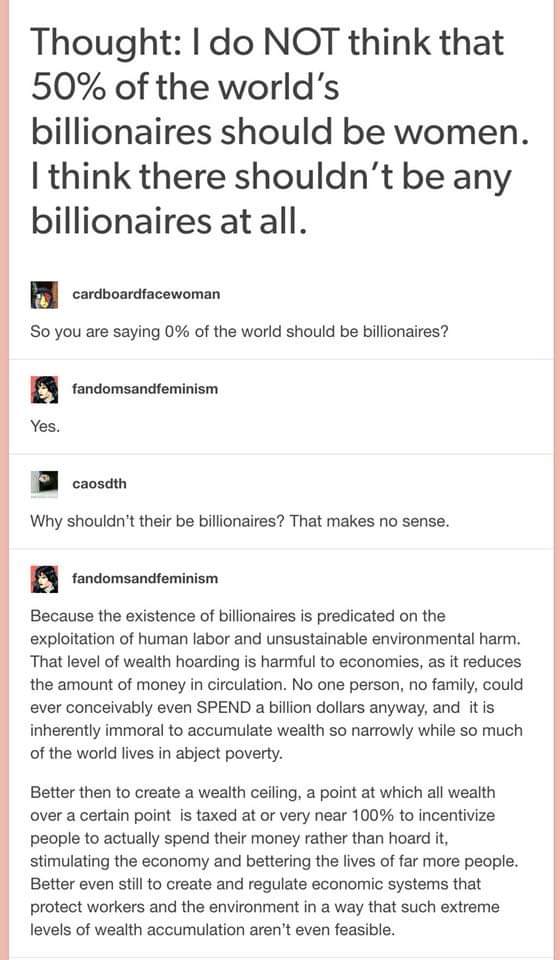
The image argues that the wealthy class is entirely wrong because concentrating money so exclusively harms the economy and reduces circulation. The text claims that no family or single person could ever spend a billion dollars, making it immoral to hoard wealth so narrowly. Instead of letting this happen, the text proposes creating a "wealth ceiling" to stop people from spending billions on nothing useful, suggesting they should be taxed near 100% instead.
simple-description (llama3.2-vision_11b)
The meme is a screenshot of a Twitter conversation between two users, @antioligarch and @nihilist, where @antioligarch posts a statement that 50% of the world's billionaires are women, and @nihilist responds with a sarcastic remark that this is not true and provides a statistic that only 0.5% of billionaires are women.
detailed-analysis (gemma3-27b-vision)
Okay, here's a breakdown of the provided text-based social media exchange, analyzed through the lenses you requested. I'll only include sections where the content genuinely lends itself to the framework. This is a complex analysis, and it’s important to remember these are interpretations, not definitive “truths” about the text.
Important Note: This analysis leans heavily on interpreting the implied arguments and assumptions within the text, as the exchange is relatively concise.
1. Visual Description
The image shows a screenshot of a social media conversation (likely Tumblr or similar). There are user handles ("cardboardfacewoman," "fandomsandfeminism," "caosdth"). The core of the image is text:
- Initial Claim: "I do NOT think 50% of the world's billionaires should be women. I think there shouldn't be any billionaires at all."
- Follow-up Questions/Challenges: "So you saying 0% of the world should be billionaires?" and “Why shouldn’t there be billionaires? That makes no sense."
- Elaborated Argument (by fandomsandfeminism): This is the bulk of the text and outlines the reasoning against billionaires. The argument covers exploitation, economic harm, and the immorality of extreme wealth hoarding in the context of global poverty. It proposes solutions like wealth ceilings, high taxation, and regulated economic systems.
2. Marxist Conflict Theory
This is the most directly applicable framework. The text is saturated with Marxist themes:
- Class Conflict: The entire argument centers on a critique of extreme wealth accumulation, which is fundamentally about class division. The existence of billionaires is presented as inherently problematic because it represents a massive concentration of capital in the hands of a few, at the expense of the many.
- Exploitation of Labor: The claim that the existence of billionaires is "predicated on the exploitation of human labor" is a core Marxist tenet. Marx argued that profit is derived from the surplus value created by workers, and that capitalism inherently involves the exploitation of the working class.
- Capital Accumulation: The concern over wealth hoarding speaks directly to the Marxist critique of capitalism's drive for endless accumulation of capital. This accumulation, the text argues, isn't simply harmless; it actively harms the economy by reducing the amount of money in circulation.
- Systemic Critique: The argument isn’t just about individual billionaires being “bad” people; it's a critique of the system that allows such extreme wealth to exist. The proposed solutions (wealth ceilings, taxation, regulation) are all aimed at fundamentally altering the economic system to create a more equitable distribution of resources.
- Alienation: Implied within the critique is the idea that the system alienates people from the fruits of their labor, concentrating wealth in the hands of a few while many struggle.
3. Critical Theory
Critical Theory, stemming from the Frankfurt School, builds on Marxist thought but expands its scope:
- Power Structures: The argument implicitly critiques the power structures that enable and protect extreme wealth. It’s not just about economic power, but also about the political and social influence that billionaires wield.
- Ideology: The text suggests that the acceptance of extreme wealth as normal or even desirable is a form of false consciousness—an ideology that obscures the exploitative nature of the system.
- Emancipation: The proposed solutions (wealth ceilings, regulation) are motivated by a desire for social justice and emancipation—a liberation from the oppressive structures of capitalism.
- Critique of Reason: While not explicit, the critique of the system implies a challenge to the idea that purely rational economic calculations justify extreme inequality. The moral argument ("immoral to accumulate wealth… while so much of the world lives in object poverty") positions ethics above purely economic considerations.
4. Queer Feminist Intersectional Analysis
This framework can be applied, although it requires reading between the lines:
- Interlocking Systems of Oppression: While the argument focuses primarily on economic inequality, a queer feminist lens could highlight how economic exploitation intersects with other forms of oppression—based on gender, race, sexuality, etc. (though this is not directly discussed). For instance, women and marginalized groups often bear the brunt of economic hardship, and the argument against billionaires could be seen as contributing to a broader struggle for social justice.
- Challenging Power Structures: The critique of billionaires can be viewed as a broader challenge to patriarchal and capitalist power structures that perpetuate inequality and oppression.
- Redistribution & Care: The call for wealth redistribution could be connected to feminist arguments for a "care economy" that prioritizes social welfare and the needs of marginalized communities.
5. Postmodernism
This is the least directly applicable framework, but some connections can be drawn:
- Deconstruction of Grand Narratives: The argument challenges the “grand narrative” of capitalism as a system that benefits everyone. It exposes the inherent contradictions and injustices of the system.
- Relativization of Truth: The claim that the acceptance of wealth is an “ideology” suggests that “truth” is not objective, but socially constructed.
- Focus on Power/Knowledge: Michel Foucault's idea of power/knowledge could be applied to analyze how the system maintains itself through the production of knowledge that justifies inequality.
6. Foucauldian Genealogical Discourse Analysis
This lens looks at the historical construction of power relations and how they manifest in discourse:
- Genealogy of Wealth: This framework would ask: how did the concept of extreme wealth become normalized and accepted? What historical processes and discourses led to the current situation?
- Power/Knowledge: The discourse around wealth is not neutral. It’s shaped by power relations. The argument in the text is attempting to disrupt that discourse by challenging the assumptions and justifications for extreme wealth.
- Disciplinary Power: The economic system functions as a form of disciplinary power, shaping behavior and enforcing norms. The argument against billionaires is an attempt to challenge that disciplinary power.
- Subjectivation: The system produces certain kinds of “subjects”—those who accept and participate in the unequal distribution of wealth. The critique aims to disrupt that process of subjectivation and encourage critical thinking.
In Conclusion:
The text is most powerfully analyzed through Marxist and Critical Theory lenses, as it directly addresses issues of class, exploitation, and power. Queer feminist and postmodern approaches can offer valuable supplementary insights, while a Foucauldian analysis helps to uncover the historical and discursive forces that have shaped the current situation.
Let me know if you'd like me to elaborate on any of these analyses or explore other frameworks!
simple-description (llama3.2-vision)
The meme is a response to a statement that 50% of the world's billionaires should be women. The commenters respond with a series of humorous and sarcastic responses, including "So you are saying 0% of the world should be billionaires?" and "Why shouldn't their be billionaires? That makes no sense." The main comment then responds with a long, satirical, and humorous response that argues that the idea of 50% of the world's billionaires being women is not only impossible, but also that the idea of 50% of the world's billionaires being women is not even a good idea. The response argues that the idea of 50% of the world's billionaires being women is not even a good idea, and that it is not even a good idea to have 50% of the world's billionaires being women.
tesseract-ocr
Thought: | do NOT think that ° 7 50% of the world’s billionaires should be women. . , | think there shouldn't be any billionaires at all. Fl cardboardfacewoman So you are saying 0% of the world should be billionaires? gf fandomsandfeminism Yes. Dh caosath Why shouldn't their be billionaires? That makes no sense. a fandomsandfeminism Because the existence of billionaires is predicated on the exploitation of human labor and unsustainable environmental harm, That level of wealth hoarding is harmful to economies, as it reduces the amount of money in circulation. No one person, no family, could ever conceivably even SPEND a billion dollars anyway, and it is inherently immoral to accumulate wealth so narrowly while so much of the world lives in abject poverty. Better then to create a wealth ceiling, a point at which all wealth over a certain point is taxed at or very near 100% to incentivize people to actually spend their money rather than hoard it, stimulating the economy and bettering the lives of far more people. Better even still to create and regulate economic systems that protect workers and the environment in a way that such extreme levels of wealth accumulation aren't even feasible.