First Seen
2023-05-24T22:38:58+00:00
simple-description (qwen3.5_2b-q8_0)
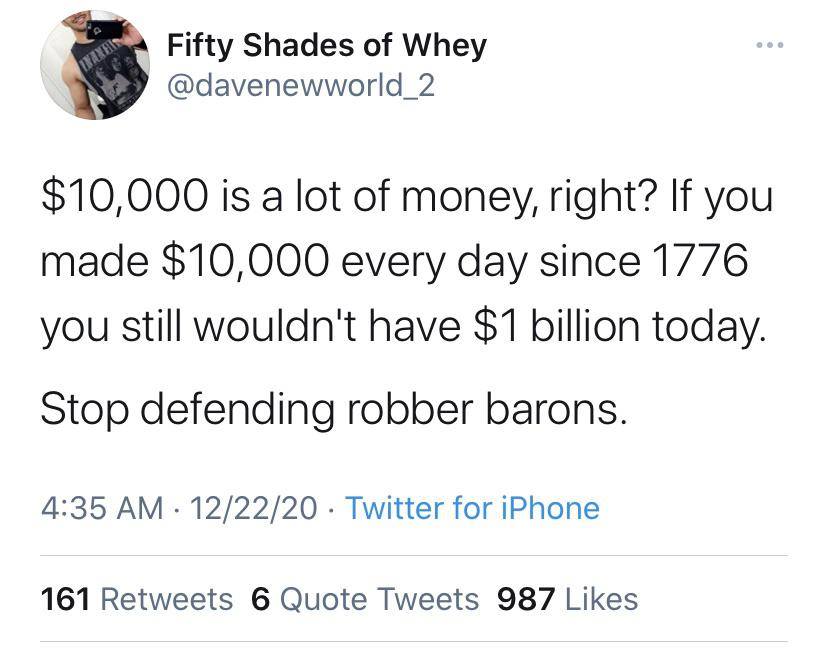
In the realm of the wealthy, the "meme" is a sharp critique of how successful they are. The creator suggests that if people in the upper class had made the same income since the US was founded, they wouldn't have accumulated enough money. This serves as a "stop defending robber barons" punchline, attacking the system of oligarchy that has rewarded them so much.
simple-description (llama3.2-vision_11b)
The meme is a humorous commentary on the wealth disparity between the ultra-wealthy and the general population. It uses a sarcastic tone to highlight the absurdity of the wealth of billionaires, comparing it to the cost of a McDonald's meal. The text reads: "If you made $10,000 a day since the beginning of time, you'd still only have $1.4 billion, which is less than Jeff Bezos' hourly wage."
detailed-analysis (gemma3-27b-vision)
Okay, here's an analysis of the Twitter post, broken down into relevant sections based on the theoretical frameworks you requested. I'll note if a framework isn't particularly applicable.
Visual Description
The post is a screenshot of a Twitter post from an account named "Fifty Shades Whey" (@daveneaworld_2). The account features a profile image depicting a black and white photo of a person wearing what appears to be military or soldier attire. The image is cropped at the shoulders and head. The tweet itself is a text-based statement. The post also displays metrics: 161 Retweets, 6 Quote Tweets, and 987 Likes. The tweet was made on 12/22/20 from an iPhone.
Marxist Conflict Theory
This tweet is strongly rooted in Marxist conflict theory.
- Class Struggle: The core message directly implicates a specific class dynamic. The terms "robber barons" explicitly evoke a historical and ideological understanding of the elite class who accumulated immense wealth through exploitative practices. The tweet asserts that wealth is not necessarily a product of merit or hard work but a consequence of systemic inequalities.
- Exploitation of Labor: The numerical comparison (making $10,000 a day since 1776) is a rhetorical device to demonstrate the impossibility of accumulating such wealth through honest labor. It implies that vast fortunes are built on the exploitation of others – the underpaid, the disenfranchised, and the historically oppressed.
- Critique of Capitalism: The entire message is a rejection of the narrative that great wealth is justifiable within a capitalist system. By highlighting the unrealistic accumulation of wealth, the tweet questions the fairness and sustainability of capitalism itself.
- Call to Action (Implicit): The statement "Stop defending robber barons" is a direct call to challenge and dismantle the power structures that allow such wealth accumulation. It suggests solidarity with those who are exploited by the wealthy.
Foucauldian Genealogical Discourse Analysis
The tweet demonstrates how power operates through discourse.
- Power/Knowledge: The phrase "robber barons" isn’t just a descriptive term, but a historically loaded one. It’s a category created through discourse to define and demonize certain types of wealth accumulation. By using this phrase, the tweeter draws on a specific historical narrative and reinforces a particular understanding of power.
- Genealogy of the Concept: A genealogical analysis would explore how the term "robber baron" emerged as a category – when, where, by whom, and in response to what conditions. The term gained prominence during the Gilded Age in the US, to describe industrialists perceived as ruthless and exploitative. The tweet leverages this historical context.
- Discursive Construction of Wealth: The calculation provided isn’t “truth” about wealth accumulation, but a specific way of framing the issue to reveal what the author considers to be its inherent unfairness. The tweet's power lies in its ability to challenge the commonly accepted narratives of wealth.
- Regulation of Discourse: The statement “Stop defending robber barons” functions as an attempt to regulate discourse – to discourage certain types of justifications for wealth and encourage critical analysis.
Critical Theory
The tweet aligns with key tenets of Critical Theory:
- Ideology Critique: The tweet challenges the dominant ideology that justifies wealth inequality. It deconstructs the myth of meritocracy and reveals how power structures perpetuate economic injustice.
- Emancipation: While not explicitly stated, the tweet implies a desire for social emancipation – a move away from systems that concentrate wealth and power in the hands of a few.
- Social Justice: The tweet’s concern with wealth inequality is fundamentally rooted in a concern for social justice. It implies that a more equitable distribution of wealth is necessary for a just society.
- Power Dynamics: The tweet highlights the power dynamics inherent in economic structures. The “robber barons” symbolize those who wield economic power to exploit and oppress others.
Postmodernism
While not strongly postmodern, some aspects are relevant:
- Deconstruction of Grand Narratives: The tweet challenges the “grand narrative” of capitalism and the belief in its inherent fairness. It suggests that there is no objective “truth” about wealth, but rather a socially constructed reality.
- Relativity of Truth: The calculation is a rhetorical device, emphasizing the impossibility of the accumulation through conventional means, rather than being a strict numerical proof.
- Critique of Authority: The tweet implicitly critiques the authority of those who defend wealth inequality. It encourages critical thinking and a rejection of unexamined assumptions.
Queer Feminist Intersectional Analysis
This framework isn't directly addressed in the tweet. While economic inequality disproportionately affects marginalized groups (including LGBTQ+ people, women, and people of color), the tweet doesn't explicitly address these intersections. An intersectional analysis would enrich this critique by connecting wealth inequality to other forms of oppression, but the message stands on its own as a critique of economic injustice.
I hope this detailed breakdown is helpful! Let me know if you'd like me to elaborate on any of these points or explore other theoretical frameworks.
simple-description (llama3.2-vision)
The meme is a humorous commentary on the value of money. The text states, "If you made $10,000 every day since 1776, you still wouldn't have $1 billion today." This is followed by a call to action, "Stop defending robber barons."
tesseract-ocr
Fifty Shades of Whey @davenewworld_2 $10,000 is a lot of money, right? If you made $10,000 every day since 1776 you still wouldn't have $1 billion today. Stop defending robber barons. 4:35 AM - 12/22/20 - Twitter for iPhone 161 Retweets 6 Quote Tweets 987 Likes