First Seen
2023-05-24T22:39:00+00:00
simple-description (qwen3.5_2b-q8_0)
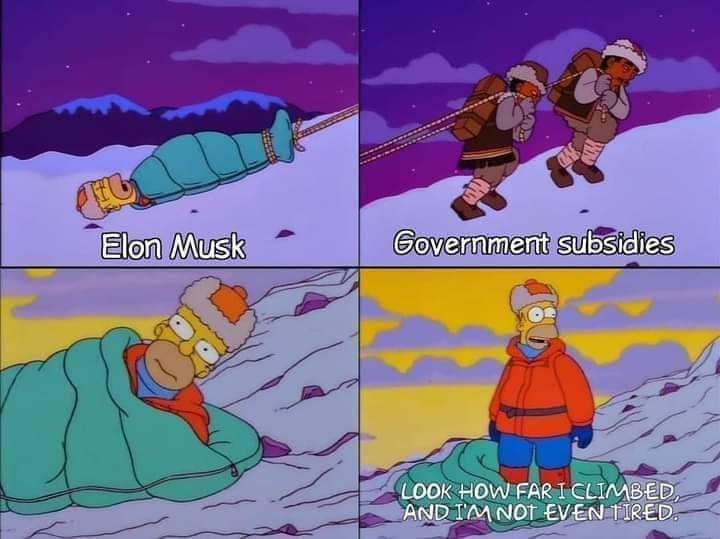
This image satirizes Elon Musk (the wealthy oligarch) and Government Subsidies (the means by which the elite climb the mountain).
Here is the breakdown of the visual metaphors:
- Top Left (Elon Musk): The wealthy elite (represented by Elon Musk) is shown in a blue sleeping bag, lying on the ground. This symbolizes them being disconnected from reality or simply resting on their wealth without working hard.
- Top Right (Government Subsidies): Two people are hiking up a mountain. One person is a government agent (resembling a character from The Sopranos or Tony Soprano's family), and the other is a hiker. They are pulling the rope, suggesting that government subsidies and political power are being used to climb the mountain, implying they are taking advantage of the elite's success or resources to get ahead.
- Bottom Left: Bart Simpson (a working-class figure) is sleeping in a green sleeping bag, looking exhausted. He represents the working class who is tired and struggling.
- Bottom Right: Bart Simpson stands up and says, "Look how far I climbed, and I'm not even tired." This line satirizes the working class's perspective of success, suggesting they feel like they achieved something great despite being physically exhausted.
In short, the meme critiques the wealthy elite (Elon Musk) who are lying on the ground, while the government agents (hiking) take advantage of their success. It also satirizes the working class (Bart Simpson) who is tired but claims to have climbed far.
simple-description (llama3.2-vision_11b)
The meme is a humorous take on the contrast between the wealth and influence of billionaires like Elon Musk and the struggles of the average person. The image juxtaposes a wealthy individual (Elon Musk) with a poor person (a "donkey") who is struggling to make ends meet, highlighting the vast income disparity between the two. The text "Elon Musk" is written above the wealthy individual, while "I'm not a donkey" is written above the poor person, with the phrase "I don't have $2000" below it, referencing the fact that the poor person cannot afford to pay the $2000 fine for not having health insurance.
detailed-analysis (gemma3-27b-vision)
Okay, let's break down this meme using the requested theoretical frameworks. It's a potent image with a lot to unpack, given its commentary on wealth, technological innovation, and societal support.
Visual Description
The meme is a four-panel image using a style reminiscent of The Simpsons. It depicts a figure resembling Elon Musk being “dragged” up a snowy mountain by two figures representing "Government Subsidies".
- Panel 1: "Elon Musk" (the figure) is suspended mid-air, tethered to a rope. He’s encased in a green sleeping bag, suggesting a degree of comfort even in a precarious position.
- Panel 2: Two figures, bundled in winter clothing, are pulling the rope, laboring uphill. They clearly represent the "Government Subsidies," visually established by the text label.
- Panel 3: "Elon Musk" is now partially down the slope, wrapped in the sleeping bag. He's much further up the mountain than in the first panel, and is being “dragged” by the subsidies.
- Panel 4: One of the figures representing the subsidies speaks, saying, "Look how far I climbed, and I'm not even tired". The figure is bundled up in heavy winter clothing and is still pulling.
The overall visual impression is one of ironic contrast: a figure seemingly passively enjoying the benefits of significant effort from others.
Marxist Conflict Theory
This meme is deeply rooted in a Marxist analysis. It encapsulates the core theme of class struggle and the exploitation of labor. Here's how it applies:
- Bourgeoisie vs. Proletariat: Elon Musk (representing the ultra-wealthy, the "bourgeoisie") is portrayed as passively benefiting from the labor (the rope-pulling) of "Government Subsidies", which can be seen as a stand-in for the working class/taxpayers (the “proletariat”). He is not doing the work to ascend the mountain (achieve success).
- Surplus Value: The "Government Subsidies" represent the collective wealth and resources (taxpayer money) extracted from society. This surplus value is then used to prop up and enable the success of the capitalist (Musk), who does not contribute an equivalent amount of effort.
- False Consciousness: The final panel, with the figure stating they aren’t even tired, is a brilliant depiction of the ideology that justifies this system. It suggests that those supporting the system are unaware of the imbalance and even take pride in contributing to it.
- Alienation: The meme subtly points to the alienation of labor. The “subsidies” are performing the strenuous labor but are not directly benefiting from the resulting outcome. Their energy is poured into propping up the wealth of another.
Foucauldian Genealogical Discourse Analysis
A Foucauldian reading centers on power dynamics and the creation of knowledge/discourse that justifies certain structures.
- Power/Knowledge: The meme reveals how the discourse surrounding innovation, entrepreneurship, and technological progress is constructed. The narrative often focuses on individual genius and ingenuity (Musk), obscuring the role of external forces (government support, labor, raw materials, infrastructure). This obscures power imbalances and normalizes the wealth accumulation of a few.
- Genealogy: Examining the historical development of these narratives reveals a pattern: the glorification of the individual innovator, the downplaying of systemic factors, and the acceptance of economic inequality. This is not a natural state; it's produced through discourse and repeated narratives.
- Disciplinary Power: While not overtly showing physical discipline, the meme points to the disciplinary power of economic systems. The 'Government Subsidies' are compelled (through taxation and policy) to contribute to a system that may not directly benefit them.
- Normalization: The complacent tone of the figure in the final panel ("I'm not even tired") shows how this imbalance is normalized. This is how power operates—not through overt force, but through the acceptance of existing structures.
Postmodernism
The meme operates on a postmodern level through its self-awareness, irony, and commentary on grand narratives.
- Deconstruction of the "Self-Made Man": The myth of the self-made man is a core grand narrative in capitalist ideology. This meme directly deconstructs that narrative by visually demonstrating that even the most celebrated "innovators" rely on extensive external support.
- Irony and Parody: The use of a Simpsons frame, known for its satirical take on society, is inherently ironic. It is a parody of success narratives.
- Questioning of Truth/Reality: The meme isn’t necessarily presenting a straightforward "truth" but rather prompting viewers to question the narratives they are presented with.
- Hyperreality: It taps into the hyperreality of modern media, where representations (like the narrative of successful entrepreneurs) often overshadow reality. We see the image of success, but the underlying mechanisms are obscured.
Critical Theory
Critical theory, stemming from the Frankfurt School, examines power structures and their impact on society.
- Ideology Critique: The meme is a direct critique of capitalist ideology, particularly the glorification of wealth and the minimization of systemic inequalities.
- Domination and Control: The image illustrates how power operates to maintain structures of domination and control. Wealth concentrates at the top, while the supporting foundations (taxpayers) bear the burden.
- Instrumental Reason: The meme can be interpreted as a critique of instrumental reason—the idea that everything is judged by its utility. The "Government Subsidies" are "useful" for enabling Musk’s success, but this utility comes at a cost (the redistribution of resources).
- Loss of Agency: The image subtly suggests a loss of agency for those providing the subsidies. They are compelled to contribute to a system that may not serve their interests.
Queer Feminist Intersectional Analysis
While less immediately apparent, an intersectional lens can reveal further layers.
- Unequal Distribution of Labor: The meme highlights how certain groups are disproportionately burdened with providing support for others' success. This connects to feminist arguments about the unequal distribution of emotional labor and care work.
- Power Imbalance and Marginalization: The image demonstrates how power dynamics create and perpetuate systems of marginalization. Those providing the subsidies are positioned as less powerful and less visible.
- Rejection of Meritocracy: The meme challenges the idea of a meritocratic system, where success is earned through individual effort. It reveals how systemic factors (like wealth, privilege, and access to resources) play a significant role.
- Deconstruction of Masculinity: Elon Musk is often presented as a hyper-masculine figure of innovation. The meme challenges this image by highlighting the dependence of his success on the labor of others, undermining the idea of individual self-reliance.
I hope this comprehensive analysis is helpful! It's a surprisingly rich image for a simple meme, and it demonstrates how different theoretical frameworks can illuminate its underlying themes.
simple-description (llama3.2-vision)
This meme is a comedic adaptation of a scene from the animated TV series "The Simpsons." In the scene, a character named Marge is forced to carry a heavy load of rocks, but the text of the meme is actually a series of statements made by various figures, including "Elon Musk," "Government," "Subsidies," and "I climbed." The text is meant to be humorous, implying that the characters are struggling to carry their loads, much like Marge.
tesseract-ocr
io Lr we ce a Sy ee i “Elen Must a7 —-+ a = Le ‘a | En | ee a NSPE Pere it